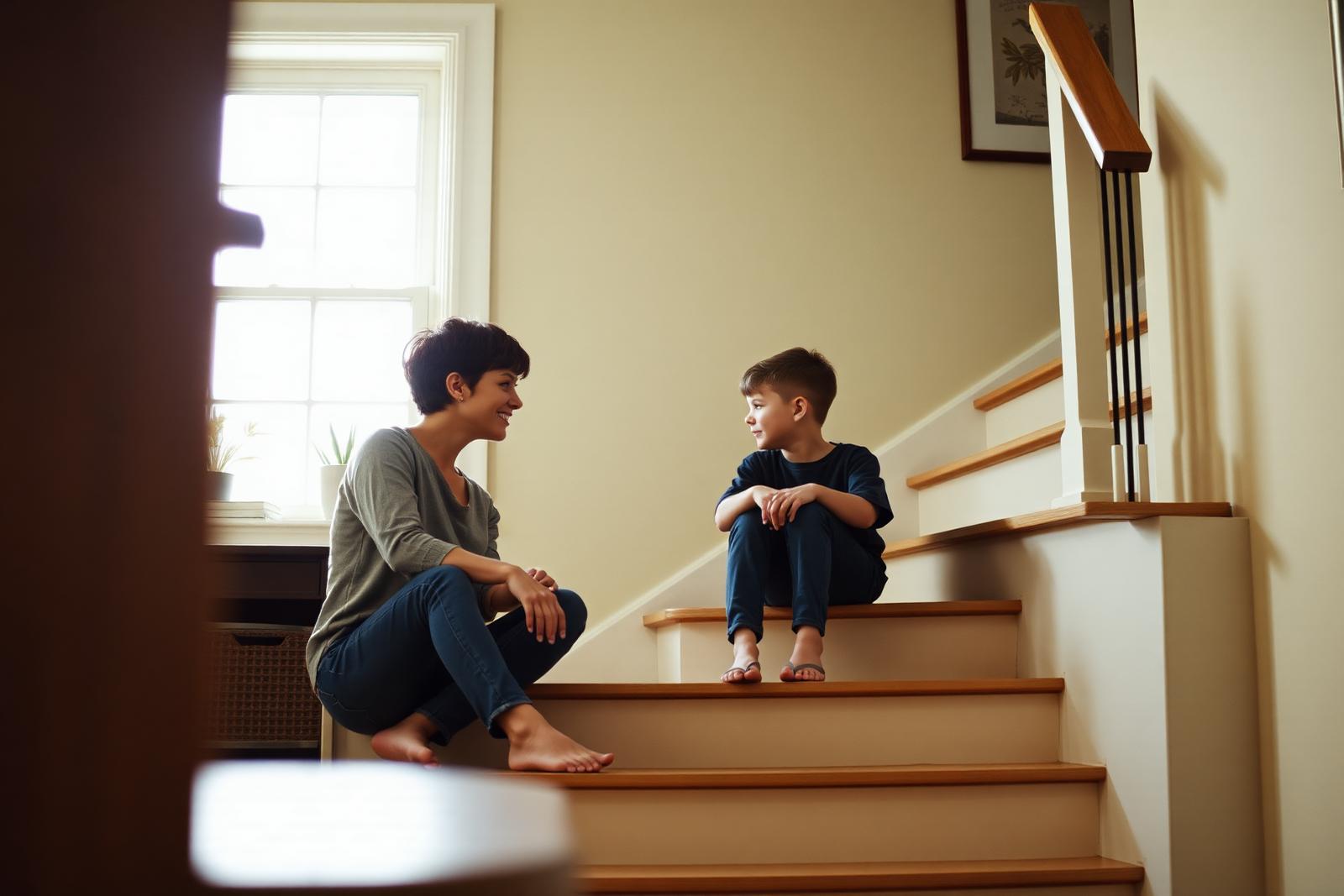
The One Who Will Not Be Moved
Strong-willed children are exhausting to raise and remarkably well equipped for adult life. The task is not to break the will — it is to keep the relationship intact while it matures.
Written by Sian Trombley · BEd, MACP, CCC
It is Tuesday. You have asked her to wear the coat. It is four degrees outside. She has explained, with the composure of a barrister, that she does not experience cold the way other people do, that the coat restricts her arms, and that you did not make her brother wear one on a day that was — she is confident about this — colder.
She is seven. You have twelve minutes before the school gate closes. And somewhere underneath the frustration there is a small, treacherous flicker of admiration, because the argument was genuinely quite good.
What a strong will actually is
Three temperament dimensions combine to produce what parents call strong-willed: persistence, which means they do not give up; intensity, which means every response arrives at full volume; and low adaptability, which means changes of plan cost them more than they cost other children. None of these is a behaviour. All of them are visible in infancy, long before parenting could have produced them.
- Needs to know why, and 'because I said so' actively inflames rather than resolves
- Holds a position long past the point where other children would move on
- Deeply invested in fairness, particularly regarding siblings
- Struggles with transitions and abrupt changes to an expected plan
- Strong sense of how things should be done — including things that are not their business
- Frequently right, which is the most exhausting part
- Highly responsive to being consulted; highly resistant to being directed
Why the traditional playbook fails here
What works
- 01Shrink the rule set
Choose the small number of things that genuinely matter and enforce those completely. Authority is a finite resource. Spending it on socks leaves none for the things that count.
- 02Build in choice everywhere it is free
Which order, which cup, which route, which jumper. Dozens of small autonomies a day reduce the pressure behind the big refusals.
- 03Give the reason once — briefly
This temperament needs the why. Give it in a sentence, not a lecture. Then stop. Repeating the reason invites a rebuttal of the reason.
- 04Let the boundary be boring
State it flatly and then decline to argue. 'That's the answer.' No escalation, no fresh justifications, no raised voice. A boundary you defend passionately is a boundary that looks contestable.
- 05Recruit them as the problem-solver
'Getting out the door is going badly for both of us. What would you do about it?' They will produce a plan. It will often be strange and it will often work, because they built it.
- 06Say what you admire, out loud
Strong-willed children hear a great deal about being difficult. Tell them what the trait is good for: 'You don't give up on things. That's going to matter one day.'
The long view
It is worth remembering what you are actually raising. The child who cannot be talked into things by you also cannot be talked into things at fourteen, in a park, by someone with a bottle. The child who demands to know why does not accept an instruction from an adult who should not be giving it. The trait that costs you every morning is the same trait that will keep them safe when you are not there.
“One day someone will ask your child to do something they should not do, and they will say no in exactly the voice that is currently ruining your mornings.”
Children do not need a perfect parent. They need a predictable one who returns after hard moments.
Sian Trombley, Canadian Certified Counsellor
What you can try this week
Decide your two non-negotiables
Write them down. Safety, and one other. Everything else becomes negotiable this month. You are not lowering standards — you are concentrating your authority where it matters.
Offer the choice before the instruction
'Shoes before coat, or coat before shoes?' The outcome is identical; the experience of control is not. This costs nothing and prevents most standoffs.
Ask them to solve one recurring problem
Pick the daily flashpoint. Describe it neutrally, then ask for their plan. Strong-willed children will defend a rule they wrote far more fiercely than one you imposed.
- A strong will is a temperament trait, not a behaviour problem.
- Power struggles are lost by entering them, not by conceding them.
- Autonomy given freely removes the need to seize it.
- The goal is a child who can hold their ground — including, one day, against you.
- Warmth plus structure predicts good outcomes; harshness plus structure does not.
Which battles am I fighting because they matter, and which because I have already started?
What would I want this child to do if an adult ever told them to do something wrong?
When did I last tell them what I admire about them?
Printable resources

Share this article
This article is educational and is not a substitute for individual clinical advice. Comments are closed so the Journal stays a calm place to read.