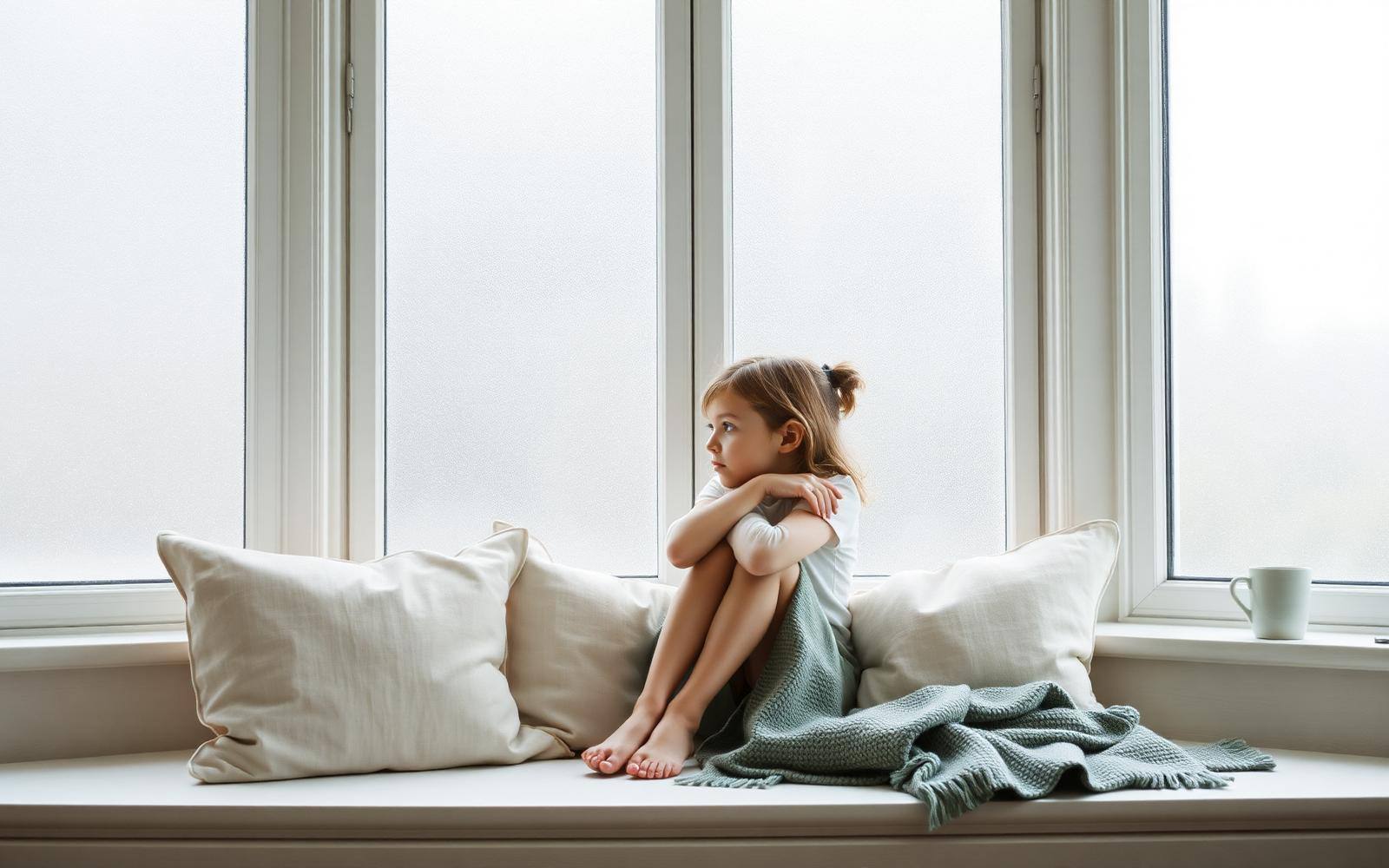
The Child Who Feels Everything
Around one in five children is born with a nervous system that registers more, and registers it more deeply. It is a temperament, not a fragility — and it needs a particular kind of parenting.
Reviewed by Sian Trombley, CCCFounder, Thrive Family Company
11 min read
Best for parents of children who are…
- going from calm to overwhelmed very quickly
- needing extra emotional support at the moment
- going through a change at home or at school

Share this
The party finishes at four. By half past three she is sitting on the stairs with her coat on, refusing to say goodbye to anyone, and you can feel the room deciding what kind of child she is and what kind of parent you are.
In the car she cries for twenty minutes and cannot tell you why. Later that evening she asks you, unprompted, whether the girl who dropped her cake was upset. She noticed. Of course she noticed. She noticed everything, all afternoon, and there was nowhere to put any of it.
What high sensitivity actually is
Sensory processing sensitivity is a temperament trait present in roughly fifteen to twenty per cent of children — and, notably, in more than a hundred other species, which tells us it confers an evolutionary advantage rather than a defect. Sensitive individuals take in more environmental information and process it more deeply before responding. That is the whole mechanism. Everything else follows from it.
- Notices small changes: a new haircut, a shifted picture frame, a change in your tone
- Overwhelmed by noise, crowds, bright light, strong smells or scratchy fabrics
- Needs solitude and quiet to recover after busy or social days
- Asks unusually deep questions about fairness, death, or other people's feelings
- Deeply affected by others' distress, including strangers and animals
- Startles easily and dislikes surprises or sudden changes of plan
- Perfectionistic; devastated by criticism that others would shrug off
- Rich inner life, strong imagination, often an intense observer before joining in
What it is not
The finding that should change how you parent
This is the most important thing to understand about raising a sensitive child. Your patience is not being wasted on someone who will never toughen up. It is landing on the child in the family who is most able to make use of it.
What helps
- 01Protect the recovery time
Sensitive children need to discharge before they can process. Build in unstructured, low-input time after school and after social events — and treat it as non-negotiable, not a luxury.
- 02Reduce surprises, not challenges
Preview what is coming: who, where, how long, and what happens if it gets too much. You are lowering the uncertainty load, not lowering the bar.
- 03Give them an exit
Agree a signal or a place to go before the event, not during it. Children who know they can leave usually stay longer.
- 04Handle correction gently but honestly
Sensitive children absorb criticism at high volume. Say it once, quietly, without the lecture — then move on. Repeating it is not emphasis; it is injury.
- 05Name the trait as a strength
Give them language for it. Children who understand themselves as sensitive rather than as too much stop apologising for a nervous system they did not choose.
- 06Watch your own regulation
They read you before you have said anything. A calm adult is not a nice extra for a sensitive child — it is the primary environmental input they are responding to.
When to seek help
“You are not raising a child who feels too much. You are raising a child who feels exactly enough, in a world built for people who feel less.”
A sensitive child is not too much. They are receiving on more channels than the rest of us.
Sian Trombley, Canadian Certified Counsellor
What you can try this week
Build in a decompression hour
Protect the first sixty minutes after school with no questions, no activities and no screens if they overstimulate. Sensitive children need to discharge the day before they can talk about it.
Preview, don't surprise
Tell them what is happening, who will be there, how long it will last and where the exit is. Most of the distress is not the event — it is the not knowing.
Name the trait out loud, warmly
"You notice things other people miss. That's a real thing about you, and I like it." Children who understand their sensitivity as a feature stop experiencing it as a fault.
- High sensitivity is a normal temperament trait, found in around one in five children.
- It is not anxiety, autism or shyness — though it can look like all three.
- Sensitive children are more affected by poor environments and more helped by good ones.
- Toughening up does not work; predictability and recovery time do.
- The trait carries real advantages: empathy, conscientiousness and depth of thought.
What does my child need after a full day, rather than during it?
Whose voice is in my head when I worry I am being too soft?
Which parts of their sensitivity do I quietly admire?
Printable resources
Recommended Thrive courses
This article is educational and is not a substitute for individual clinical advice. Comments are closed so the Journal stays a calm place to read.
Share this
Keep going
You may also like
Courses, worksheets and pathways from the same part of the library.
- JournalThe Things They Used to Love: When Nothing Is Fun Any MoreThe football boots have not moved in six weeks. They say they are fine. They are not sad, exactly — they are flat, and flat is easy to miss.Read
- ResearchThe Research LibraryPeer-reviewed parenting and child mental health research, translated into plain language.Read
- Thrive GuideThrive GuideAsk a question and get warm, evidence-informed guidance drawn from the Thrive library.Read
- Thrive Care PlanThrive Care PlanA short check-in that turns how your week actually went into one focused plan.Read
- Thrive ToolThrive ToolsPremium printable workbooks and therapeutic tool kits.Read
- CollectionThe Resource LibraryFree printable worksheets, scripts and planners for families.Read