The Rescue That Costs Them Something
Zipping the coat, finishing the sentence, emailing the teacher before your child even asks — every rescue teaches a lesson, and it isn't always the one you meant.
Reviewed by Sian Trombley, CCCFounder, Thrive Family Company
14 min read
Best for parents of children who are…
- needing help bouncing back after setbacks
- needing extra emotional support at the moment
- going through a change at home or at school

Share this
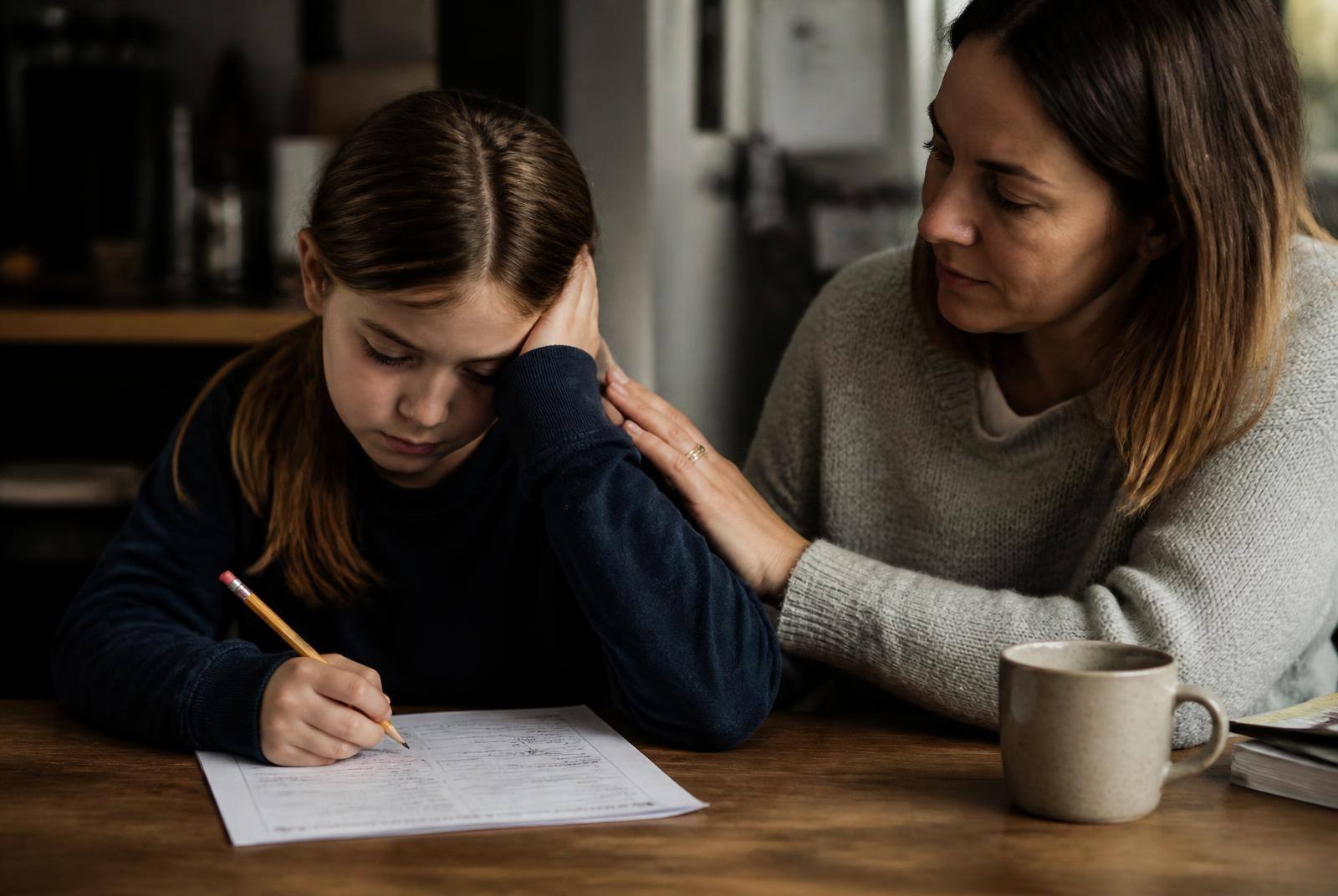
It rarely looks like a mistake in the moment. A four-year-old struggles with a zipper for eleven seconds and a parent, hands already moving, finishes it for her. A ten-year-old sighs over a maths problem and a parent slides the answer sideways before frustration can build. A fifteen-year-old forgets his kit and a parent, already halfway to the car, drives it to school before the bell rings. Each of these is small. Each one, alone, changes nothing. But children do not experience parenting as isolated moments — they experience it as pattern, and the pattern being learned in each of these small rescues is the same: someone will arrive before I have to find out whether I can do this myself. This is not a piece about tough love, and it is not an argument for letting children flounder. It is about learning to see the difference between support, which builds capability, and rescue, which quietly erodes it — and about developing the far harder skill of tolerating a child's struggle long enough to let them discover their own competence.
Why rescuing feels like good parenting
Rescuing a child from a hard moment produces an immediate, visible reward: the crying stops, the tantrum de-escalates, the problem disappears. Parents are wired to respond to distress, and a fast fix delivers relief to both people in the interaction almost instantly. This is precisely what makes the pattern so easy to fall into and so hard to see from the inside — it works, every single time, in the short term.
The cost is invisible because it accumulates slowly and shows up somewhere else entirely. It rarely appears as "my child can't tie shoes." It appears months or years later as a child who melts down at the first sign of difficulty, who says "I can't" before attempting something, or who has developed a habit of outsourcing effort to whichever adult is nearest. The rescue and its cost are separated by enough time that parents genuinely do not connect them.
The difference between scaffolding and rescuing
Developmental psychologists use the term scaffolding to describe support that is temporary, responsive and designed to be removed. A parent who holds a bike seat while a child pedals, and gradually lets go as balance improves, is scaffolding. A parent who continues holding the seat indefinitely because letting go once produced a wobble is rescuing.
The test is not how much help is given, but what happens to the help over time. Good scaffolding shrinks. A rescue pattern, left unexamined, tends to grow, because each rescue slightly lowers the child's tolerance for the next difficulty, which in turn makes the next struggle look more alarming to the watching parent, which invites a faster rescue. It is a loop that tightens on its own unless someone interrupts it.
- Scaffolding is offered after the child has attempted the task; rescuing arrives before the attempt.
- Scaffolding narrates the strategy ("try turning it the other way"); rescuing simply completes the action.
- Scaffolding is withdrawn as competence grows; rescuing tends to become the default even after competence is demonstrated.
- Scaffolding tolerates visible frustration for a stretch; rescuing is often triggered by the adult's own discomfort with that frustration.
What over-helped children actually learn
Children are constantly drawing conclusions about their own competence from how the adults around them respond to their struggle. A child who is rescued reliably and quickly from every hard moment does not conclude "my parents are wonderfully supportive." More often, without any words being exchanged, they conclude something closer to: this was too hard for me, which is why someone stepped in.
This matters because a child's belief in their own capability, sometimes called self-efficacy, is built almost entirely from lived evidence, not from being told they are capable. Praise alone does not build it. What builds it is a memory bank of moments where something felt hard, the child pushed through some or all of it, and it worked out. Every rescue that arrives before that memory can form is a missed deposit into that bank.
The anxious-child trap
Parents of anxious children are especially prone to over-rescuing, and understandably so — an anxious child's distress is louder and arrives faster than a confident child's, which pulls intervention toward them disproportionately. A child who cries at the first sign of difficulty gets rescued sooner than a sibling who shrugs and keeps trying, not because the parent loves one more, but because distress is a powerful, involuntary signal to step in.
The trouble is that anxious children need the opposite of what their distress pulls toward. Repeated rescue confirms the anxious belief that the situation was, in fact, too much to handle — which is precisely the belief driving the anxiety in the first place. Breaking this cycle does not mean withholding comfort. It means separating comforting the feeling from removing the task: "I can see this is really hard. I'm right here. I'm not going to do it for you."
“The most protective thing a parent can offer an anxious child is not the removal of every hard moment, but steady, calm proof that they can come through one.”
Sian Trombley, CCC
How to tell if you're rescuing too often
Most parents cannot see their own rescue pattern clearly because it happens in fractions of a second, often before conscious thought. A useful way to surface it is to look for a handful of recurring signs across a week.
A framework for calibrating support in the moment
When your child hits a wall, a brief internal pause before acting can change the entire interaction. The goal is not to develop a rigid rule but a habit of asking a few fast questions before your hands move.
- 01Pause before intervening
Give a genuine few seconds — longer than feels comfortable — before stepping in. Most struggles that look urgent are not actually time-critical.
- 02Ask what kind of help is wanted
"Do you want me to help, or do you want to try one more time first?" This single question returns the decision to the child and often surfaces more resilience than expected.
- 03Offer strategy before solution
If help is genuinely needed, narrate a next step rather than completing the task: "Try turning it the other way," rather than turning it yourself.
- 04Name the effort afterward
Once the task is done, whether independently or with support, reflect the process back: "You stayed with that even though it was frustrating. That's exactly the skill that gets easier with practice."
- 05Track the pattern, not the moment
One rescue will not shape a child's sense of capability. Notice whether, across a month, the balance is shifting toward more independence or less.
When to step in without hesitation
None of this argues for withholding help when a child is genuinely at risk, overwhelmed beyond their developmental capacity, or facing a situation with real safety implications. A toddler at the top of a staircase, a child being genuinely bullied, a teenager in a crisis — these require immediate, unambiguous intervention, not a pause for reflection.
The distinction that matters is between rescuing a child from discomfort and protecting a child from harm. Discomfort — frustration, embarrassment, a hard conversation, a missed goal — is where growth actually happens and where over-rescuing does the most quiet damage. Harm is a different category entirely, and no framework about building independence should ever be used to justify ignoring it.
More often it's a sign the pattern has been reinforced for a while and needs to be unwound gradually rather than all at once. Start with one low-stakes task, hand it back consistently, and expect some protest — that's part of the process, not evidence it isn't working.
Watch your child's emotional state, not just the outcome. If they're regularly overwhelmed, shutting down, or the task is genuinely beyond their developmental stage, that's a sign to scaffold more, not less. Calibration goes both directions.
A meltdown in response to being handed responsibility is common, especially at first, and it doesn't mean you made the wrong call. Stay calm, acknowledge the frustration, and hold the boundary: "This is still your task. I'm here if you want to talk about how to approach it."
Rebuilding trust in your child's own capability
If you recognise a rescue pattern that has been running for a while, the goal is not to reverse it overnight. Children who have been over-helped for years have understandably come to expect it, and withdrawing support abruptly can feel less like empowerment and more like abandonment. The shift works better as a gradual renegotiation, openly discussed rather than silently enforced.
Tell your child directly what is changing and why: "I've realised I've been jumping in to help before giving you a real chance to try things yourself. I want to change that, not because I don't want to help, but because I know you're more capable than I've been letting you show me." This framing matters — it positions the change as an expression of belief in the child, not a withdrawal of care.
Children do not need a perfect parent. They need a predictable one who returns after hard moments.
Sian Trombley, Canadian Certified Counsellor
What you can try this week
Name one daily rescue
Pick a single moment this week where you typically step in early — packing the bag, finding the missing shoe, rephrasing the apology to a sibling. Say out loud, "I'm going to give you a minute to try this first," and then physically wait before acting.
Ask before you fix
The next time your child brings you a problem, resist offering the solution immediately. Ask, "Do you want me to help you solve it, or do you just want me to listen right now?" Let their answer guide you.
Debrief the near-miss
After a moment where your child struggled and came through it without your intervention, name it afterwards: "You were really frustrated with that zip, and you figured it out anyway. What did you notice?"
- A rescue and a support look identical from the outside; the difference is whether the child was given a real chance to attempt the task first.
- Children read their parents' anxiety about their struggle as evidence that the struggle is dangerous, not that it is ordinary.
- Calibrated support means staying close enough to catch a genuine fall while resisting the urge to prevent every stumble.
- The most over-helped children are often the most anxious ones, because rescuing frequently increases in response to visible distress rather than actual need.
- Handing a task back to a child is a skill in itself — it requires tolerating their frustration and your own discomfort at watching them struggle.
When your child struggles, whose discomfort are you actually responding to — theirs, or your own?
Can you think of a recent moment where you stepped in a beat too early? What would have happened if you had waited thirty more seconds?
What is one task your child could plausibly do without you, that you are currently still doing for them?
Printable resources
Recommended Thrive courses
This article is educational and is not a substitute for individual clinical advice. Comments are closed so the Journal stays a calm place to read.
Share this
Keep going
You may also like
Courses, worksheets and pathways from the same part of the library.
- JournalWhat Your Child Can Do That You Still DoMost families are quietly doing dozens of tasks for their children that the children are developmentally capable of doing themselves — not out of laziness, but out of habit, speed and the accumulated weight of a busy week. A simple audit, done honestly, changes more than any lecture about responsibility ever could.Read
- CollectionConfidence & ResilienceEverything Thrive publishes on confidence & resilience — articles, courses, worksheets and research.Read
- JournalGrowing Brave: How Real Courage Is Built in Small StepsWe cannot talk a child into bravery, and we cannot protect them into it either. Courage is built by doing slightly hard things, repeatedly, with someone steady nearby.Read
- Learning PathwayMental Health & WellbeingA guided Learning Pathway from Thrive Family Company.Read
- ResearchThe Research LibraryPeer-reviewed parenting and child mental health research, translated into plain language.Read
- Thrive GuideThrive GuideAsk a question and get warm, evidence-informed guidance drawn from the Thrive library.Read