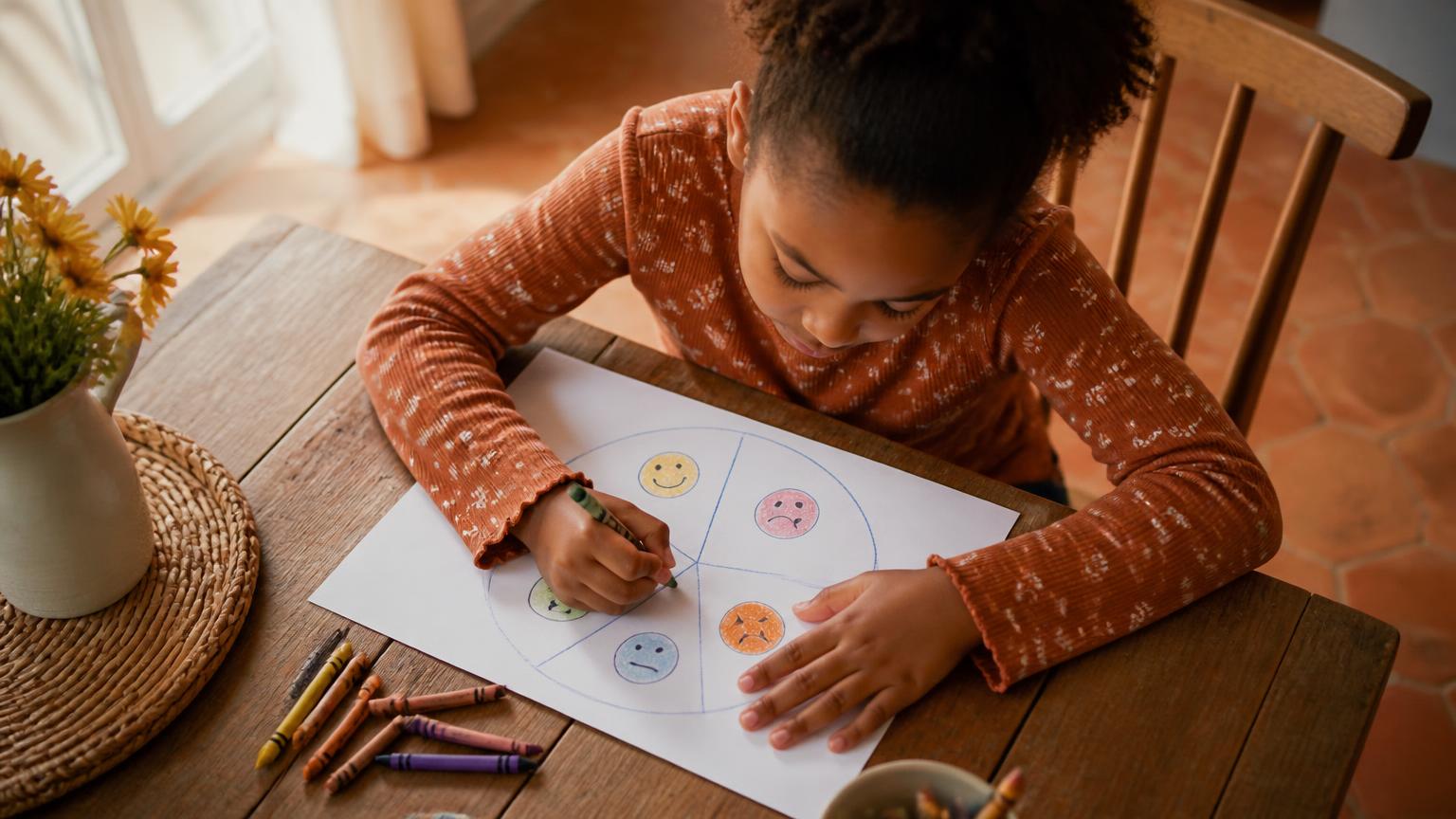
Building Your Child's Feeling Vocabulary
Children do not lack self-control. They often lack the words to describe the storm inside. A richer emotional vocabulary is one of the most powerful tools you can give them.
Written by Sian Trombley · BEd, MACP, CCC
The child who throws a block, who cries at a small change, who shuts down when asked how they are, is often a child who knows something is wrong but does not have the words to say it. Behaviour becomes language when language is not available. The antidote is a richer feeling vocabulary.
Emotions are not abstract concepts for children. They are physical events. A tight chest, a hot face, a heavy stomach, a rushing feeling. The goal is to help children connect those sensations to words, so that instead of hitting, they can say, 'I am frustrated.' Instead of hiding, they can say, 'I am worried.' Words are a bridge between the body and the world.
Why naming matters
When we can name an emotion, it becomes less overwhelming. It is no longer a shapeless storm. It is a known thing. Research shows that labelling emotions reduces activity in the amygdala, the brain's alarm centre. This is why naming a feeling genuinely helps a child feel better. It is not magic. It is neuroscience.
Going beyond mad, sad, and happy
Many children learn three emotion words: mad, sad, happy. But human experience is far more nuanced. A child who is 'mad' might actually be embarrassed, jealous, rejected, or overwhelmed. A child who is 'sad' might be lonely, disappointed, or ashamed. The more words they have, the more accurately they can describe their inner world.
- Frustrated — when something is harder than expected.
- Disappointed — when reality does not match hope.
- Overwhelmed — when too much is happening at once.
- Lonely — when connection feels missing.
- Jealous — when wanting what someone else has.
- Embarrassed — when feeling exposed or judged.
- Anxious — when worrying about something uncertain.
- Grateful — when noticing something good was given.
- Proud — when recognising effort or achievement.
- Content — when feeling quietly okay.
Emotion coaching in everyday moments
Emotion coaching does not require a special lesson. It happens in the car, at the table, during bedtime, after a hard moment. The habit is simple: notice, name, validate, and if needed, guide. This sequence teaches children that emotions are information, not enemies.
- 01Notice the emotion
'I can see your face changed when your friend left.' This says you are paying attention.
- 02Name it gently
'I wonder if that felt lonely.' Offer a word without forcing the child to accept it.
- 03Validate the feeling
'It makes sense that you feel that way.' This is not the same as validating any behaviour.
- 04Guide the next step
'What would help right now?' Invite problem-solving after the feeling is acknowledged.
By age: what vocabulary looks like
Emotion vocabulary grows with age and language capacity. Toddlers benefit from simple labels and picture books. School-age children can learn more nuanced words and use them in sentences. Tweens and teens can understand layered emotions, such as feeling anxious about a test and annoyed at a sibling at the same time.
- 01Toddlers: use simple words, match faces to feelings, and validate without long explanations.
- 02Preschoolers: introduce slightly more words, ask 'how did that feel?' and read stories about emotions.
- 03School-age: explore mixed emotions, talk about what emotions feel like in the body, and practise expressing needs.
- 04Tweens and teens: support nuanced emotional language, discuss context, and respect privacy while staying available.
What to avoid
Some responses accidentally teach children that emotions are not safe to share. Dismissing, minimising, or rushing to fix can make a child feel unheard. Even well-meaning phrases like 'you are fine' can close the conversation. The goal is not to change the feeling immediately. It is to understand it.
The long-term gift
A child who can say 'I feel left out' is a child who can ask for help. A child who can say 'I am overwhelmed' is a child who can ask for a break. A child who can name loneliness is a child who can seek connection. This is the long-term gift of emotional vocabulary: not better behaviour today, but better relationships for a lifetime.
Children do not need a perfect parent. They need a predictable one who returns after hard moments.
Sian Trombley, Canadian Certified Counsellor
What you can try this week
Add one new emotion word a day
Introduce words like 'frustrated,' 'disappointed,' 'overwhelmed,' 'excited,' 'lonely.' Use them in context naturally.
Wonder out loud
'I wonder if you are feeling disappointed that the plan changed.' This teaches naming without forcing agreement.
Make a family feelings chart
Draw faces or write words. Put it somewhere visible. Ask everyone to point to where they are on the chart.
- Naming emotions is the first step toward regulating them.
- Children need more words than just 'mad,' 'sad,' and 'happy.'
- Emotion coaching is a habit, not a one-time lesson.
- Validation does not mean agreement; it means understanding.
- A richer feeling vocabulary reduces acting-out behaviour.
How many emotion words do I regularly use in front of my child?
When my child is upset, do I name the feeling or jump to fixing the behaviour?
What emotions were safe to express in my own childhood?
Printable resources
Recommended Thrive courses

Share this article
This article is educational and is not a substitute for individual clinical advice. Comments are closed so the Journal stays a calm place to read.