What Childhood Anxiety Is Actually Asking For
Reassurance feels like the kindest response to a worried child — and it is often the reason the worry keeps returning. Here is what anxiety is really asking for, and how to give it.
Reviewed by Sian Trombley, CCCFounder, Thrive Family Company
12 min read
Best for parents of children who are…
- worrying often, or asking the same question again and again
- needing help bouncing back after setbacks
- needing extra emotional support at the moment

Share this
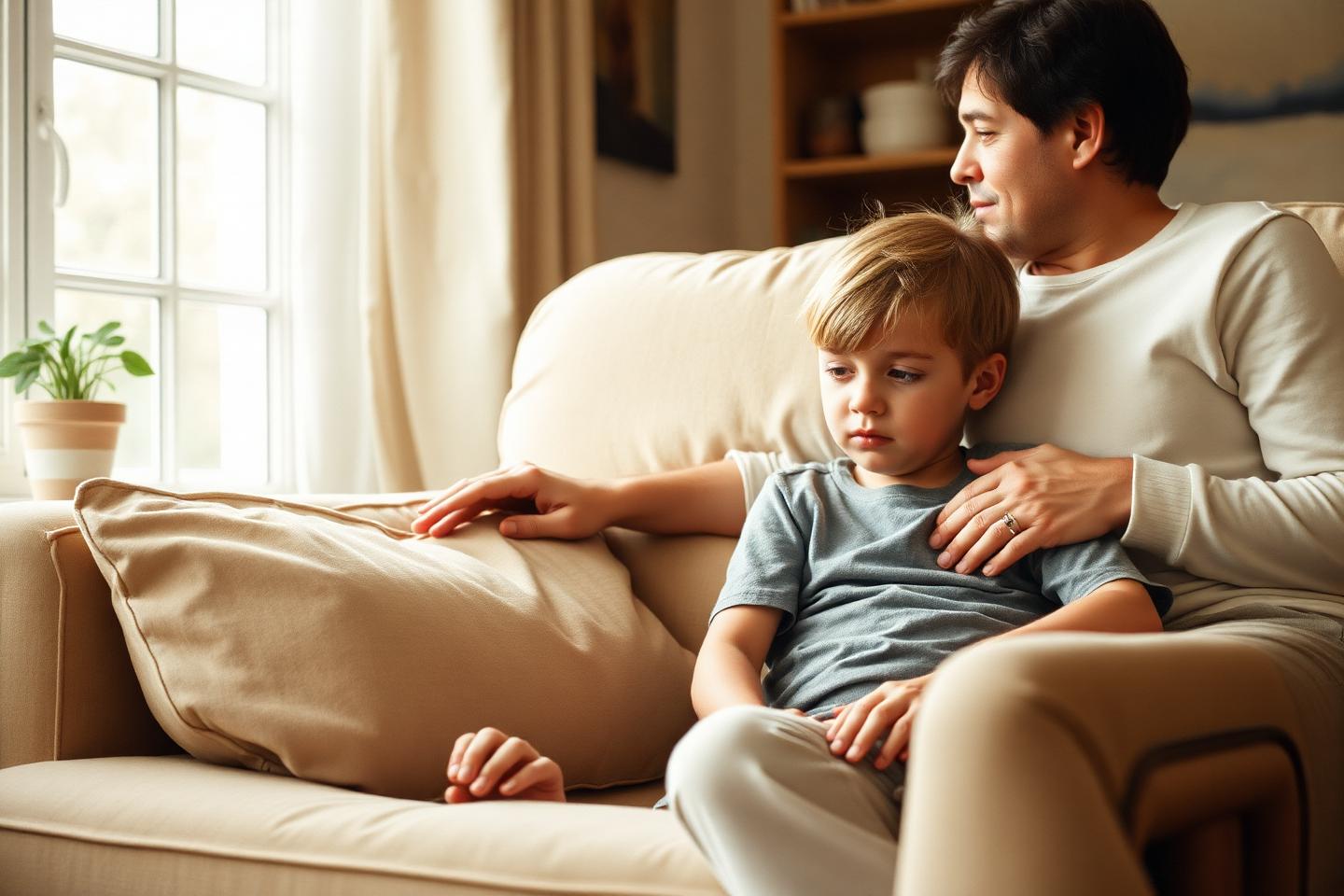
There is a moment most parents of an anxious child know intimately. It is 8:47pm. The lights are low, the day is nearly survived, and a small voice from the doorway says: 'But what if it happens tomorrow?' You have answered this question — the same question — four times tonight. You answer it again, warmly, thoroughly, with all the evidence you have. And you watch it work for about ninety seconds.
If that is your evening, nothing has gone wrong with your parenting. What is happening is a well-documented, entirely predictable feature of how anxiety works — and understanding it changes everything about how you respond. Anxiety is not asking to be argued with. It is not asking for better information. It is asking for something much simpler, and much harder to give.
Anxiety is a protective system, not a malfunction
Anxiety is the body's threat-detection system doing its job with the volume turned too high. It is old machinery — designed to keep a small human safe in a genuinely dangerous world — and its bias is deliberately conservative. It would rather sound a hundred false alarms than miss one real one. In a child, that system is still being calibrated, and calibration takes years.
When your child says 'my tummy hurts' before a birthday party, they are not fabricating a symptom to avoid an event. Their nervous system has flagged uncertainty as danger, released stress hormones, redirected blood flow away from digestion, and produced a genuine physical sensation. The stomach ache is real. The threat is not. Both facts are true at once, and holding both is the beginning of every good response.
The Anxiety Cycle
Why avoidance feels like help and teaches fear instead.
Why reassurance stops working
Reassurance is a beautiful instinct. When your child is frightened, you soothe them — that is attachment doing exactly what it evolved to do. And for a one-off fear, reassurance works perfectly well. The difficulty arises when reassurance becomes the mechanism by which anxiety is managed, day after day.
Here is the mechanics of it. Anxiety asks a question: 'Is this safe?' Your answer temporarily lowers the distress. That relief feels wonderful — for both of you. But the brain has just learned something unhelpful: the way to make this feeling stop is to get a parent to answer. So the next time uncertainty appears, the urge to ask arrives faster and louder. Clinicians call this reassurance-seeking, and it functions like any other compulsion: it relieves in the moment and strengthens over time.
This is not a reason to feel guilty. Family accommodation is not a parenting flaw — it is love operating on incomplete information. Every parent who has ever driven a route that avoids a dog, sat outside a bedroom door, or answered the same question for the fifth time was doing the most loving thing available to them at that moment. What we can do now is add a second tool alongside the warmth.
What anxiety is actually asking for
Anxiety is asking three things, in this order: 'Am I safe with you?', 'Can this feeling be survived?', and 'What is the very next small thing I can do?' Reassurance only ever answers the first — which is why it soothes but does not resolve. A complete response answers all three.
- 011. Connect before you correct
Get lower than your child. Lower your voice below theirs. Slow your own breathing visibly. Before any words, your nervous system is offering theirs a template to borrow. This is co-regulation, and it is not a soft extra — it is the physiological precondition for everything else.
- 022. Name it without inflating it
'Your worry brain is loud right now' does more work than 'there's nothing to worry about.' Naming separates the child from the feeling. It says: this is a thing that visits you, not a thing you are.
- 033. Express confidence, not evidence
Instead of listing reasons the fear is unlikely, say: 'This feels big, and I know you can handle big feelings.' Evidence invites debate. Confidence transfers capability.
- 044. Offer the next smallest step
Not the whole terrifying goal — the next rung. Not 'you'll sleep in your own bed all night' but 'I'll sit in the doorway instead of the chair tonight.' Small enough to be almost boring is exactly right.
- 055. Notice the effort afterwards
'You did the brave thing even though your body said no' is one of the most powerful sentences in a parent's vocabulary. It names courage as an action, repeatable and learnable.
Building a bravery ladder that actually gets climbed
Graded exposure sounds clinical. In practice, it is one of the warmest things you can do with a child: you sit down together and make a plan for facing something hard, in steps small enough that they can imagine surviving each one.
The Bravery Ladder
Courage is built in rungs small enough to succeed at.
- 01Pick one fear. Not all of them. Anxiety generalises, so progress on one fear tends to lift the others.
- 02Ask your child to describe the hardest version of it — that becomes the top rung, and you may never need to climb it.
- 03Work backwards to something they could do today with mild discomfort. That is rung one.
- 04Rate each rung 0–10 for how worried it feels. Aim to spend your time in the 3–6 range.
- 05Repeat a rung until the number drops by at least two, then move up. Repetition, not intensity, is what rewires prediction.
- 06Treat setbacks as data. A hard week means returning to the last comfortable rung, not abandoning the ladder.
“Bravery is not a personality trait some children are lucky enough to have. It is a skill, built one deliberately uncomfortable step at a time — and it is transferable to every fear that comes afterwards.”
Where anxiety hides: the signs parents often miss
Anxiety rarely announces itself as 'I feel anxious.' In children, it wears costumes — and several of them look like defiance, laziness or rudeness, which is how anxious children so often end up in trouble for being frightened.
- Anger and refusal — fight is a threat response, and 'no' is often the fastest way out of a frightening situation.
- Physical complaints — stomach aches, headaches and nausea that cluster around specific days or events.
- Perfectionism and procrastination — not starting because starting risks getting it wrong.
- Endless questions — a search for certainty that no answer can satisfy.
- Rigidity about small things — controlling the controllable when the big thing feels uncontrollable.
- Bedtime unravelling — the day's held-together feelings arriving once the distractions stop.
- Clinginess or sudden regression in a child who was previously independent.
The Behaviour Iceberg
What you see is a fraction of what is happening.
Common myths about anxious children
Your own nervous system is part of the treatment
Children borrow regulation before they build it. That means your breathing, your voice, your face and your pace are not background details — they are active ingredients. A calm adult beside a frightened child is doing measurable neurological work.
How Co-Regulation Works
Regulation is borrowed before it is learned.
Which is why the least glamorous advice is the most important: lower your own arousal first. Two slow out-breaths before you speak. Sitting rather than standing. Fewer words. It feels like doing nothing. It is doing the most.
When to seek additional support
Education is powerful, and it is not everything. Please involve a professional if anxiety is significantly limiting your child's life — school attendance, friendships, sleep, eating — if it has persisted at that level for more than a few weeks, if you see panic attacks, or if there is any mention of self-harm or not wanting to be here. Anxiety is highly treatable, and getting help early is a strength, not an escalation.
Most families notice something within two to three weeks of consistently changing the response pattern — usually a shorter recovery time after a spike rather than fewer spikes. Meaningful reduction in the anxiety itself typically takes 8 to 12 weeks of steady practice.
Not remotely. Comfort the child; don't feed the compulsion. Warmth, presence and physical closeness are always available. What we limit is the repeated answering, checking and removing of the feared thing.
The step is too big. Halve it, then halve it again. A rung that feels laughably easy still teaches the brain something, and momentum matters far more than ambition.
Sudden onset is worth a conversation with your GP or paediatrician, especially if it follows an illness or a specific event, or if it comes with obsessive thoughts or rituals. Sudden change deserves proper assessment rather than self-management.
Often, yes — gently. Anxiety reorganises whole households, and siblings frequently absorb both the accommodation and the resentment. Naming the plan in age-appropriate terms reduces both.
Anxiety is the dizziness of freedom.
Søren Kierkegaard
What you can try this week
Choose one moment
Pick a single recurring flashpoint this week rather than reforming everything at once.
Name it out loud
Put language to what you notice: “Your body looks like it's had enough of today.”
Repair afterwards
Return once everyone is settled. Repair, not the rupture, is what children remember.
Track it lightly
Note what happened before and after. Patterns show up within about a week.
- The behaviour you are seeing is a nervous system doing its best with the skills it currently has.
- Small, repeated responses change more than one big conversation ever will.
- Your calm is the intervention — regulation is caught before it is taught.
- Avoidance shrinks a child's world; graded practice grows it back.
- Repair after a hard moment matters more than preventing every hard moment.
Which moment in this article felt most familiar in your own home?
What is one response you would like to change this week?
What support would make that change realistic rather than aspirational?
Printable resources
Recommended Thrive courses
This article is educational and is not a substitute for individual clinical advice. Comments are closed so the Journal stays a calm place to read.
Share this
Keep going
You may also like
Courses, worksheets and pathways from the same part of the library.
- JournalGrowing Brave: How Real Courage Is Built in Small StepsWe cannot talk a child into bravery, and we cannot protect them into it either. Courage is built by doing slightly hard things, repeatedly, with someone steady nearby.Read
- JournalThe Weather Inside: Helping Children Carry Anxiety About the WorldYou cannot promise a child that the world will be fine. You can promise that they will not be carrying it alone.Read
- ResearchThe Research LibraryPeer-reviewed parenting and child mental health research, translated into plain language.Read
- Thrive GuideThrive GuideAsk a question and get warm, evidence-informed guidance drawn from the Thrive library.Read
- Thrive Care PlanThrive Care PlanA short check-in that turns how your week actually went into one focused plan.Read
- Thrive ToolThrive ToolsPremium printable workbooks and therapeutic tool kits.Read