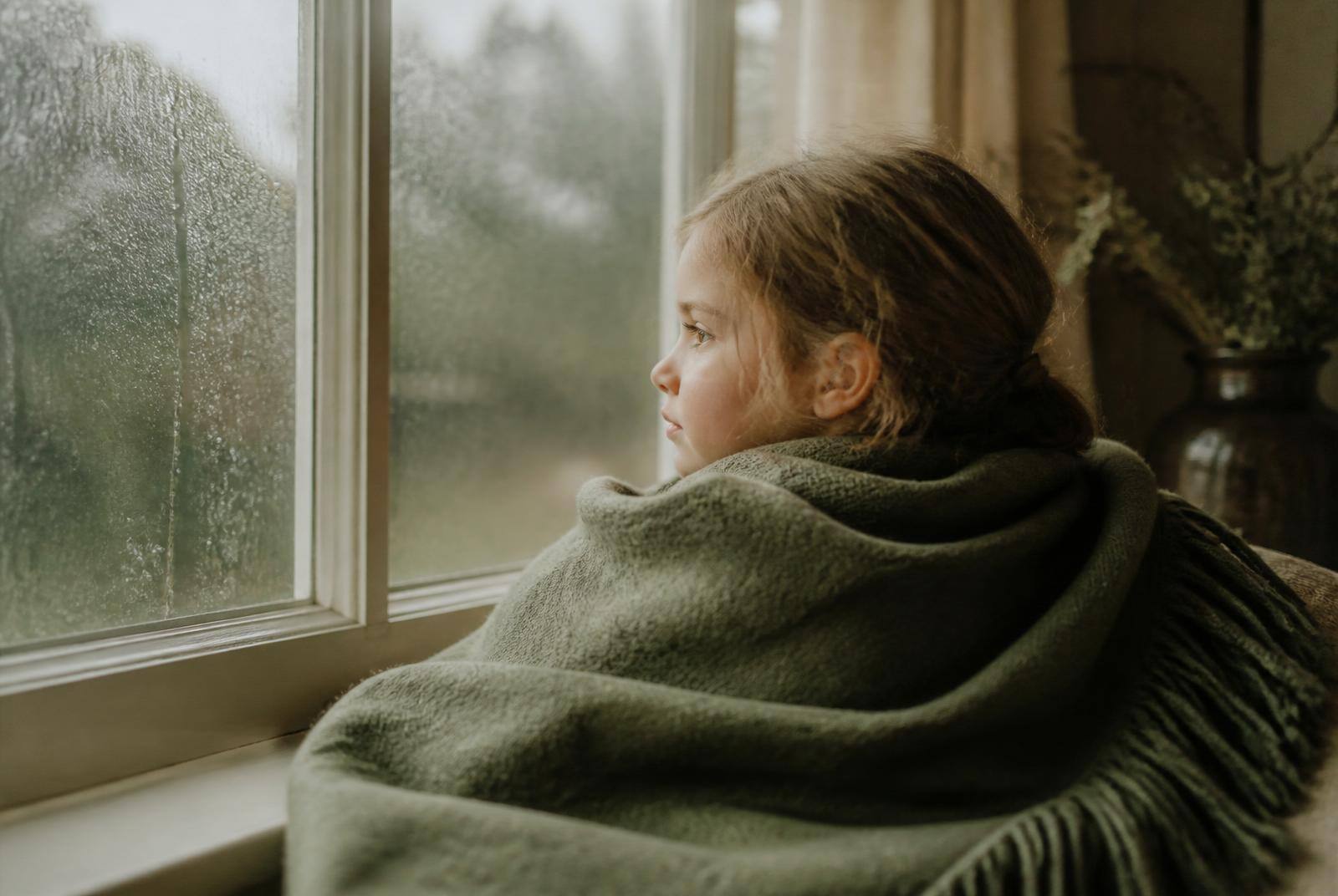
The Weather Inside: Helping Children Carry Anxiety About the World
Climate, conflict, headlines they were never meant to see. Children are absorbing global fear at an age when the world should still feel small — and reassurance alone will not hold it.
Reviewed by Sian Trombley, CCCFounder, Thrive Family Company
9 min read
Best for parents of children who are…
- worrying often, or asking the same question again and again
- having big feelings that arrive faster than words
- needing help bouncing back after setbacks

Share this
It usually arrives at bedtime, when the day has quietened enough for the large questions to surface. Will the fires come here. Is there going to be a war. What happens when the ice melts. And the parent, halfway out of the room, has about four seconds to decide what kind of adult to be.
Children have always asked frightening questions. What has changed is the supply. A ten-year-old now encounters global catastrophe as ambient content — in a feed, on a screen in a shop, in a fragment of adult conversation — without any of the framing that used to arrive alongside it.
Why reassurance alone fails
The instinct is to close the fear down: it won't happen here, don't worry, that's for grown-ups to sort out. It rarely works, for a simple reason. The child can check. And when the reassurance turns out to be thinner than the evidence, they learn something worse than the original fact — that this is not a subject you can help with.
Honesty, company, agency
- 01Find out what they already believe
"Tell me what you've heard." Most fear is a fragment plus an imagination. Correcting the fragment often does most of the work.
- 02Answer small and true
One honest sentence, pitched to age, with no extra detail volunteered. Then stop and let them ask the next question.
- 03Name who is working on it
Scientists, engineers, governments, charities, people whose whole job this is. Children need to know they are not the last line of defence.
- 04Give the worry somewhere to go
One real, repeatable action they lead. Agency converts helpless dread into something the nervous system can discharge.
- 05Return to it on purpose
Raise it again a week later, lightly. A worry you revisit voluntarily is a worry the child learns is safe to hold with you.
When it is more than worry
Concern about the world is a sign of a child paying attention, and in moderation it is healthy. It becomes clinical when it takes over function: sleep lost to it, school affected, refusal to imagine or plan a future, physical symptoms, or persistent hopelessness. At that point it is anxiety wearing a global costume, and it responds well to the same evidence-based support as any other anxiety.
Children cannot carry the whole world. They can carry their corner of it, if somebody carries it with them.
Sian Trombley, Canadian Certified Counsellor
What you can try this week
Find out what they think they know
"Tell me what you've heard" before any explanation. Most childhood fear is built from a fragment overheard and completed by imagination.
Give the worry a job
One concrete family action they choose and lead — a repair, a letter, a monthly habit. Helplessness is the toxic ingredient, not concern.
Contain the news
No background rolling coverage, no headlines at bedtime, and a named time each week where questions are welcome. Predictable exposure beats ambient exposure.
- False reassurance fails because children can check it; honesty plus company works.
- Agency is the antidote to helplessness — small, real, repeated action.
- Ask what they have heard before you explain anything.
- Perceived adult inaction increases distress more than the facts do.
- Watch for functional impact: sleep, school, appetite, refusal to plan for the future.
What do I say about the future in front of them when I am tired?
Am I reassuring them, or reassuring myself?
What is one thing we could genuinely do together this month?
Printable resources
Recommended Thrive courses
This article is educational and is not a substitute for individual clinical advice. Comments are closed so the Journal stays a calm place to read.
Share this
Keep going
You may also like
Courses, worksheets and pathways from the same part of the library.
- JournalWhen a Child Sees Something Frightening: The First Week Matters MostMost children recover from frightening events. The strongest predictor of how well is what the adults around them do next.Read
- ResearchThe Research LibraryPeer-reviewed parenting and child mental health research, translated into plain language.Read
- Thrive GuideThrive GuideAsk a question and get warm, evidence-informed guidance drawn from the Thrive library.Read
- Thrive Care PlanThrive Care PlanA short check-in that turns how your week actually went into one focused plan.Read
- Thrive ToolThrive ToolsPremium printable workbooks and therapeutic tool kits.Read
- CollectionThe Resource LibraryFree printable worksheets, scripts and planners for families.Read