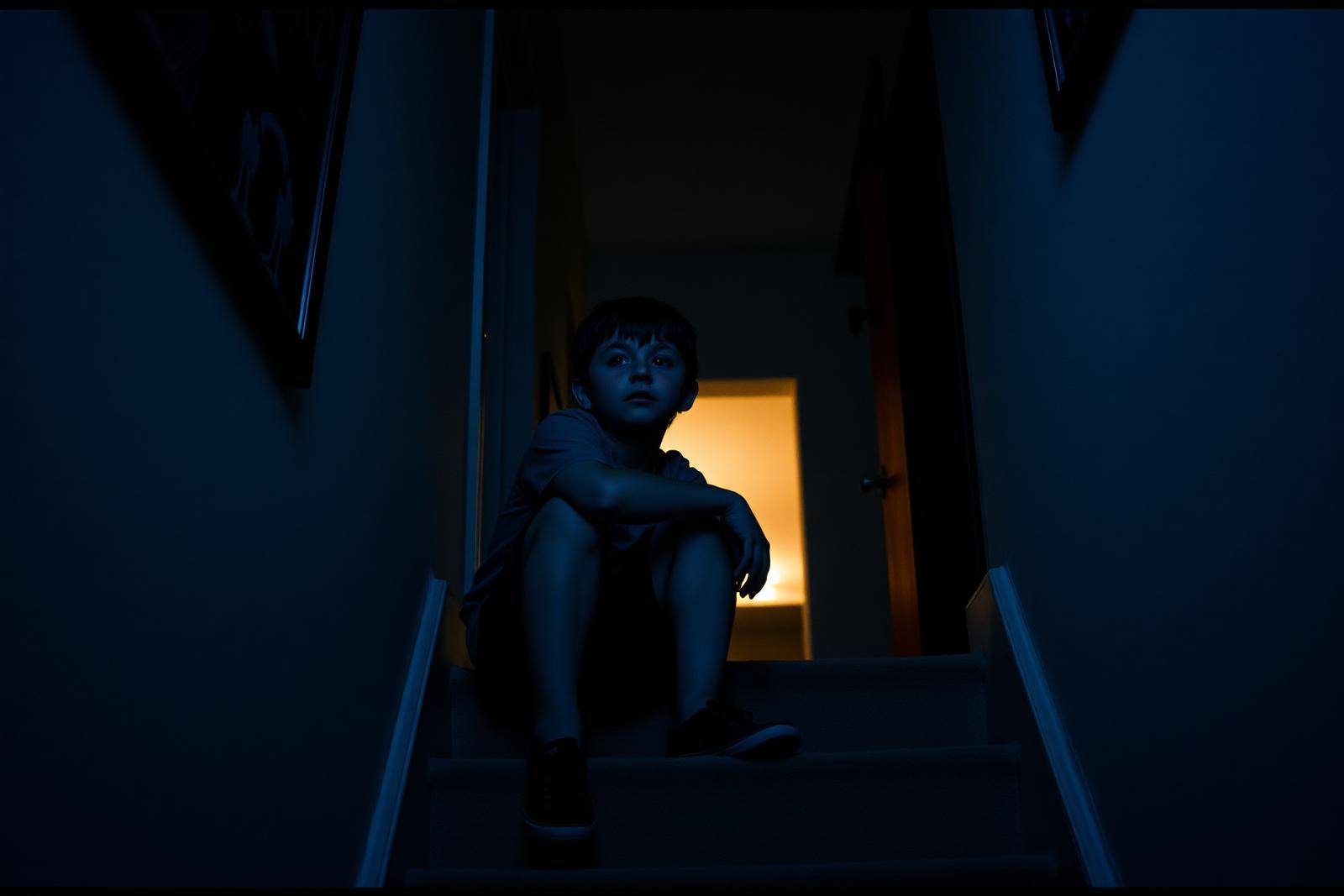
What Safety Actually Feels Like to a Child
A locked door and a stable roof are not the same thing as felt safety. Here is what a child's nervous system is actually scanning for — and why predictability, tone and repair matter more than reassurance.
Reviewed by Sian Trombley, CCCFounder, Thrive Family Company
14 min read
Best for parents of children who are…
- carrying something frightening that happened to them
- needing extra emotional support at the moment
- going through a change at home or at school

Share this
A father once told me, with real bewilderment, that he couldn't understand why his eight-year-old flinched when he raised his voice to call across the garden — he had never hit her, never even come close. He was right that nothing dangerous had happened. He was describing actual safety. What he hadn't yet learned to ask was a different question: what has her body learned to expect from a raised voice, and where did it learn that, and how long will it take to unlearn? This is the gap most parents don't know they're standing in. You can provide every fact of safety — food, shelter, love, consistency of intention — and still have a child whose nervous system has not caught up to the facts. Felt safety runs on different evidence than the evidence adults use to reassure themselves.
Two different kinds of safety
Actual safety is measurable from the outside: is the child fed, housed, physically unharmed, free from ongoing threat. It is the safety adults tend to think about first, because it is the safety they are responsible for providing and can point to as evidence of having done their job.
Felt safety is a conclusion the child's body reaches, continuously and mostly without words, based on a running tally of small cues — was that tone warm or clipped, did the promised thing happen, did the adult's face match their words, did anyone come back after the argument. A child can hold both conclusions at once, in either direction: actually safe but not feeling it, or — more rarely — feeling calm in a genuinely unsafe situation because the danger has become familiar.
Why the body doesn't take your word for it
Stephen Porges's polyvagal theory describes a process he called neuroception — the nervous system's continuous, largely unconscious scanning of the environment for signals of danger or safety. This scanning happens beneath the level of conscious thought and relies heavily on cues like vocal tone, facial expressiveness, rhythm and pacing, rather than on the literal content of what is said.
This is why a truthful, well-meant sentence like 'you don't need to worry about that anymore' can land with almost no effect on a child whose body is still braced. The sentence is processed by the thinking brain. The bracing is managed by a different system entirely — one that is not persuaded by logic, and was never designed to be. It is persuaded by pattern: enough repetitions of calm-follows-upset, enough times the promised thing actually happens, enough evidence that this adult's tone means what it usually means.
Predictability is a form of love a child can measure
Children who have experienced disruption, instability or unpredictable caregiving often develop a heightened need to know what happens next, not because they are controlling or difficult, but because 'what happens next' has historically not been reliable information. Predictability is not the enemy of spontaneity or fun; it is the floor that makes both possible without cost.
This does not mean rigid schedules down to the minute. It means naming the shape of a day before it happens, giving real warning before transitions, and being honest when a plan is about to change rather than letting the child discover the change on arrival. 'We were going to the park, but it's raining, so we'll go tomorrow instead' costs a sentence and prevents a small betrayal from registering as one more unreliable adult.
- Say the shape of the day out loud each morning, even in outline
- Give advance warning before transitions — 'five more minutes, then bath'
- Tell the truth immediately when a plan is changing, rather than letting it surprise the child
- Keep the emotional tone of routine moments (meals, pickup, bedtime) as flat and predictable as the schedule itself
Tone carries more information than content
A child who has learned to be watchful will often respond to how something is said long before they process what was said. This is adaptive, not oversensitive — tone historically predicted what was coming with more reliability than words did. Parents sometimes describe feeling unfairly judged by a child who 'overreacts' to a normal, tired voice. It helps to remember this is not an accusation of the parent's character; it is a well-practised detection system doing exactly what it was built to do.
“The body keeps score long after the mind has been told the danger has passed.”
adapted from Bessel van der Kolk's clinical writing on trauma and the body
This is also why matching your face to your words matters more than most parents realise. Saying 'I'm not upset' through a tight jaw and clipped sentences teaches the opposite lesson to the one intended. If you are genuinely calm, let your body show it — slower movements, softer voice, unhurried pace. If you are not calm yet, it is more honest, and ultimately more regulating, to say so: 'I'm still frustrated, give me a minute before we talk.'
Repair matters more than avoiding conflict
One of the most freeing findings for exhausted parents is that felt safety does not require a household free of conflict, raised voices or mistakes. Research on parent-infant interaction by Edward Tronick and colleagues found that even securely attached, well-functioning dyads are in a state of misattunement or mismatch a significant proportion of the time — what matters for the child's developing sense of safety is not the absence of rupture, but whether rupture is reliably followed by repair.
This reframes the goal. You do not need to become a parent who never loses patience. You need to become predictably repairing — a parent whose lapses are reliably followed by a return, a naming of what happened, and an ordinary re-entry into connection. A child who has enough evidence that repair always comes eventually stops needing to brace for the possibility that this time it won't.
What felt-unsafe behaviour actually looks like
Children rarely announce 'I don't feel safe.' The signal usually arrives sideways: excessive checking in, difficulty separating even in familiar settings, hoarding small objects, sleep disruption, a need to control minor details of routine, or conversely, a flat compliance that looks like ease but is actually a strategy to avoid drawing attention. None of these behaviours prove danger is present now — they prove the nervous system's evidence base has not yet updated.
Building felt safety, one confirmed prediction at a time
There is no single conversation, gift, or reassuring speech that installs felt safety. It accumulates the way trust accumulates in any relationship — through many small moments where the child predicted one outcome and got exactly that outcome, enough times that the prediction becomes background rather than a live question.
- 01Make fewer promises, and keep every one you make
A parent who promises less but is completely reliable builds more felt safety than one who promises generously and occasionally falls through.
- 02Let the child see you regulate, not just perform calm
Narrate your own coping in real time — 'I'm going to take three breaths because I'm getting frustrated' — so the child learns that adults have feelings too, and manage them visibly rather than by suppression.
- 03Return to the same people, places and routines often
Familiarity is not boring to a nervous system building trust; it is evidence. Resist the urge to constantly introduce novelty as a way to keep a child happy — steadiness does more of the actual work.
- 04Ask, don't assume, what would help right now
'Do you want me to stay, or would you rather I check on you in a few minutes?' gives the child some authority over their own environment, which is itself a safety signal.
Trust the behaviour as the more reliable signal, without treating the verbal reassurance as a lie. Children, especially older ones, often genuinely believe they're fine because that is the more socially acceptable answer, even while their body is still bracing. Respond to what you observe — sleep changes, clinginess, irritability — rather than only the verbal report.
Predictability of tone and relationship is different from rigidity of schedule. You can vary activities and introduce spontaneity freely as long as the relational cues — warmth, honesty about changes, reliable repair — stay consistent. Rigidity becomes a problem when it's used to avoid ever preparing a child for change; healthy predictability actually makes change easier to tolerate because the relationship underneath it is stable.
There's no fixed timeline, and it varies enormously by child and history. What matters more than duration is consistency — repeated, reliable evidence that the new normal holds. Many families notice a meaningful shift over several months of steady routine, though some children, particularly those with earlier disruptions, take considerably longer.
Children do not need a perfect parent. They need a predictable one who returns after hard moments.
Sian Trombley, Canadian Certified Counsellor
What you can try this week
Narrate the predictable parts of the day out loud
Each morning this week, say the shape of the day aloud in one sentence: 'After breakfast we go to school, I pick you up at the usual time, then we have dinner and bath.' This costs nothing and gives an anxious nervous system a map it can check itself against.
Practise the repair sentence after a hard moment
The next time you raise your voice or lose patience, come back within the hour and say plainly: 'I got too loud earlier. That wasn't about you being bad, it was me struggling with my own frustration. I'm sorry.' Do not wait for the child to ask.
Check your face, not just your words
Before delivering reassurance ('everything's fine'), notice your own tension — jaw, shoulders, breathing. A calm sentence said through a clenched jaw registers as danger, not safety, to a watchful child.
- Actual safety (facts about the environment) and felt safety (what the nervous system concludes) are different systems, and children can lack one while having the other.
- Felt safety is read through tone, facial expression, pacing and predictability — largely beneath conscious awareness — not through verbal reassurance alone.
- Predictable routines and honest warnings about change do more to build felt safety than comfort statements delivered in a crisis.
- How you repair after conflict or a raised voice matters more to long-term felt safety than whether conflict happens at all.
- Felt safety is rebuilt slowly, through many small confirming moments, not restored by a single apology or reassurance.
When your child is anxious, do you tend to offer facts ('nothing bad is happening') or presence (slowing down, softening your voice, staying close)? Which actually settles them?
Think of the last time you snapped or lost patience. How long afterward did you reconnect and name what happened, out loud?
Is there a part of your child's daily routine that changes unpredictably from their point of view, even if it makes sense to you as an adult?
Printable resources
Recommended Thrive courses
This article is educational and is not a substitute for individual clinical advice. Comments are closed so the Journal stays a calm place to read.
Share this
Keep going
You may also like
Courses, worksheets and pathways from the same part of the library.
- JournalThe Child Who Seems FineEveryone said how well she was coping. That was the part that concerned me.Read
- JournalThe Child Who Remembers More Than You ThinkA child too young to describe what happened is not too young to have been affected by it. Implicit and body memory can hold an experience for years, surfacing later as a fear, a flinch, or a reaction that seems to come from nowhere.Read
- CollectionEmotional RegulationEverything Thrive publishes on emotional regulation — articles, courses, worksheets and research.Read
- ResearchThe Research LibraryPeer-reviewed parenting and child mental health research, translated into plain language.Read
- Thrive GuideThrive GuideAsk a question and get warm, evidence-informed guidance drawn from the Thrive library.Read
- Thrive Care PlanThrive Care PlanA short check-in that turns how your week actually went into one focused plan.Read