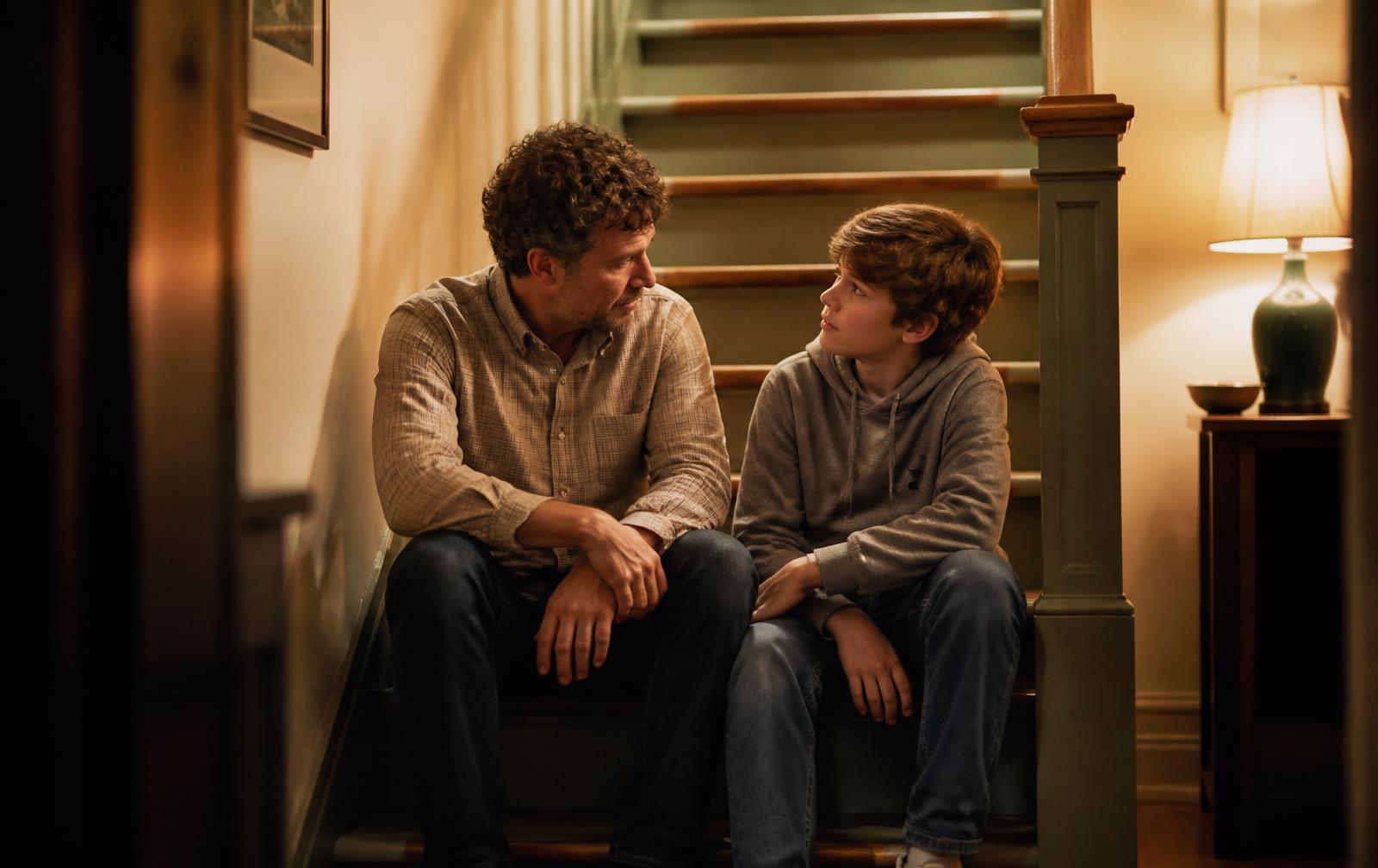
When Your Child Hits
Hitting is frightening to be on the receiving end of, and frightening to witness in someone you love. It is also, almost always, a communication problem before it is a character problem.
Written by Sian Trombley · BEd, MACP, CCC
It happens fast. One second you are negotiating over a jumper, the next there is a hand against your arm and a room that has gone very quiet. Almost every parent describes the same aftershock: not pain, but a kind of vertigo. Is this normal? Is this my fault? Is this who they are?
Hitting is one of the most alarming behaviours a parent encounters and one of the most misunderstood. It arrives with moral weight attached, which is precisely what makes it so difficult to respond to well. We start managing our own shame at the same moment our child needs us to manage the room.
Why the hand moves first
In a heightened moment, a child's arousal climbs faster than their capacity to describe it. Language is a slow, effortful, prefrontal skill. Movement is fast and subcortical. When the gap between those two systems is wide — which it is for every young child, and stays wide for longer in children with ADHD, autism, sensory differences or trauma histories — the body speaks before the mouth can.
What hitting is usually saying
- "I am overwhelmed and I do not have the words for it."
- "Something in this environment hurts — noise, hunger, tiredness, transition."
- "I am powerless in this situation and this is the only lever I have."
- "This worked last time and nobody has taught me what to do instead."
- "I am frightened, and my body has read fear as fight."
The response that actually works
- 01Interrupt calmly
Move in close and low. Take the hand or place your body between children. Say one short sentence: 'I won't let you hit.' Avoid volume — raised voices add fuel to an already flooded system.
- 02Reduce the input
Fewer words, less eye contact, lower voice, more space. Every additional stimulus lengthens the storm. You are trying to bore the nervous system back down.
- 03Attend to the hurt party first
If a sibling has been hit, give the warmth to them. This is not punishment by omission; it teaches that aggression does not gain attention while care always does.
- 04Wait for the drop
Regulation takes twenty to forty minutes to return fully. Any teaching before that is filed under noise.
- 05Rehearse the replacement
Later, and lightly: 'When your body gets that big feeling, your hands need a job. Let's practise the wall push.' Rehearse it when calm, three or four times, so the pattern is available under pressure.
Why consequences alone stop working
A consequence tells a child what not to do. It never tells them what to do instead. If the underlying skill gap — reading rising arousal, finding a word, asking for help — is left unaddressed, the behaviour simply reappears in a context where the consequence does not reach. Suppression is not the same as learning.
When to seek more support
Reach out to a professional if aggression is escalating in intensity rather than frequency, if it appears at school as well as home, if your child seems genuinely frightened of themselves afterwards, or if anyone in the home is being hurt. None of these mean something is wrong with your child; they mean the strategy needs more than a household can carry alone.
Children do not need a perfect parent. They need a predictable one who returns after hard moments.
Sian Trombley, Canadian Certified Counsellor
What you can try this week
Map the last three incidents
Write down time of day, what happened just before, who was present, and how long the child had been awake, hungry or on a screen. Patterns show up in three data points more often than parents expect.
Block, don't lecture
In the moment, physically and calmly stop the hand: 'I won't let you hit.' Six words. Save the teaching until the nervous system has come down.
Give the hands another job
Aggression is energy looking for an exit. Push against a wall, squeeze a cushion, stamp ten times. Redirect the impulse rather than deleting it.
- Hitting peaks when language lags behind feeling — it is developmental before it is moral.
- Stopping the behaviour and understanding it are two separate jobs. Do the first in the moment, the second later.
- Consequences suppress; skills replace. Only one of those lasts.
- Most hitting has a predictable trigger — find the pattern and you find the intervention.
- Your steadiness in the moment teaches more than any lecture afterwards.
What was happening in the ten minutes before the last incident?
What did I learn about anger in my own childhood home?
Do I respond differently when other people are watching?
Printable resources
Recommended Thrive courses

Share this article
This article is educational and is not a substitute for individual clinical advice. Comments are closed so the Journal stays a calm place to read.