Guide
The Household Inbox
One tray, one hour a week, and the end of the paper that lives on the worktop.

Share this
- Time in real life
- One tray, plus 40 minutes on a Sunday
- Ages
- All ages
- Reading
- 7 min
Reviewed by Sian Trombley, CCCFounder, Thrive Family Company
7 min read
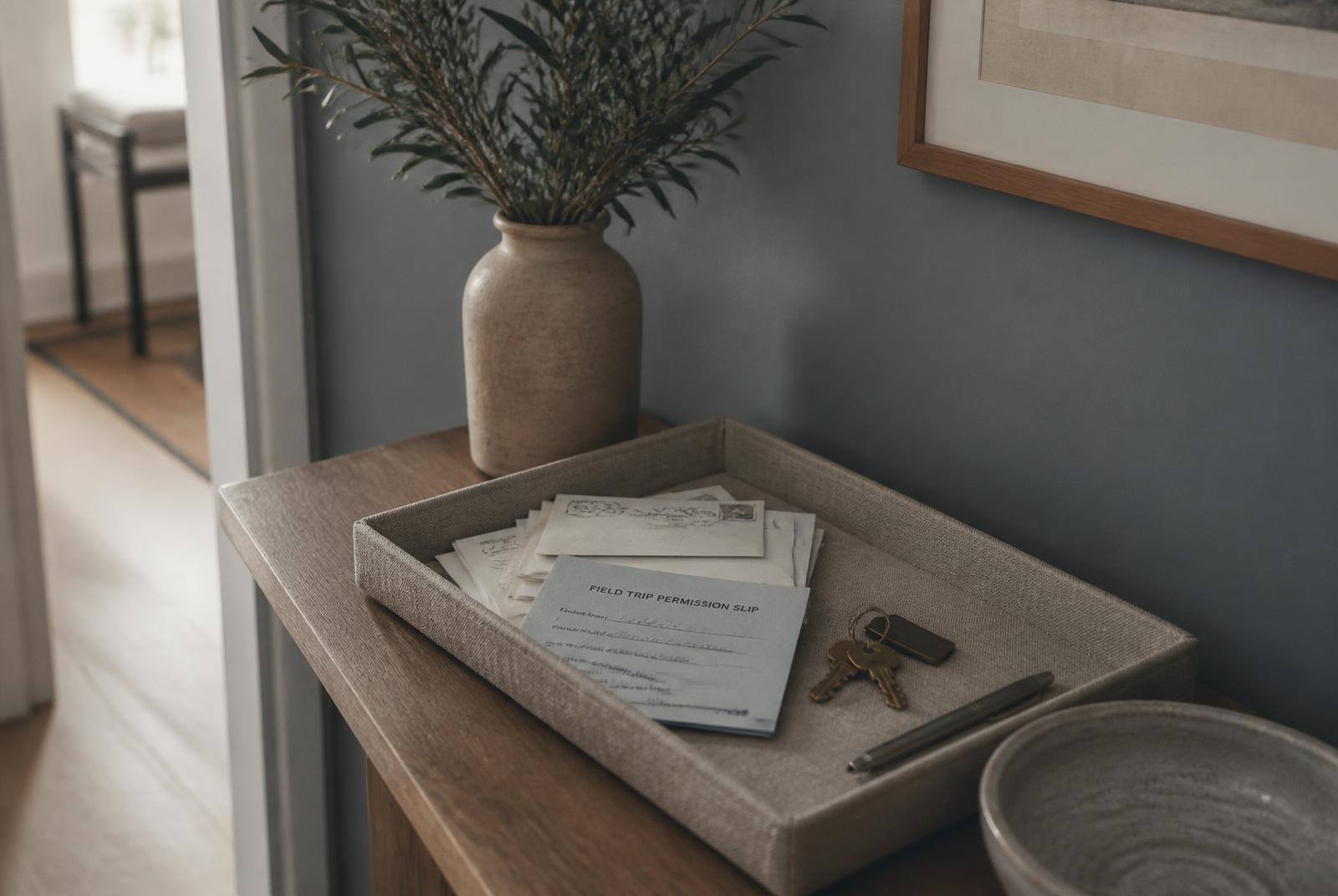
There is a pile on your kitchen worktop. It has a permission slip in it, something from the dentist, a birthday invitation with an RSVP date that has probably passed, and a letter you have moved four times without opening.
The pile is not evidence of disorganisation. It is what happens when a household receives obligations through six different channels — bag, post, email, app, text, verbal — and has no agreed place for them to land.
Everything in this guide is a version of one idea: give the admin a container, and give the container a scheduled hour.
Why family paperwork feels heavier than the work involved
Almost none of these tasks are difficult. Signing a form takes eleven seconds. What is expensive is holding them: the low, constant background scan of everything unfinished, running in a mind that is also cooking dinner. Unfinished obligations occupy attention out of all proportion to their size, which is why a worktop pile can make an otherwise fine week feel like drowning.
A container solves the holding problem before it solves the doing problem. Once every open loop is physically in one tray, your mind can stop keeping the list.
Building the inbox
- 01
One physical tray, by the door
Not a drawer — a drawer hides its contents and hidden things stop being trusted. A shallow open tray where you can see the depth of what is waiting. Everything paper goes in it: letters, slips, invitations, receipts you might need.
- 02
One digital equivalent
A single email folder or notes list called Family. School emails, app notifications you screenshot, the message from a parent about a party. Two inboxes are the maximum a household can maintain; three becomes a filing system nobody uses.
- 03
One weekly hour
Same time each week — Sunday evening works for most, before the week has opinions. Empty both inboxes to zero. Anything that takes under two minutes is done immediately; everything else becomes a dated item on the family calendar.
- 04
Children empty their own bags into it
The tray is the drop point, and it is their job to use it — from about six years old. What arrives in a school bag becomes their responsibility to deliver, not yours to excavate.
The four decisions, and only four
- Do it now — under two minutes, finished, in the recycling.
- Diarise it — the action goes on the shared calendar with a date, and the paper is filed or binned.
- File it — passports, medical letters, anything you might need to produce. One box file, no categories.
- Bin it. The majority of the tray. Almost nothing needs keeping twice.
The absence of a fifth option matters. "Deal with later" is what created the pile, and re-reading the same letter four times is a real, measurable cost paid in a week that had no spare capacity.
Sharing it between two adults
The inbox hour is the most transferable job in the house, and it is very often the one that has quietly become one person's forever. Alternate it fortnightly, or split by domain — one adult holds school and medical, the other holds money and household. What matters is that the ownership is stated out loud rather than inherited by whoever noticed first.
The relief is not in the paperwork being done. It is in knowing there is nowhere else it could be hiding.
Try this week
- 01Put one open tray by the door and move every loose paper in the house into it.
- 02Create a single Family folder in your email and nothing else.
- 03Book a recurring forty minutes on Sunday evening and defend it.
- 04Empty both inboxes to zero once, using only the four decisions.
- 05Agree out loud who owns which half of the family admin.
The therapist's perspective
I include this in Grow because parents describe the mental load in emotional language — resentment, overwhelm, invisibility — and it is usually treated as a relationship problem. Sometimes it is. Often it is a systems problem being felt emotionally, and the system is genuinely fixable in an evening.
Start with the tray. If the weekly hour does not survive, the tray alone will still carry most of the benefit, because the holding stops even when the doing lags.
Sian
Sian
Founder, Thrive Family Company
Share this
Continue in Family Systems
The School Communication System
School communication is now a genuine administrative load carried mostly by one adult. Here is a system that catches what matters and lets the rest go.

The Appointments and Health File
Health admin arrives at the worst moments and asks you to recall dates from two years ago. A simple file, kept lightly, removes most of that burden.
The Shared List That Replaces Nagging
When one person holds every task in their head, the only way to distribute the work is to speak — which everyone experiences as nagging. A visible list changes who is being asked.