Ritual
The Morning Send-Off Sentence
The last thing you say at the door, and why it should be the same every day.

Share this
- Time in real life
- 10 seconds
- The change
- The household adopts one repeated sentence at the door, replacing the last-minute reminder.
- Ages
- 4–18
- Reading
- 6 min
Reviewed by Sian Trombley, CCCFounder, Thrive Family Company
6 min read
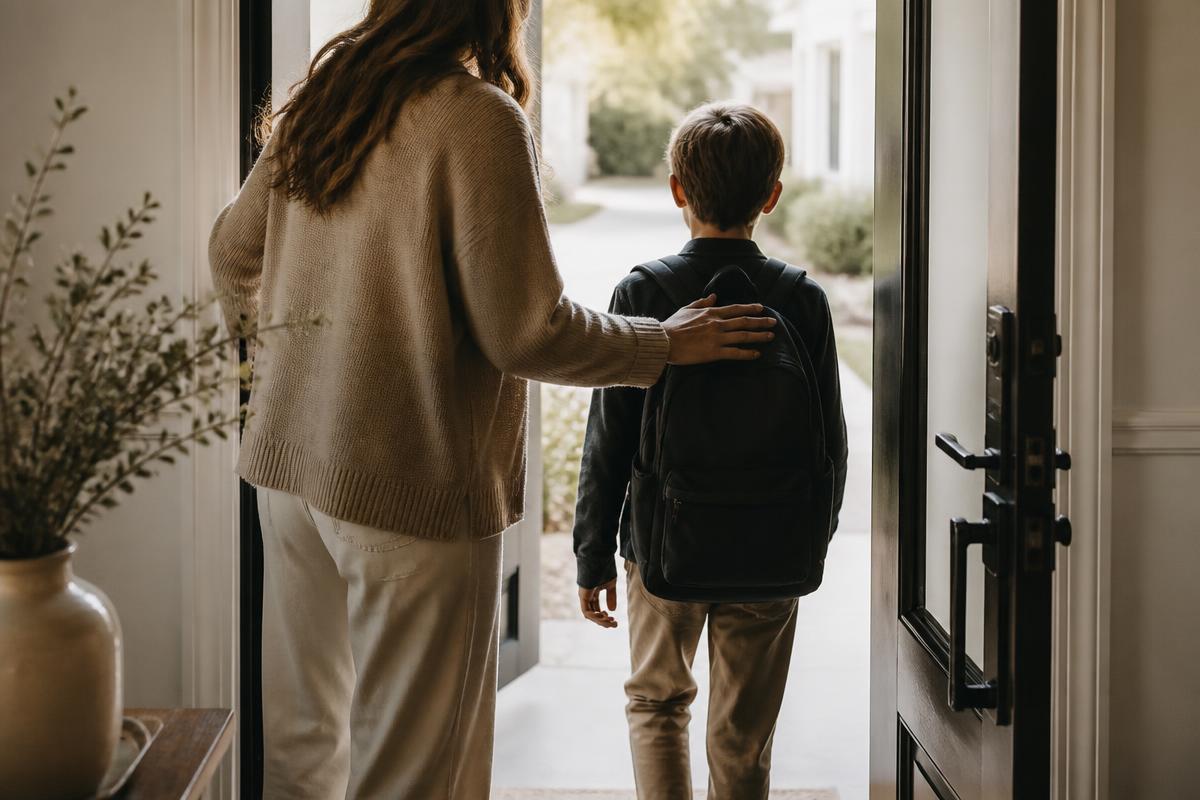
Listen to the last ten seconds of a school morning in most households and you will hear logistics: have you got your kit, don't forget the form, remember you're at your grandmother's tonight.
None of it is unreasonable. All of it is forgotten within a hundred metres. And it means the final thing a child hears from you each day, five days a week, is a piece of administration or a correction.
That final line is disproportionately memorable. It is the sentence they carry into the building, and the one many adults can still quote from their own childhood decades later.
Why the same sentence, every day
Repetition is what turns a nice thing said occasionally into something a child can rely on. A varied compliment is pleasant; a fixed sentence becomes a fact about the household. Children stop hearing the words fairly quickly and start hearing the fact that the words happened, which is the part that does the work.
It is also robust to bad mornings. After an argument, a scripted line is available when a spontaneous warm one is not — and being able to send a child off well on a morning that went badly is precisely the point.
What makes a good one
- Short enough to say while a door is closing. Under eight words.
- About them, not their performance. Not "good luck in the test" — that ties the send-off to an outcome.
- True on every day, including the days they were difficult and you were short.
- Yours. Borrowed phrases wear out; the ones families keep tend to be slightly odd and specific to them.
Where the reminders go
Not into the doorway. Put them on the launch pad the night before, on a note in the bag, or say them at breakfast where there is still time to act on them. The door is the last emotional moment of the morning and it should not be spent on a swimming kit.
Teenagers
Expect no visible response. A grunt, headphones, the door. Say it anyway. Adolescents who appear to ignore a send-off line will very often reproduce it exactly, years later, when asked what home sounded like. Do not require acknowledgement — requiring it turns a gift into a transaction.
The last thing said at the door is the sentence a child carries into the building.
Try this week
- 01Choose your sentence, write it down, and say it at the door every day this week without varying it.
- 02Move the reminders to the night before or the breakfast table.
- 03Use it unchanged on the worst morning of the week — that is the day it matters.
- 04Expect nothing back from a teenager, and keep going.
The therapist's perspective
Adults in therapy quote their childhood send-off lines with startling accuracy, and they quote the absence of one just as clearly.
If saying something warm feels artificial at first, that is usual. It stops feeling like a script somewhere around week three, and it was doing its work throughout.
Sian
Founder, Thrive Family Company
Share this
Continue in Daily Practices

The Five Senses Pause
A grounding practice short enough to use in a supermarket car park, and concrete enough to work when breathing exercises are refused.

The Evening Inventory
A short, structured way to close a parenting day that neither replays every mistake nor pretends it went well.

The Two-Minute Check-In That Helps Families Stay Connected
Two minutes, same time each day, one question, no follow-ups. The practice works precisely because it asks for so little.