Guide
The Paper Drawer
Forty minutes once, and then never again.

Share this
- Time in real life
- 40 minutes once, then 2 minutes a day
- Ages
- All ages
- Reading
- 6 min
Reviewed by Sian Trombley, CCCFounder, Thrive Family Company
6 min read
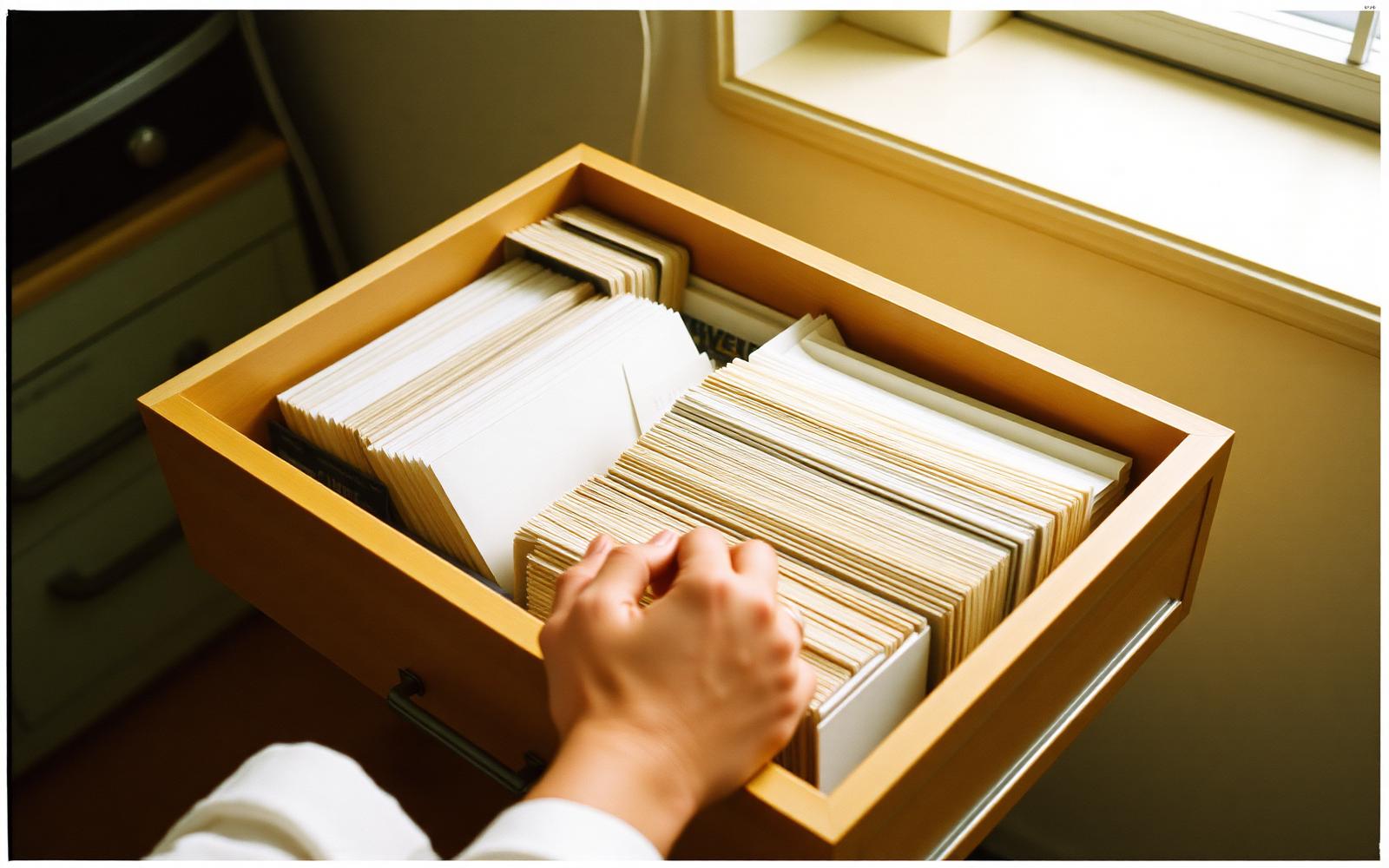
The pile lives on the worktop, the stairs, the shelf by the door. School letters, a form, a card from an appointment, something from the bank, a permission slip that may or may not have a deadline.
It looks like clutter. It is closer to an open browser with forty tabs, each one costing a small amount of attention every time you walk past.
Clearing it is not about tidiness. It is about converting each sheet into a decision, once, so it stops asking.
Four destinations, no fifth
- 01
Bin
The majority. If it can be found online, or is more than a year old and unremarkable, it goes. Be ruthless — the anxiety of throwing away is almost always cheaper than the anxiety of the pile.
- 02
Do — under two minutes
Sign it, reply, put the date in the calendar. Anything that takes less than two minutes never touches a filing system.
- 03
Diary — it has a date
Straight onto the shared calendar, then bin the paper. The paper was only ever a carrier for a date.
- 04
Keep — genuinely
Passports, certificates, tenancy, medical, insurance, warranties in force. One box, five labelled folders, done.
The two-minute daily gate
The pile reforms unless something intercepts new paper on arrival. One tray by the door, emptied at the same moment each day — while the kettle boils works well — using the same four destinations. It takes about two minutes and it is the difference between a system and a clearance.
The five folders
- Identity — passports, birth certificates, national insurance, immigration papers.
- Home — tenancy or mortgage, insurance, the boiler, anything with a service history.
- Health — vaccination records, referrals, current prescriptions, one page per person.
- School — the current year only. Last year's goes at the summer holidays.
- Money — the current tax year and last. Everything older is either digital or unnecessary.
A pile of paper is a stack of decisions you have agreed to make again tomorrow.
Try this week
- 01Set a timer for forty minutes and run the whole pile through the four destinations.
- 02Put one tray by the door and empty it while the kettle boils each day.
- 03Photograph the artwork, keep six pieces, let the rest go.
- 04Label five folders and refuse to create a sixth.
The therapist's perspective
People often describe household paper as a sign of failure. It is a sign of volume. Households produce more administrative paper now than at any point in history, and no amount of personal discipline substitutes for a system with a gate on it.
If the pile carries something painful — a letter you can't open, a bill you're avoiding — separate that one item and give it its own time, with another adult present if you can. Do not let one envelope hold the whole drawer hostage.
Sian
Founder, Thrive Family Company
Share this
Continue in Family Systems
The School Communication System
School communication is now a genuine administrative load carried mostly by one adult. Here is a system that catches what matters and lets the rest go.
The Appointments and Health File
Health admin arrives at the worst moments and asks you to recall dates from two years ago. A simple file, kept lightly, removes most of that burden.
The Shared List That Replaces Nagging
When one person holds every task in their head, the only way to distribute the work is to speak — which everyone experiences as nagging. A visible list changes who is being asked.