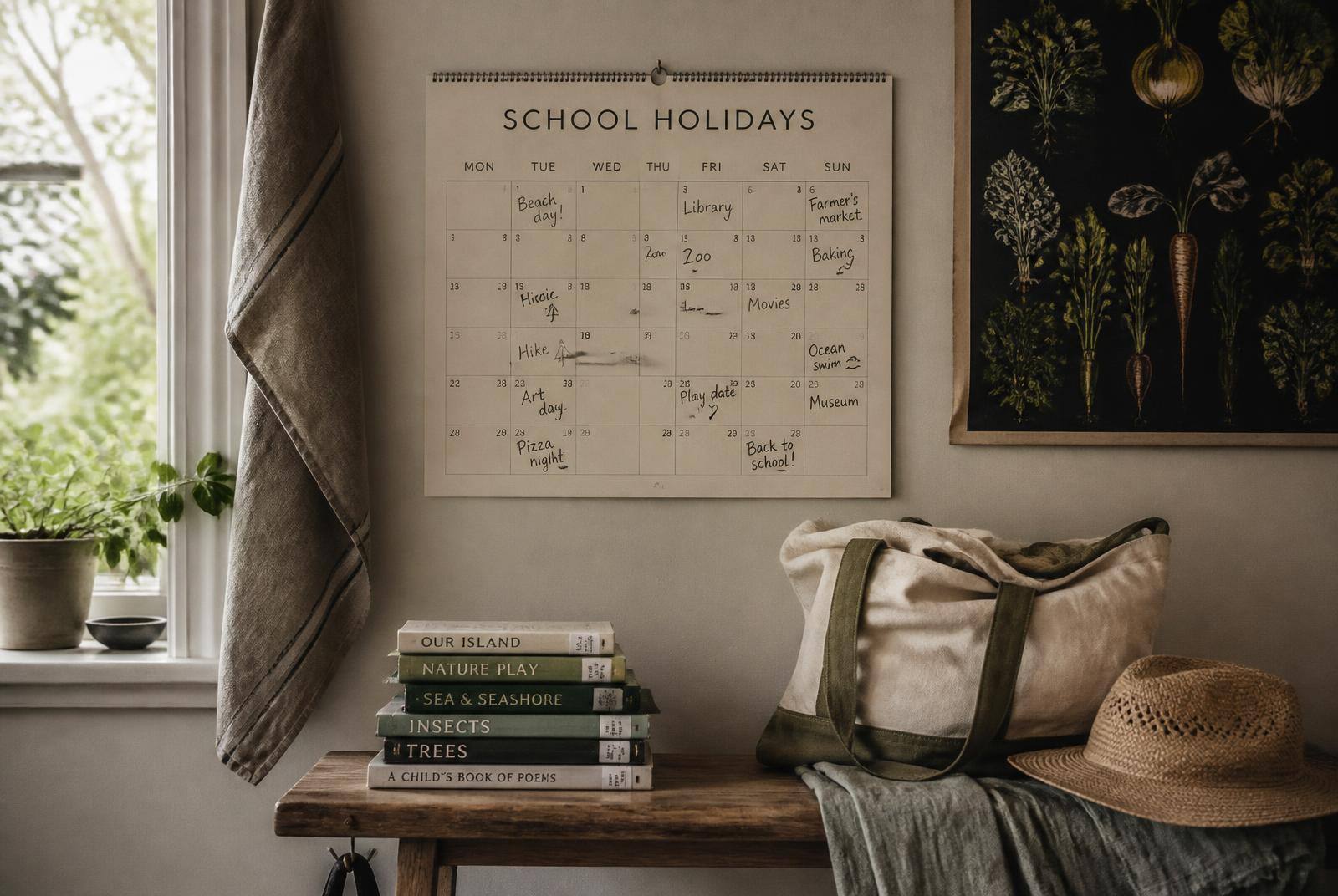
Guide
The Shape of a School Holiday
Six weeks is not a plan. Here is the structure that makes an unstructured stretch survivable.

Share this
- Time in real life
- 40 minutes, once, before the holiday starts
- Ages
- 5–16
- Reading
- 8 min
Reviewed by Sian Trombley, CCCFounder, Thrive Family Company
8 min read
Every family begins a long holiday with the same two contradictory hopes: that it will feel free, and that it will not descend into six weeks of screens, snacking and low-grade bickering. Both hopes are reasonable. They are also, without a shape, incompatible.
The mistake is almost never laziness. It is that parents plan a holiday the way they plan a project — a list of activities — when what children actually regulate against is rhythm. A child does not need to know what Thursday holds. They need to know what a day in this house looks like.
What follows is not a timetable. It is a shape: three anchors a day, one anchor a week, and a deliberate plan for the three points where every holiday reliably falls over.
Why unstructured time is harder, not easier, for children
In term time, a child's day is scaffolded by somebody else. Bells, transitions, expectations, and the low hum of knowing what happens next. Remove all of it at once and most children under twelve do not relax into freedom — they become dysregulated by it. The behaviour parents describe in the second week of a holiday, the whining and the sudden fragility, is very often a nervous system with nothing to lean on.
Adolescents show the same thing differently: sleep drifts, days invert, and by the middle of the break the household has two teenagers operating on a timezone of their own. Neither group is being difficult. Both are responding to the removal of external structure they had not realised they were using.
Three anchors a day
- 01
A morning anchor
One fixed point before 11am that happens every single day — breakfast at the table, the dog walked, the kitchen tidied together to one song. It does not matter what it is. It matters that it does not move. This is what stops the day from starting at two in the afternoon.
- 02
An out anchor
One leaving-the-house event a day, even if it is nine minutes to the postbox. The threshold matters more than the destination. Days that contain no exit reliably produce the worst evenings.
- 03
An evening anchor
One thing that signals the day is closing — the same meal ritual, a chapter, a shower, lights down. Holiday bedtimes can be later. They should not be absent, because the following morning is built the night before.
The three places every holiday falls over
- The first Monday. Everyone is still on term-time nervous systems and the day has no walls. Plan the busiest, most physical day of the whole break for it — outdoors if you possibly can — and let the collapse into slowness come afterwards.
- The middle week. Novelty has worn off, the money is thinner, and boredom has turned into friction. This is the week to lower ambition and raise routine: same three anchors, cheaper days, more time at home. Do not add activities to fix it. Add rhythm.
- The last two days. Anxiety about returning arrives disguised as bad behaviour. Move bedtimes back forty minutes at a time, lay out the uniform two days early, and name the feeling out loud rather than waiting for it to come out sideways.
The boredom conversation, before it happens
Boredom is not a problem to be solved. It is the doorway to self-directed play, and children only walk through it if the adult does not keep closing it for them. The parent's job is to tolerate the ten uncomfortable minutes on the other side of the complaint.
Protecting the adult in the holiday
Write your own anchor into the shape before anyone else's. One hour, at a fixed point, that is yours — early, late, or in the middle of the afternoon with a film on for everybody else. A holiday in which the adult never gets a single unclaimed hour is not a holiday; it is a six-week shift with worse hours than work.
Children do not remember the itinerary. They remember whether the house was calm.
Sian Trombley
Try this week
- 01Write your three daily anchors on one piece of paper and put it where everyone eats. Three lines, not a timetable.
- 02Choose the weekly landmark and say it out loud on the first day so the children can count to it.
- 03Plan the first Monday as the most physical day of the break.
- 04Book your own hour into the shape before anyone else's activity goes in.
- 05Start moving bedtimes back two days before term, forty minutes at a time.
The therapist's perspective
Families who come to me exhausted in September rarely had a bad holiday. They had an unshaped one — six weeks of improvising, each day negotiated from scratch, which is far more tiring than any timetable.
If you take one thing from this, take the morning anchor. Everything else in a holiday day organises itself around whether the day began on purpose.
Sian
Founder, Thrive Family Company
Share this
Continue in Family Systems
The School Communication System
School communication is now a genuine administrative load carried mostly by one adult. Here is a system that catches what matters and lets the rest go.

The Appointments and Health File
Health admin arrives at the worst moments and asks you to recall dates from two years ago. A simple file, kept lightly, removes most of that burden.

The Shared List That Replaces Nagging
When one person holds every task in their head, the only way to distribute the work is to speak — which everyone experiences as nagging. A visible list changes who is being asked.