10 ADHD Tools That Make Everyday Life a Little Easier
Practical supports for time, organization, focus, movement and everyday executive functioning.
Reviewed by Sian Trombley, CCCFounder, Thrive Family Company
12 min read
Best for parents of children who are…
- struggling to start, focus or finish things
- losing track of time, tasks and belongings
- needing extra emotional support at the moment
Share this
Most of the everyday difficulties that come up in ADHD households are not about willingness. They are about demand — how much a person is being asked to hold in mind at once, and for how long.
Remembering. Planning. Organizing. Starting. Transitioning. Estimating how long something will take. Filtering out the dishwasher, the sibling and the notification. Keeping track of step four while step two is still unfinished. These are executive functions, and they run on limited fuel in every brain — they simply run out sooner, and less predictably, in an ADHD one.
Which is why the right environmental support can be quietly transformative. It does not add skill. It reduces how much information a person has to keep internally, so that whatever attention is available goes into the task rather than into remembering what the task was.
“ADHD tools aren't about 'fixing' ADHD. They're about moving some of the work out of the brain and into the environment.”
Everything below is a tool, not a treatment. None of these objects treats ADHD, reduces symptoms, replaces medication or therapy, or is in any way necessary. They are simply ten ordinary things that can make ten ordinary problems slightly less effortful.
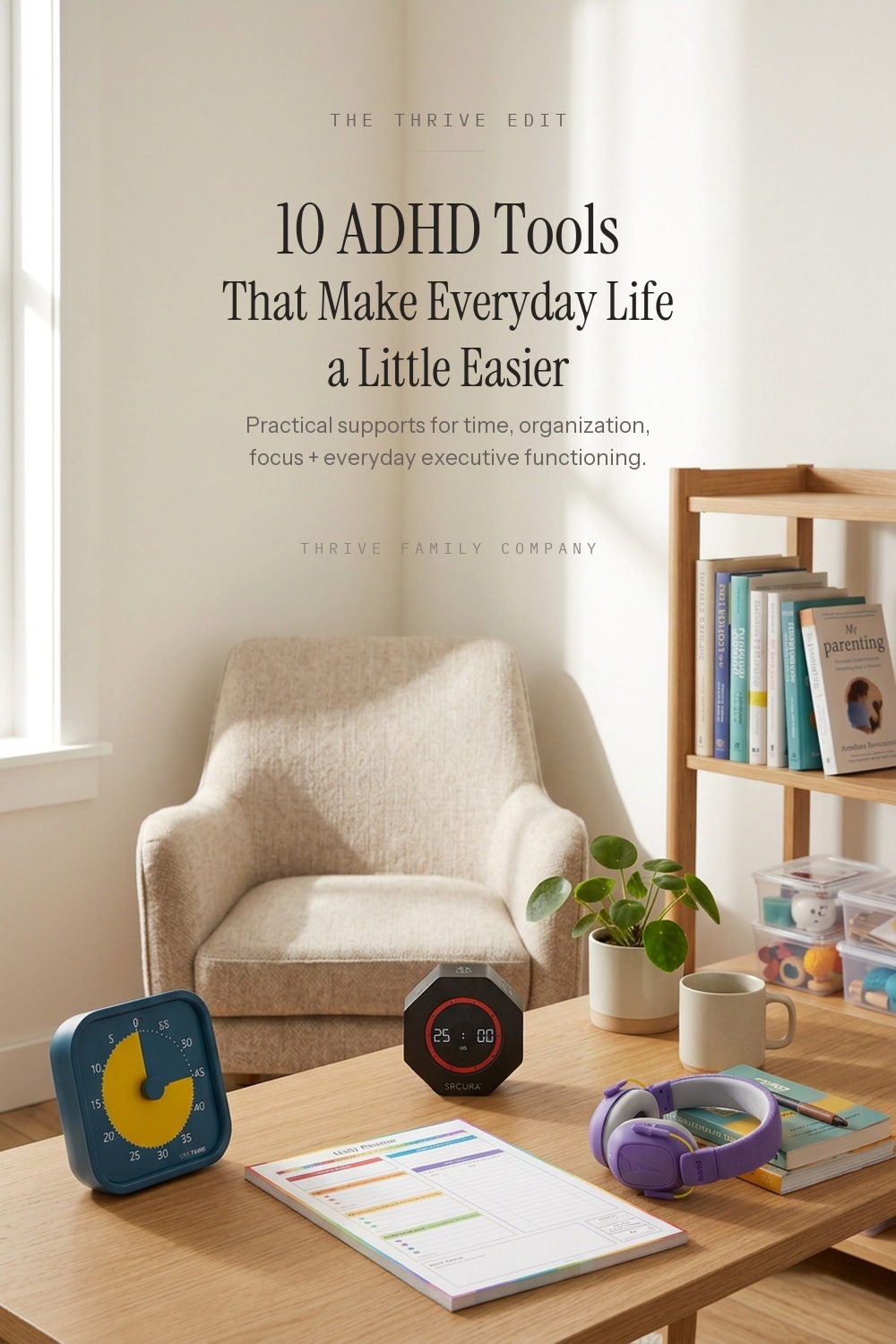
When time feels invisible
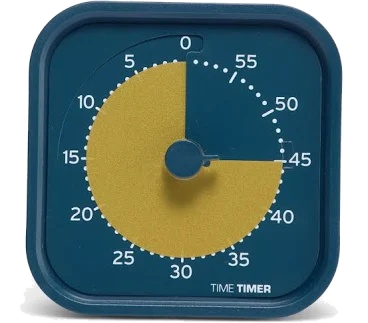
Time is an abstraction. For an absorbed brain, twenty minutes and two minutes feel almost identical until someone announces that it is time to leave — at which point the ending arrives as a shock rather than as something that was approaching.
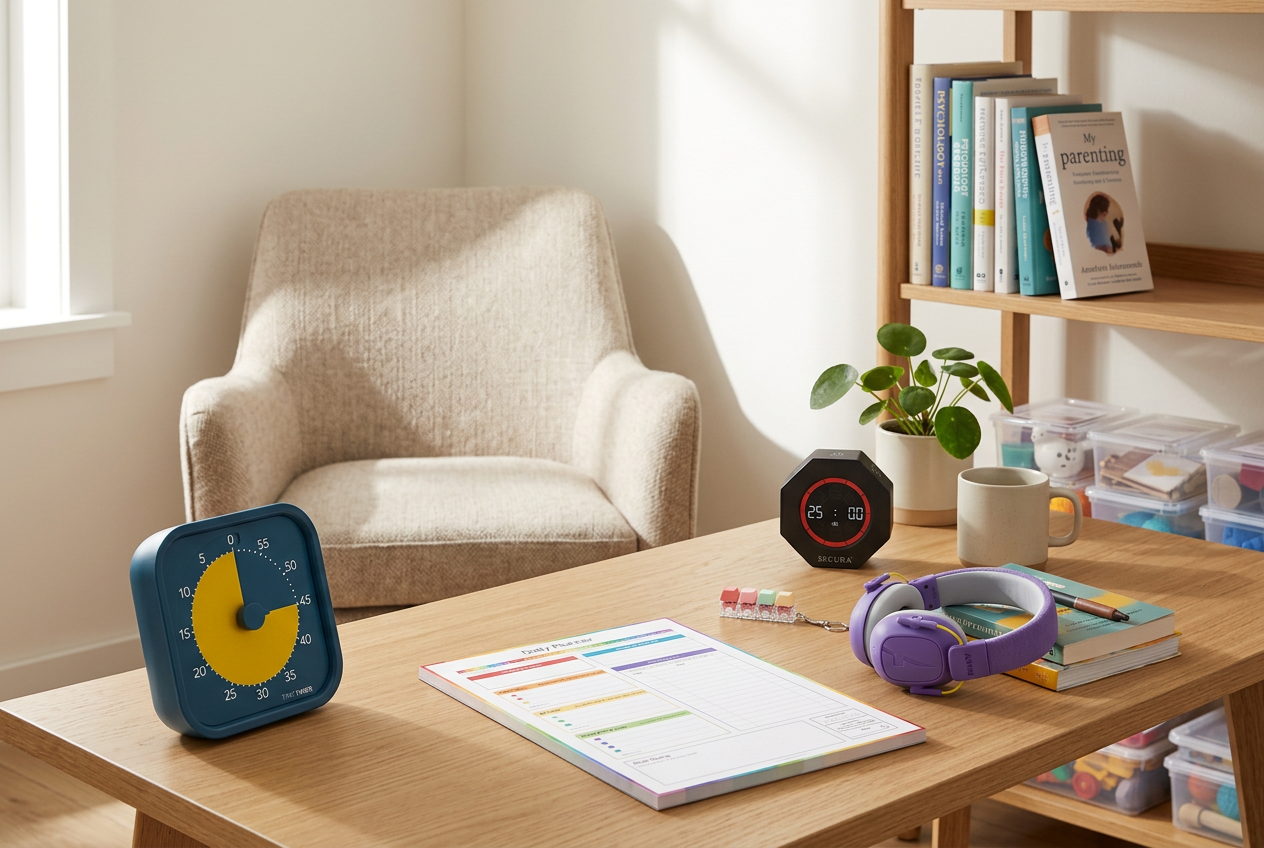
A visual timer turns elapsed and remaining time into something you can see across a room. The child is no longer being asked to estimate time internally while doing something else; the wall does that part.
Time awareness · Transitions · Routines
Set it for the pleasant part, not the unpleasant one. 'The timer is for how much longer you get' lands very differently from 'the timer is how long you have before you're in trouble.' Same object, entirely different relationship with it.
Choose one that is visually simple and readable at a glance from across the room. Multi-function timers with menus and modes add a small executive-function task to a device whose whole purpose is to remove one.
When routines have too many steps
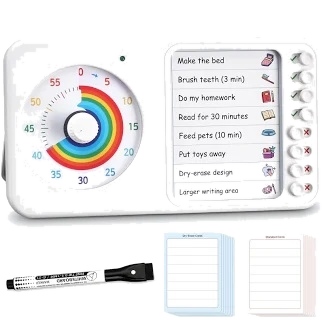
A morning routine sounds like one instruction and is actually eleven. Get dressed, teeth, bag, shoes, lunch, water bottle — each one requires working memory to hold the sequence, sequencing to keep it in order, and initiation to begin the next thing after finishing the last.
A visual routine puts the sequence on the wall instead of in the head. It also changes who the reminder comes from, which quietly removes a great deal of conflict: the board is asking, not you.
Morning routines · Bedtime · Transitions
Start with one routine — the single part of the day that reliably goes wrong. Four or five steps. Not a colour-coded plan for the entire waking day, which almost always ends up as decoration.
Simplicity is the whole design brief. The best visual schedule is not the most thorough one; it is the one still in use in three weeks.
When everything lives in your head
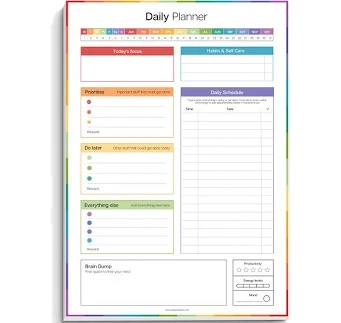
Holding tasks, appointments, priorities and reminders in mind is expensive, and the cost is paid continuously — the brain keeps rehearsing the list so it doesn't lose it, which leaves less capacity for the thing actually being done.
A planner is a place to put all of that down. Written externally, a task stops needing to be held.
Planning · Prioritizing · Remembering
Before filling in anything else, identify today's top three. If nothing else on the page gets written, the day still has a shape.
Avoid elaborate systems for anyone who is already overwhelmed by planning itself. A planner should reduce cognitive load, not become another thing to maintain, fall behind on and feel guilty about.
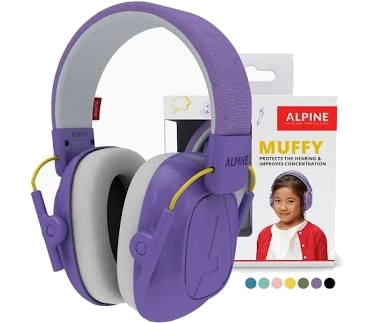
When background noise steals your attention
Attention is not only about what you focus on; it is also about what you manage not to hear. In a busy kitchen, a shared bedroom, a school hall or a train, that filtering job runs constantly in the background and it is genuinely tiring.
Reducing incoming noise reduces the amount of filtering required. That is all it does — and for some people it is the difference between homework happening and homework not happening.
Noisy spaces · Homework · Concentration environments
Make them an available option rather than a requirement. Left within reach on the desk, they get picked up on the days they help and ignored on the days they don't.
Changing the environment is often more useful, and considerably kinder, than repeatedly telling someone to just focus.
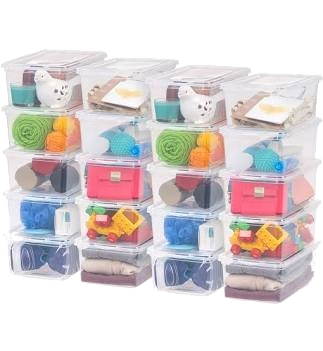
When 'out of sight' really does mean 'out of mind'
Opaque boxes require a mental index: you have to remember what you own, where it went, and which lid it lives under. Visible storage removes that whole layer of remembering.
It also makes tidying up a matching task rather than a decision-making task, which is a much smaller ask at the end of a long day.
Bedrooms · Playrooms · School supplies · Family organization
Organize by broad categories — art, building, sport, school — rather than by dozens of precise ones. Broad categories survive contact with a real Tuesday.
A system that looks perfect but takes eight steps to maintain isn't an executive-function support. It is another demand wearing a nice label.
“Make the environment do some of the remembering.”
It is worth naming the pattern running underneath all of these, because once you can see it you stop needing lists like this one. Supports that help tend to work in the same way: they make time, steps, objects, priorities or expectations more visible. Something that was being held invisibly, and effortfully, becomes something you can simply look at. Everything below does the same job in a different corner of the day.
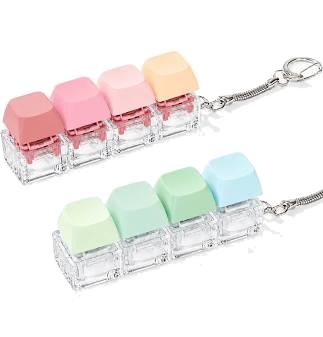
When your hands need something to do
Some people listen, think and wait more comfortably with quiet movement available. Sitting perfectly still can take up attention that would otherwise go to the conversation.
This is genuinely individual. Fidgets help some people and distract others, and the same person may find one useful in a lesson and useless at the dinner table. There is no universal claim to make here.
Quiet movement · Waiting · Listening
Choose one that needs no visual attention, makes no significant noise, and cannot become the main event. If it is being watched or shown to friends, it has stopped being a fidget.
The question isn't 'is this an ADHD fidget?' The better question is whether this particular tool makes this particular task easier for this particular person.
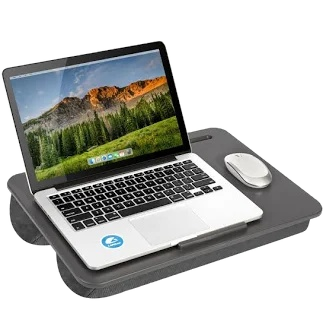
When sitting at a desk just isn't working
The idea that all work must happen upright at a dedicated desk is a convention, not a requirement. For many people, a change of position or posture makes a long task feel possible.
A portable surface simply lets the workspace follow the person — the floor, the couch, the kitchen table — without losing the stable surface the task needs.
Homework · Reading · Flexible work spaces
Let them experiment for a week: desk, floor, couch, somewhere else entirely. Notice together where the work actually gets done rather than where it looks like it should be done.
The goal is successful engagement with the task, not performance of the task in the most conventional-looking posture.
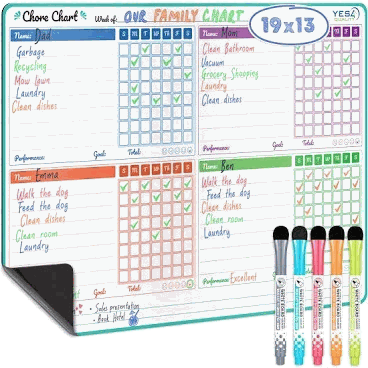
When you keep forgetting the same three things
Recurring routines shouldn't require rebuilding the sequence from memory every single morning. If the same three things are forgotten every week, that is a design problem, not a discipline problem.
A reusable checklist makes the sequence permanent and the progress visible, which also gives the satisfying part: crossing things off.
Morning routines · Chores · Bedtime · Leaving the house
Include only the steps that are genuinely forgotten. Adding 'wake up' and 'eat breakfast' to feel complete makes the list longer and the important items easier to skim past.
A checklist should remove mental work. If maintaining it creates more work than it saves, cut it in half.

When the backpack becomes a black hole
Searching a bag is a small task that happens ten times a day and generates a surprising amount of stress, usually at the least convenient moment.
Predictable locations mean the item can be found without a search — and, more importantly, put back without a decision.
School organization · Teens · Everyday essentials
Assign three broad zones — tech, school, personal — rather than building a filing system. Three is rememberable. Nine is theoretical.
Organization holds when the correct home for an item is obvious and reaching it takes very few steps.
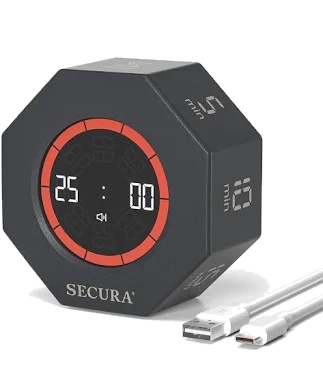
When getting started is the hardest part
Task initiation is often the real barrier, and it is rarely about motivation. An open-ended task has no visible edge, and a task with no edge is hard to walk into.
A defined interval gives the task a shape and an ending. Beginning something that finishes in ten minutes is a much smaller act than beginning something that finishes when it is done.
Task initiation · Work sessions · Study time
Instead of 'finish the whole assignment', try 'let's work on it for ten minutes and then reassess.' The reassessment is real — sometimes the answer is to stop.
Fixed work-and-break intervals suit some people and irritate others; if the interval keeps interrupting good momentum, ignore the method. Reducing the size of the starting commitment is often more useful than trying to increase motivation.
Children do not need a perfect parent. They need a predictable one who returns after hard moments.
Sian Trombley, Canadian Certified Counsellor
What you can try this week
Choose one moment
Pick a single recurring flashpoint this week rather than reforming everything at once.
Name it out loud
Put language to what you notice: “Your body looks like it's had enough of today.”
Repair afterwards
Return once everyone is settled. Repair, not the rupture, is what children remember.
Track it lightly
Note what happened before and after. Patterns show up within about a week.
- Tools are environmental supports, not treatments — none of them change ADHD.
- The useful ones make time, steps, objects or priorities visible outside the brain.
- Start with the one moment of the day that repeatedly goes wrong, not with ten new systems.
- A support only counts as successful if it makes life easier and actually gets used.
Which moment in this article felt most familiar in your own home?
What is one response you would like to change this week?
What support would make that change realistic rather than aspirational?
Printable resources
Recommended Thrive courses
This article is educational and is not a substitute for individual clinical advice. Comments are closed so the Journal stays a calm place to read.
Share this
Keep going
You may also like
Courses, worksheets and pathways from the same part of the library.
- Learning PathwayADHD & Executive FunctioningA guided Learning Pathway from Thrive Family Company.Read
- CollectionADHD & Executive FunctioningEverything Thrive publishes on adhd & executive functioning — articles, courses, worksheets and research.Read
- JournalADHD Burnout in Children Is RealIt is not that they have stopped trying. It is that trying has become more expensive than they can currently afford.Read
- JournalIt Is Not Laziness: Understanding the Motivation MythCapable, bright, and somehow unable to begin. Laziness is the most common misreading in family life — and the most costly. Here is what is really happening, and how to help.Read
- Thrive Resource GuideADHD & Executive FunctioningTherapist-reviewed books, apps, websites and tools for adhd & executive functioning.Read
- WorksheetADHD Homework RoutineAn externalised homework flow, from landing at the door to a real finish lineRead