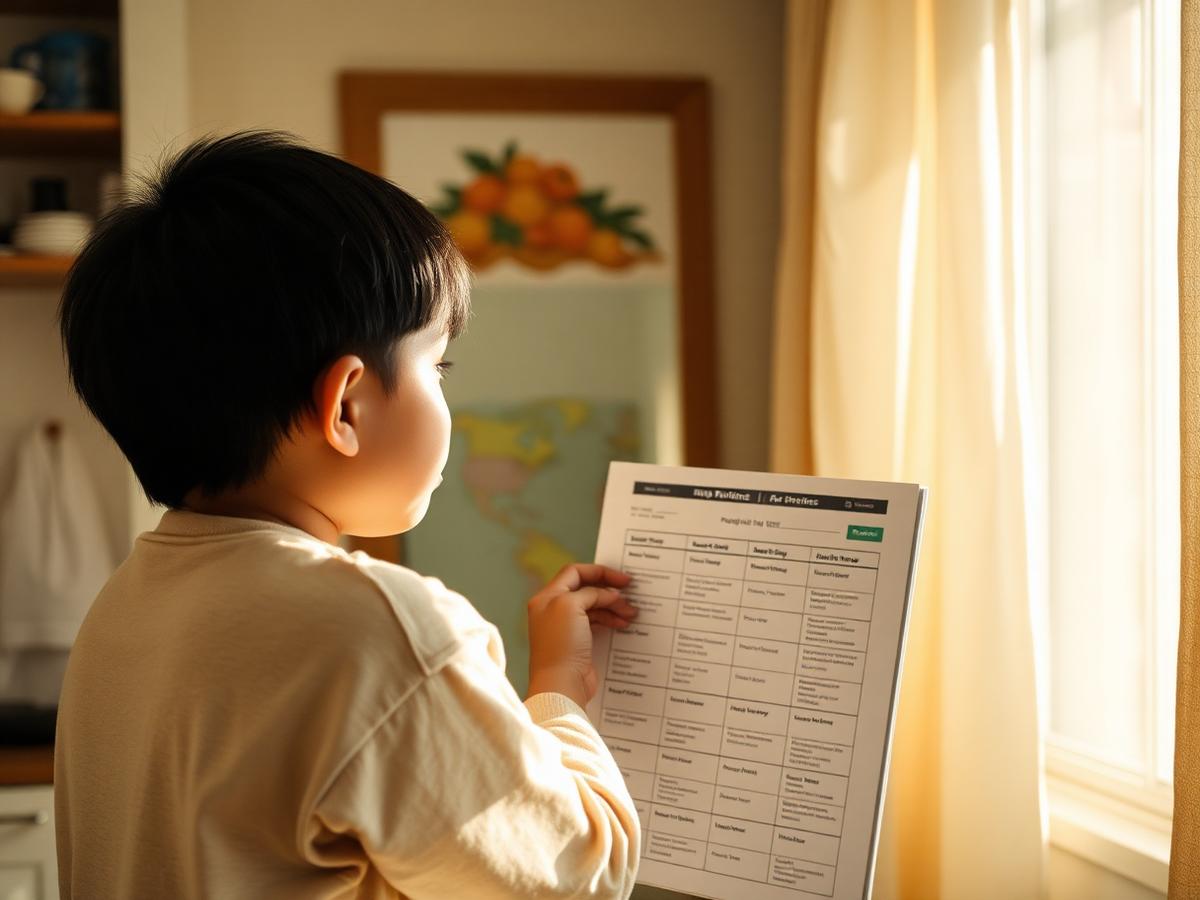
Why "Be More Consistent" Is the Wrong Advice for ADHD Households
Parents of children with ADHD are told to be more consistent more often than almost anyone. The advice is not wrong so much as aimed at the wrong target — here is what to build instead.
Reviewed by Sian Trombley, CCCFounder, Thrive Family Company
13 min read
Best for parents of children who are…
- struggling to start, focus or finish things
- losing track of time, tasks and belongings
- showing behaviour that feels out of character

Share this
Every parent of a child with ADHD has been handed the same sentence, usually by someone with good intentions and no lived experience: 'You just need to be more consistent.' It lands like a verdict. You have colour-coded the chore chart, laminated the routine, set alarms on three devices — and this morning your child still walked past their shoes twice while looking for their shoes.
The advice is not entirely wrong. Consistency does help. But it is usually aimed at the wrong target — the child's willingness — when the actual difficulty lies somewhere much more specific and much more fixable: the gap between knowing and doing.
ADHD is not an information problem
Your child knows the morning routine. They could recite it to a stranger. They know that homework precedes screens, that shoes go by the door, that shouting at a sibling ends badly. Knowledge is intact. What ADHD affects is the set of brain functions that convert knowledge into action at the right moment — what clinicians call executive functioning.
The Air-Traffic Control System
Six skills that mature slowly — into the mid-twenties.
Think of executive functioning as an air traffic control tower for behaviour. In ADHD, that tower is not absent or broken. It is understaffed, especially when the task is boring, the reward is distant, and the day is already long. Researchers describe ADHD as a developmental delay in these functions of roughly 30%, which means a capable, articulate ten-year-old may be operating with the self-management capacity of a seven-year-old. Both of those facts can be true simultaneously.
Why the usual consistency advice misfires
Consistency, as it is usually meant, asks the parent to apply the same expectation and consequence every time, and assumes the child will eventually internalise the pattern. For a neurotypical child that assumption is broadly sound. For an ADHD brain, three things interfere.
- 01Working memory is short. Instructions evaporate mid-journey. A child who forgets is not being defiant; the sentence genuinely left the building.
- 02Motivation is interest-based, not importance-based. The ADHD brain mobilises effort for novelty, urgency, interest and challenge — not for 'because I said so' or 'because it matters in three weeks'.
- 03Consequences work backwards in time only if you can feel the future. Time-blindness makes a Friday consequence nearly meaningless on a Tuesday.
“Stop asking an ADHD brain to hold information it cannot hold. Put the information in the world instead — on the wall, on the timer, on the counter, in the routine itself.”
Build structure outside the child's head
This is the central move, and everything else follows from it. If working memory is the bottleneck, then every instruction that lives only in speech is a bottleneck waiting to fail. Externalising means making the plan visible, physical and unchanging so that the child does not have to generate it each morning.
- 01Make it visual
A five-picture morning strip beats a five-step spoken list every time. Photograph your own child doing each step — ownership dramatically raises compliance. Put it at eye level where the task happens, not on the fridge.
- 02Make time visible
Time-blindness responds to analogue visual timers, not digital clocks. Seeing ten minutes disappear is information; being told 'ten more minutes' is noise.
- 03Shorten the chain
'Get ready for school' is nine tasks. Break it into two or three chunks with a checkpoint between. The chunk length should match your child's actual capacity, not their age.
- 04Reduce the friction
Shoes in one place. Uniform laid out the night before. Water bottle filled. Every gram of friction removed is executive capacity freed for something harder.
- 05Front-load transitions
Transitions are where the ADHD day breaks. Give a two-minute warning, name what is coming, and where possible let the child end at a natural stopping point rather than mid-task.
Motivation: the interest-based nervous system
The most common misreading of ADHD is the assumption of laziness — a child who can focus for four hours on a game but not four minutes on spelling. That contrast is not evidence of choice; it is the defining signature of the condition. The ADHD brain has reduced access to the dopamine signalling that makes ordinary, low-stimulation tasks feel worth starting.
So instead of demanding motivation, engineer it. Four levers reliably increase the chance a task gets started: novelty, urgency, interest and social connection. Almost any dull task can be improved with at least one of them.
- Novelty — change the pen, the room, the order, the music. Rotate the reward before it goes stale.
- Urgency — a visible ten-minute timer creates useful, kind pressure that a distant deadline cannot.
- Interest — let the topic ride in on something they love. Multiplication through football statistics still teaches multiplication.
- Connection — body-doubling (sitting alongside, doing your own work) is one of the most powerful and least used tools available to parents.
Emotional regulation is part of ADHD, not separate from it
Families often arrive expecting to talk about focus and end up talking about rage, tears and tiny slights that detonate an entire evening. Emotional impulsivity is a core feature of ADHD, not an add-on. The same reduced braking system that struggles to inhibit a blurted answer struggles to inhibit a feeling.
The Window of Tolerance
Learning, listening and problem-solving only happen inside the window.
- Over
- Window
- Under
Practically, this means two things. First, no teaching happens above the window — a dysregulated child cannot access strategy, so the only job in that moment is co-regulation. Second, the day's structure is an emotional intervention. Food, movement, sleep and predictability widen the window before the difficult moment arrives.
Common myths about ADHD at home
A realistic week: what 'consistent' should actually mean
Here is the reframe. Consistency in an ADHD household is not about applying identical consequences forever. It is about keeping the environment stable so the child's variable capacity has something dependable to lean on.
The Predictable Evening
Predictability is a nervous-system intervention, not a scheduling preference.
- Same anchors, flexible middle: wake, meals, homework window and bedtime hold; the rest can move.
- One new support at a time, given two weeks before you judge it.
- Repair after ruptures out loud — 'I got loud earlier, that was mine, not yours' teaches more than perfect calm ever could.
- Expect regression at term boundaries, illness and growth spurts. It is not failure; it is load.
- Protect one part of the week that has nothing to do with performance, where your child is simply liked.
No. Medication, where it is appropriate, tends to improve availability for learning — it does not install skills or structures. The best outcomes usually combine medical input with environmental scaffolding and skill-building.
Give any single change two weeks. ADHD brains habituate to novelty quickly, so expect a strong first few days, a dip, and then a truer baseline. Judge it on week two, not day three.
Then make it theirs. Older children respond to phone reminders, whiteboards, sticky notes, or a shared list app. The principle is externalising, not the format.
Name it directly: fair means everyone gets what they need, not everyone gets the same. Then make sure the sibling has something visibly theirs — attention, time, or a support of their own.
Often, yes. Inattentive presentations are under-recognised in girls, who may mask through anxiety, perfectionism and exhaustion rather than visible impulsivity. If your daughter is coping brilliantly at school and collapsing at home, that pattern deserves proper attention.
Consistency is not doing more. It is doing one small thing long enough for it to matter.
Sian Trombley, Canadian Certified Counsellor
What you can try this week
Choose one moment
Pick a single recurring flashpoint this week rather than reforming everything at once.
Name it out loud
Put language to what you notice: “Your body looks like it's had enough of today.”
Repair afterwards
Return once everyone is settled. Repair, not the rupture, is what children remember.
Track it lightly
Note what happened before and after. Patterns show up within about a week.
- The behaviour you are seeing is a nervous system doing its best with the skills it currently has.
- Small, repeated responses change more than one big conversation ever will.
- Your calm is the intervention — regulation is caught before it is taught.
- Avoidance shrinks a child's world; graded practice grows it back.
- Repair after a hard moment matters more than preventing every hard moment.
Which moment in this article felt most familiar in your own home?
What is one response you would like to change this week?
What support would make that change realistic rather than aspirational?
Printable resources
Recommended Thrive courses
This article is educational and is not a substitute for individual clinical advice. Comments are closed so the Journal stays a calm place to read.
Share this
Keep going
You may also like
Courses, worksheets and pathways from the same part of the library.
- ResearchThe Research LibraryPeer-reviewed parenting and child mental health research, translated into plain language.Read
- Thrive GuideThrive GuideAsk a question and get warm, evidence-informed guidance drawn from the Thrive library.Read
- Thrive Care PlanThrive Care PlanA short check-in that turns how your week actually went into one focused plan.Read
- Thrive ToolThrive ToolsPremium printable workbooks and therapeutic tool kits.Read
- CollectionThe Resource LibraryFree printable worksheets, scripts and planners for families.Read
- JournalIt Is Not Laziness: Understanding the Motivation MythCapable, bright, and somehow unable to begin. Laziness is the most common misreading in family life — and the most costly. Here is what is really happening, and how to help.Read