Energy Drinks and the Teenage Night
Caffeine has quietly become the scaffolding of adolescent life. Here is how energy drinks, iced coffees and pre-workout powders interact with an already delayed body clock, anxiety and school performance — and how to renegotiate without a power struggle.
Reviewed by Sian Trombley, CCCFounder, Thrive Family Company
13 min read
Best for parents of children who are…
- finding it hard to settle or stay asleep
- needing extra emotional support at the moment
- going through a change at home or at school

Share this
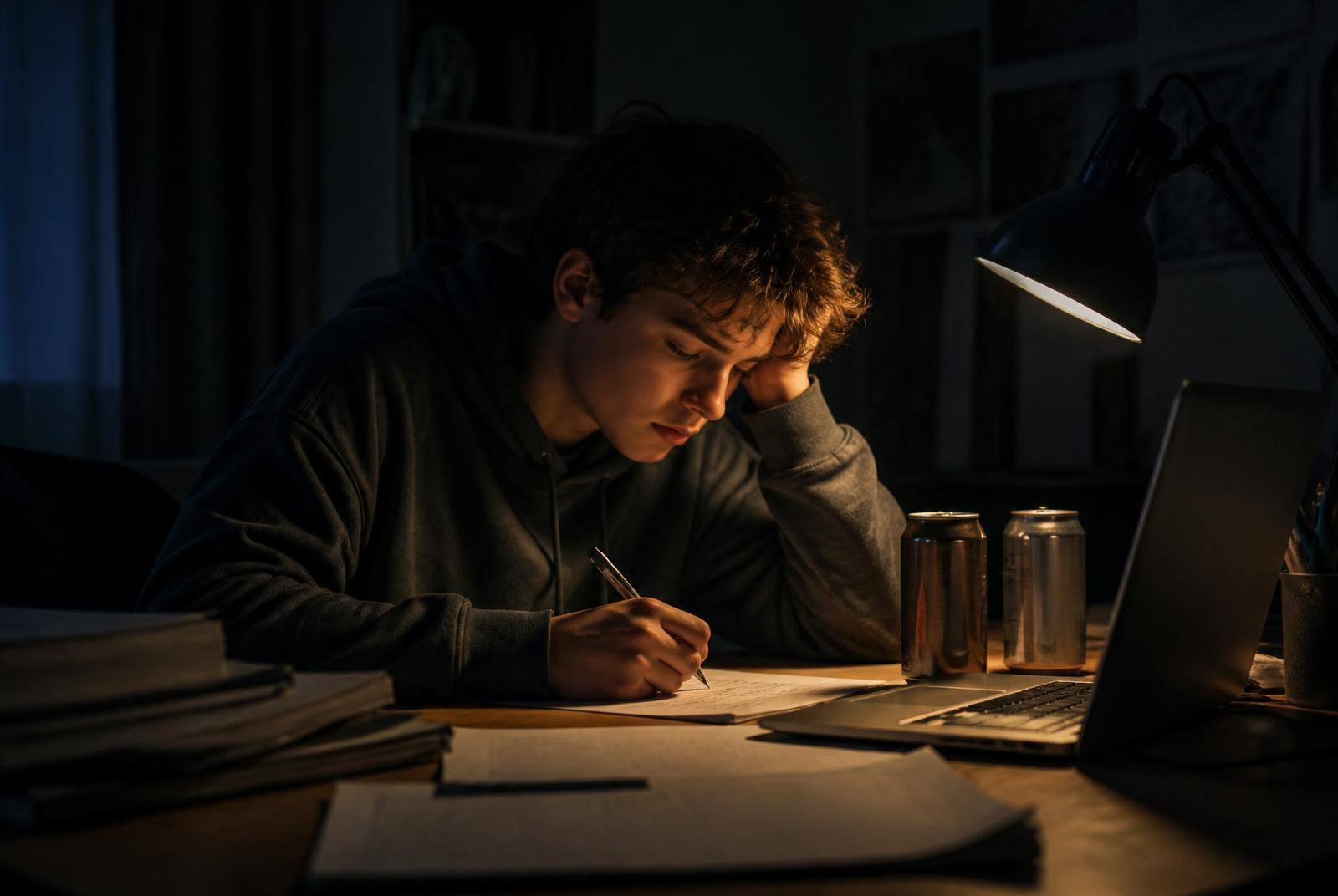
The can sits beside the laptop at 11pm, already half empty. Your teenager insists it is not the caffeine keeping them up — it is the workload, the group chat, the game that will not pause. They may be partly right. But if you traced the day backwards, you would likely find caffeine threaded through most of it: an energy drink at lunch, an iced coffee before practice, maybe a scoop of pre-workout before a match, and now this late can to push through an assignment. None of this makes your teenager reckless. Energy drinks are marketed directly at exactly this life stage — gaming, sport, exam pressure, social belonging — and caffeine is now one of the most normalised substances in adolescent culture. The trouble is that it lands on a body clock already working against sleep, and it can quietly intensify anxiety that looks, on the surface, like ordinary teenage stress. This is not a chapter about banning cans or confiscating pre-workout tubs. It is about understanding what caffeine actually does to an adolescent brain and body at night, and how to renegotiate its place in the day without turning bedtime into a battleground.
Why a 3pm can still matters at 11pm
Caffeine has a half-life of roughly five to six hours in most healthy adults and adolescents, though this varies with genetics, body size and even hormonal cycles. That means a drink consumed at 3pm is still roughly half active in the bloodstream by 8 or 9pm, and a meaningful trace remains well past midnight. A teenager who has an energy drink after school, a caffeinated soda with dinner and perhaps chocolate or a caffeinated pre-workout supplement before an evening training session may be carrying several overlapping doses by the time they try to fall asleep.
Caffeine works by blocking adenosine, the chemical that builds up across the day and creates the pressure to sleep. Block enough of it, late enough in the day, and the brain simply does not feel sleepy at the time it should. This is different from lying awake worrying, though the two often travel together. It is a genuine biochemical delay of the sleep signal, which is why a teenager can feel exhausted and simultaneously wide awake — a state worth naming clearly as the tired–wired cycle.
This is why a teenager who "doesn’t feel tired" until 1am is not necessarily choosing defiance over sleep. Their internal clock may genuinely not be signalling sleepiness yet, and caffeine in their system is actively working against the signal arriving at all. Understanding this mechanism — and explaining it to your teenager in plain terms — tends to land far better than a lecture about discipline, because it describes something happening to them rather than something wrong with them.
The anxiety–caffeine–insomnia loop
Caffeine is a stimulant, and in adolescents — whose stress response systems are still maturing — it can produce or intensify symptoms that closely resemble anxiety: a racing heart, restlessness, a churning stomach, shaky hands, a sense of dread. In someone already anxious, caffeine can amplify physical sensations enough to tip a normal nervous system into something that feels like a panic attack. In someone who is not usually anxious, a large or fast-consumed dose — a big energy drink on an empty stomach, for instance — can still produce a frightening physical experience that mimics one.
The loop tends to run like this: caffeine delays and fragments sleep; poor sleep lowers the threshold for anxiety and irritability the next day; a tired, anxious teenager reaches for caffeine to cope with fatigue and to sharpen focus for school or sport; the next dose again disrupts the coming night. Research on adolescent sleep and mental health has repeatedly shown this relationship runs in both directions — poor sleep worsens anxiety and depressive symptoms, and those conditions in turn disrupt sleep further. Caffeine sits squarely inside that loop, often unnoticed, because the anxiety gets the blame while the drink that fuelled it stays invisible.
If your teenager describes racing thoughts, a pounding heart or a feeling of impending doom in the evening, it is worth asking gently what and when they last drank, before assuming the symptom is purely psychological. Sometimes it is both — genuine anxiety and caffeine intensifying it together — and addressing the caffeine can meaningfully lower the intensity even if it does not resolve the underlying worry.
Hidden caffeine, supplements and sport culture
Energy drinks are the most visible source, but caffeine hides in places many parents do not think to check: pre-workout powders (which can contain far more caffeine per serving than a can of cola, sometimes 200mg or more), certain flavoured waters and sports drinks, chocolate and coffee-flavoured snacks, some over-the-counter headache and cold medications, and caffeinated gum or mints marketed for focus. Pre-workout supplements deserve particular attention because they are largely unregulated for adolescent use, dosing can be inconsistent between batches, and some products combine caffeine with other stimulants whose interactions in a developing body are not well studied.
Gaming and sport are two of the biggest cultural drivers of teenage caffeine use, and they call for slightly different conversations. Gaming-related energy drink use tends to be about staying alert for long evening sessions and fitting into a peer or streaming culture where the drinks themselves are part of the aesthetic. Sport-related use is often framed as performance — a pre-workout scoop before practice, a can before a match — and can carry an implicit belief that more stimulant equals better performance, which is not well supported for adolescent athletes and can backfire through jitteriness, dehydration and disrupted recovery sleep.
- 01Read labels together, once, without judgement
Sit down with your teenager and their usual drinks or supplement tubs and simply read the caffeine content aloud. Comparing a 250ml energy drink to a shot of espresso or a mug of tea is genuinely useful information most teenagers have never seen laid out.
- 02Ask about the pre-workout specifically
If your teenager uses a pre-workout supplement, ask to see the label and look up the per-serving caffeine dose together. Some products exceed recommended adolescent limits in a single scoop. This is a fact-finding conversation, not an accusation.
- 03Separate performance belief from evidence
Gently explore where the idea that "more caffeine equals better performance" came from — often a teammate, coach or influencer. Note that recovery sleep is at least as important to athletic performance as any pre-workout dose, and that jitteriness and dehydration can actively hurt performance.
- 04Agree on one supplement rule
Rather than banning supplements outright, agree on a boundary you can both live with — for example, no pre-workout after early afternoon, or checking new products together before they are purchased.
School refusal and the morning after
The tired–wired cycle often shows up first as a morning problem: a teenager who cannot be woken, who is nauseated or irritable before school, or who increasingly negotiates to stay home. It is worth distinguishing ordinary caffeine-fuelled sleep deprivation from genuine school refusal rooted in anxiety, since the two can look identical at 7am but need different responses. A teenager who is simply under-slept from a late caffeine habit usually perks up once the sleep debt is addressed. A teenager whose refusal persists even on well-rested mornings, or who shows dread specifically about school itself, may be dealing with something the caffeine is only obscuring.
Either way, mornings are rarely the right time to have this conversation. A groggy, caffeine-withdrawing or anxious teenager at 7am has minimal capacity for a calm discussion about habits. Save the conversation for a low-stakes moment — a car ride, a walk, or after a meal — when neither of you needs to be anywhere in the next ten minutes.
The withdrawal week: taper, do not ban
A sudden, total ban on caffeine in a teenager who has been consuming it daily will usually produce a rough few days: headaches, fatigue, irritability and low mood, sometimes mistaken for the original problem getting worse. This is genuine caffeine withdrawal, typically peaking around day two and easing within a week. It is uncomfortable enough that many teenagers abandon the change entirely and return to their previous intake, concluding that "cutting back doesn’t work."
A taper avoids most of this. Reducing total daily caffeine by roughly 25 percent every few days, or swapping one drink at a time for a lower-caffeine alternative, allows the body to adjust gradually with far milder symptoms. This also gives you both time to notice what changes — sleep onset, morning mood, afternoon anxiety — which tends to build motivation for the next step far better than an abrupt cut that mostly just produces suffering.
Notice what the parent does not do: they do not demand full compliance, they do not attach the change to a punishment, and they let the teenager keep one non-negotiable item for now. This preserves the teenager’s sense of control, which matters enormously at this age, while still moving the total daily intake and timing in a healthier direction.
A household caffeine agreement that survives a teenager buying their own drinks
Many teenagers have their own money, their own transport to a shop or vending machine, and increasingly their own judgement about what they consume. A household rule that depends entirely on parental purchasing power — "we simply won’t buy them" — often collapses the moment a teenager can buy their own. A workable agreement needs to be something your teenager helps design and genuinely agrees to, not a rule imposed and then unenforceable.
Useful elements to negotiate together include a rough daily caffeine ceiling, a cut-off time after which no new caffeine is consumed, an agreement to read labels on new products before trying them, and a check-in point — perhaps in a few weeks — to review whether the agreement is working for sleep, mood and school mornings. Frame it as a shared experiment rather than a permanent law: "Let’s try this for three weeks and see how you feel, then adjust it together." Teenagers are far more likely to keep an agreement they helped write than a rule handed down.
When caffeine is masking something bigger
Occasionally, heavy or secretive caffeine use is not really about staying awake for homework or gaming — it is a coping strategy for something underneath. Caffeine suppresses appetite, and a teenager relying on multiple energy drinks instead of meals may be managing disordered eating rather than simple busyness. A teenager using caffeine to power through days despite crushing fatigue, low motivation and flat mood may be self-medicating depression rather than a sleep-timing problem. It is worth watching for these patterns alongside the caffeine itself: skipped meals, marked weight change, loss of interest in previously enjoyed activities, persistent low mood, or using caffeine specifically to avoid feelings rather than to stay alert for a task.
If you notice these signs, the caffeine conversation should widen rather than narrow. Raise your observations directly and with warmth: "I’ve noticed you’re drinking these instead of eating lunch, and I’m more worried about that than about the caffeine itself." This usually calls for support from a family doctor, school counsellor or a regulated mental health professional rather than a household habit-change plan alone.
When to seek medical assessment
Most teenagers who cut back on caffeine feel noticeably better within a week or two: easier sleep onset, calmer mornings, less afternoon anxiety. Some symptoms, however, warrant medical attention rather than a home experiment. Seek prompt medical assessment if your teenager experiences heart palpitations, chest pain, fainting or near-fainting, severe or escalating anxiety with physical symptoms that do not settle, or any chest tightness or breathlessness after consuming energy drinks or pre-workout supplements. These can, in rare cases, signal a genuine cardiac sensitivity to high-dose caffeine or stimulant combinations, particularly in someone with an undiagnosed heart condition. In Canada, call 9-1-1 or attend an emergency department for chest pain, fainting or severe palpitations; do not wait to see if it passes. For ongoing but less acute concerns — ask your family doctor or a paediatric provider for guidance, particularly before your teenager continues using any pre-workout or stimulant supplement regularly.
Renegotiating caffeine with a teenager is rarely a single conversation. It is closer to a series of small, honest check-ins: about the science, about what the drinks are actually doing for them, and about what a fairer trade might look like between the alertness caffeine offers today and the sleep, mood and mornings it may be quietly costing them. Approached with curiosity rather than control, most teenagers are willing partners in that experiment — because, more than almost anything else, they want to feel less tired and less wired, even if they would never quite put it that way.
Children do not need a perfect parent. They need a predictable one who returns after hard moments.
Sian Trombley, Canadian Certified Counsellor
What you can try this week
Track the real caffeine day
For three days, ask your teenager to jot down every caffeinated drink and roughly when it was consumed — including energy drinks, iced coffee, pre-workout, cola and even chocolate or some over-the-counter medications. Most families are surprised by the total and by how late in the day it extends. Do this as shared curiosity, not surveillance; the goal is information, not a case for prosecution.
Name one swap, not a ban
Choose a single realistic change together: moving the afternoon energy drink to lunchtime, switching the pre-workout can for a smaller dose or plain coffee, or capping intake at one drink per day. Let your teenager pick which swap to try first. Small, chosen changes are more likely to stick than an imposed rule that invites secrecy.
Build a caffeine-free wind-down hour
Agree on a cut-off time roughly eight to ten hours before your teenager’s usual bedtime, and pair it with one calming activity in the last hour before sleep — music, a shower, reading or low-key conversation. This targets the whole tired–wired cycle, not just the drink itself.
- Caffeine has a half-life of roughly five to six hours, so an afternoon drink can still be a quarter to half active in the body at bedtime.
- Adolescent circadian rhythms are naturally delayed by puberty; caffeine stacks on top of this and pushes sleep onset later still.
- Caffeine can mimic or worsen anxiety and panic-like symptoms, especially in high doses or on an empty stomach.
- A gradual taper is far more sustainable than an abrupt ban, and prevents withdrawal headaches and irritability from derailing the plan.
- Persistent reliance on caffeine to function can sometimes mask depression, disordered eating or another concern that needs its own attention.
What is the caffeine actually doing for your teenager — energy, focus, appetite control, social ritual, or something else?
Is your teenager’s tiredness a sleep-timing problem, a caffeine problem, or a sign of something else, like low mood or anxiety, that deserves its own conversation?
Are your household rules about caffeine realistic given that your teenager may buy and pay for their own drinks?
Printable resources
Recommended Thrive courses
This article is educational and is not a substitute for individual clinical advice. Comments are closed so the Journal stays a calm place to read.
Share this
Keep going
You may also like
Courses, worksheets and pathways from the same part of the library.
- ResearchThe Research LibraryPeer-reviewed parenting and child mental health research, translated into plain language.Read
- Thrive GuideThrive GuideAsk a question and get warm, evidence-informed guidance drawn from the Thrive library.Read
- Thrive Care PlanThrive Care PlanA short check-in that turns how your week actually went into one focused plan.Read
- Thrive ToolThrive ToolsPremium printable workbooks and therapeutic tool kits.Read
- CollectionThe Resource LibraryFree printable worksheets, scripts and planners for families.Read
- JournalThe Child Who Walks at NightYour child is standing in the hallway with their eyes open, and they are not there. It is frightening to watch, and almost always harmless.Read