Nail Biting and Hair Pulling
Nail biting and hair pulling are often automatic ways of regulating tension, not wilful misbehaviour. A practical guide to reducing shame, identifying patterns and teaching safer replacement responses.
Written by Sian Trombley · BEd, MACP, CCC
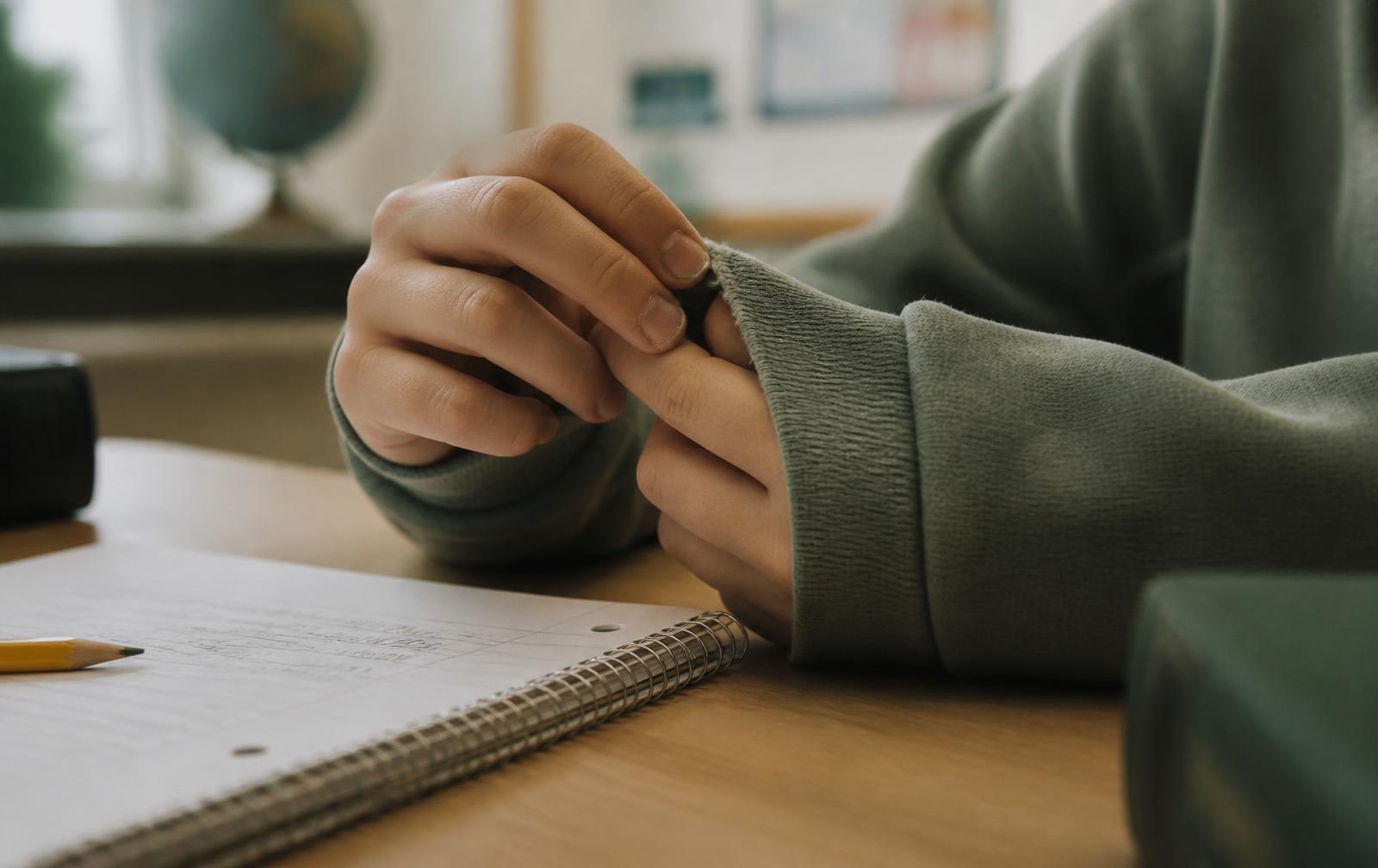
It is 7:40 on a school morning. Your child is searching for a missing worksheet while biting the skin beside one thumbnail. You say, “Please stop chewing,” then hear yourself repeat it before their shoes are on. Later, you notice short hairs on the bathroom counter, or a widening area near the parting. Your child shrugs, denies pulling or says, “I don’t know. My hand just goes there.” You may feel worried, frustrated and uncertain about whether to intervene. Nail biting and hair pulling belong to a broader group known as body-focused repetitive behaviours. These behaviours can be deliberate, automatic or both. They often provide brief relief, sensory satisfaction or help with concentration, which is why a simple instruction to stop is rarely enough. The useful reframe is not “How do I make this behaviour disappear?” but “What is happening before, during and after it, and what skill could fit that moment?” That shift moves your family away from blame and towards a practical, evidence-informed plan.
What the behaviour is doing for your child
Body-focused repetitive behaviours include nail biting, hair pulling, skin picking and biting the lips or inside of the cheeks. They sit on a spectrum. One child may occasionally bite a rough nail without harm; another may repeatedly bite until fingers bleed. Hair pulling may involve scalp hair, eyelashes or eyebrows and can lead to noticeable loss. A behaviour’s seriousness is determined less by how odd it appears than by injury, loss of control, distress and interference with ordinary life.
Some episodes are focused. Your child may describe a building urge, search for a coarse hair and feel release after pulling it. Other episodes are automatic: their hand drifts upwards while reading, gaming, watching television or lying in bed. Many children experience both patterns. “I don’t know” can therefore be accurate rather than evasive. Awareness often arrives only when a parent comments, the finger begins to sting or the child sees hair beside them.
Anxiety can increase these behaviours, but it is not the only explanation. Boredom, fatigue, sensory preferences, perfectionistic grooming, sustained concentration and transitions can all matter. Avoid announcing that your child “must be stressed” whenever you see a hand move. Instead, ask specific questions: “Were you aware of it starting?” “Was there an itch or a hair that felt wrong?” “What were you doing just before?” Their answers may change from one setting to another.
Why punishment and constant reminders fall short
Consequences assume that a child can reliably notice the behaviour and choose differently. That is often the missing skill. Removing screen time after an automatic pulling episode does not create earlier awareness or teach the hands where to go. It may instead add tension, which can increase the urge, and teach your child to pull privately. Likewise, public reminders can make a child monitor your face rather than their own internal and physical cues.
Bitter nail products are sometimes marketed as the answer to nail biting in children. At best, the taste may serve as an immediate awareness cue. It does not address pulling, picking, urges or the need for a competing movement. Some children bite through it; others move to surrounding skin. Never apply a product secretly or as punishment. If your child wants to use one, check age guidance, ingredients and broken-skin warnings, and pair it with skills.
You can still set protective limits. You might say, “I won’t let you use tweezers on your scalp, because the skin is injured,” while offering another grooming activity. Clean wounds, cover damaged fingertips when medically appropriate and arrange dental or medical assessment where needed. The distinction is important: a boundary protects the body; a punishment attempts to make the child regret the behaviour. Protection can be calm, predictable and free of humiliation.
How habit-reversal training works
Habit-reversal training is a structured behavioural approach rather than a demand for willpower. Its central elements are awareness training, a competing response and support for using the skill in daily life. In treatment, these are tailored to the child’s movements and circumstances. Families can borrow the principles gently at home, but significant hair loss, injury or impairment deserves assessment by a clinician trained in body-focused repetitive behaviours.
Awareness training makes a rapid sequence visible. Your child learns to identify early movements, such as scanning fingertips, lifting an elbow, twisting a hair or bringing a hand towards the mouth. They may also notice situations and sensations that predict the behaviour. Practise describing these without asking them to resist at first. A child who can say, “My fingers are searching for a rough bit,” has gained a point at which another response can begin.
- 01Choose one target
Define the action precisely and begin with one setting. “Reduce right-hand nail biting during homework” is easier to observe than “stop all habits.” Ensure your child agrees that this is something they want help with. If they do not, begin with safety, relationship and curiosity rather than surveillance.
- 02Find the earliest sign
Ask your child to demonstrate the movement slowly without completing it. Look for the first detectable step: fingers feeling nail edges, an elbow rising or a hand entering the hair. Also note places, activities and feelings associated with episodes. This becomes the signal for the new response.
- 03Select a competing response
Choose a discreet movement that physically prevents the behaviour for about one minute. Hands may rest flat under the thighs, clasp gently together or hold an object. The response should be safe, socially manageable and sustainable. Avoid painful fist clenching, snapping bands or anything intended to punish the body.
- 04Rehearse when calm
Practise the sequence briefly: notice or imagine the early sign, name it, then use the competing response. Repeat in relevant rooms and positions. Rehearsal matters because the difficult moment is not the best time to invent a skill. Keep practice short and matter-of-fact rather than turning it into a test.
- 05Review and adjust
Track awareness, skill attempts and healing, not only whether the behaviour occurred. If the response is never used, ask whether it is uncomfortable, too visible or introduced too late. A plan that fails offers information. Adjust the environment or response instead of concluding that your child is unmotivated.
A competing response must be incompatible with the specific movement. For nail biting, gently clasped hands or fingertips pressed against the thighs may work. For hair pulling, hands can remain beneath the legs while seated or hold a manageable object. Generic advice to “use a fidget” is not enough: the object must be available in the high-risk setting, occupy the relevant hand and satisfy enough of the sensory need to be acceptable.
Changing the surroundings without policing
Stimulus control means changing predictable cues or access points while new skills develop. Keep a nail file near the homework space so a rough edge can be smoothed rather than bitten. Move tweezers out of a bedroom if they support damaging pulling. A child who pulls while reading might wear their hair in a comfortable style they choose, hold the book with both hands or use finger covers at home. Changes should feel supportive, not like restraints imposed without agreement.
Build a small kit around the actual pattern. It might contain a file, moisturiser for intact skin, plasters, a textured fabric square and a soft object for both hands. Place duplicates where episodes happen rather than expecting your child to remember one kit. Sensory substitutes need experimentation: a smooth stone will not help a child seeking rough texture, and a noisy fidget may be unsuitable in class. Ask what their fingers are looking for.
School support should be discreet and proportionate. With your child’s involvement, a teacher might permit a quiet hand object, provide a nail file through the office or use an agreed private cue. Avoid asking staff to monitor every movement or report daily failures. For teenagers, privacy and consent are especially important. The useful question is not how many adults can watch, but how the environment can support independent skill use without exposing the child to peers.
Expect uneven progress. Automatic episodes may decrease before urge-driven ones, or one setting may improve while another becomes more noticeable. Avoid rewards that require total abstinence, because one early episode can make the entire day feel lost. If you use encouragement, recognise behaviours within your child’s control: completing practice, carrying the kit, accepting a cue, noticing an urge or telling you honestly that a strategy did not work.
When your child needs additional support
Arrange a medical assessment when there is bleeding that will not settle, warmth, swelling, pus, worsening pain or other signs of infection. Dental pain, chipped teeth or jaw concerns linked with biting also need attention. Hair pulling warrants prompt medical advice if your child eats or swallows hair, has abdominal pain, vomiting, persistent constipation, reduced appetite or a swollen abdomen. Swallowed hair can rarely form a dangerous mass and should not be managed only as a habit.
Seek psychological support when there is visible hair loss, repeated skin damage, significant shame, hiding, teasing, avoidance of school or activities, or substantial time spent pulling or biting. Support is also appropriate when your child wants to stop but cannot, or family efforts have become conflictual. A clinician should consider medical and dermatological explanations and explore emotional wellbeing without assuming that every repetitive behaviour represents one particular disorder.
Ask prospective clinicians whether they assess body-focused repetitive behaviours and use habit-reversal training or a comprehensive behavioural model. Treatment should include a detailed functional assessment, practical rehearsal and developmentally appropriate family involvement. For older children and teenagers, private time with the clinician can support honest discussion. Medication decisions require a qualified prescriber; behavioural treatment is generally central, and no medicine should be presented as a universal solution for these varied behaviours.
You do not need to choose between ignoring the behaviour and fighting it. There is a steadier middle path: notice patterns, protect your child’s body, teach one usable response and keep shame out of the room. Change may begin quietly, with a hand pausing halfway to the mouth or your child telling you about an urge they once hid. Those moments are not small. They are the beginnings of awareness, trust and greater choice.
These are not bad habits. They are a nervous system reaching for the nearest available regulation, and shame makes the reaching worse.
Sian Trombley, Canadian Certified Counsellor
What you can try this week
Map one ordinary episode
Choose one predictable period, such as homework or television, rather than watching your child all day. Quietly record the place, activity, hand position, feeling and what happened immediately afterwards. Invite your child’s observations without correcting them. The purpose is to identify one workable pattern, not to calculate failures or prove that the behaviour is constant.
Practise before the urge
At a neutral time, help your child choose a competing response: gently clasping both hands, pressing fingertips against the thighs or holding a textured object. Practise for one minute while chatting about something unrelated. Rehearsal outside the difficult moment makes the movement easier to retrieve when an urge or automatic hand movement appears.
Create a private cue
Ask whether your child wants help noticing and agree on a discreet cue, such as touching your own wrist or saying, “Hands check.” Use it once, neutrally, then step back. Do not repeat it across the room or in front of friends. At week’s end, ask whether the cue helped, irritated or embarrassed them, and adjust together.
- Nail biting and hair pulling are usually reinforced by relief, stimulation or automatic habit rather than defiance.
- Shame, punishment and constant reminders can increase secrecy and tension without teaching a replacement skill.
- Habit-reversal training combines careful awareness with a physically incompatible competing response.
- Changing predictable environments can make the behaviour less automatic while a child practises new responses.
- Pain, infection, hair ingestion, significant hair loss or emotional impairment should prompt professional assessment.
When is the behaviour most likely, and what sensory or emotional need might it be meeting then?
Has your child begun hiding the behaviour because of how adults or peers respond?
What small sign of awareness or skill use could you recognise without making appearance the measure of success?
Printable resources
Recommended Thrive courses

Share this article
This article is educational and is not a substitute for individual clinical advice. Comments are closed so the Journal stays a calm place to read.
Keep going
You may also like
Courses, worksheets and pathways from the same part of the library.
- CollectionBehaviour & Positive ParentingEverything Thrive publishes on behaviour & positive parenting — articles, courses, worksheets and research.Read
- Learning PathwaySupporting Families in a Digital WorldA guided Learning Pathway from Thrive Family Company.Read
- Learning PathwayMindful FamiliesA guided Learning Pathway from Thrive Family Company.Read
- CollectionFriendships & Social SkillsEverything Thrive publishes on friendships & social skills — articles, courses, worksheets and research.Read
- ResearchThe Research LibraryPeer-reviewed parenting and child mental health research, translated into plain language.Read
- Thrive GuideThrive GuideAsk a question and get warm, evidence-informed guidance drawn from the Thrive library.Read