Time Blindness
Why your child genuinely does not know that forty minutes have passed — and what to build instead of nagging.
Written by Sian Trombley · BEd, MACP, CCC
You asked them to get ready at eight. It is now twenty past, they are still in one sock, and when you point at the clock they look genuinely surprised. Not caught out. Surprised.
What time blindness actually is
Time blindness describes an impaired ability to sense the passage of time and to estimate how long things take. It is one of the most consistent findings in ADHD research, and it appears in many children without a diagnosis too, particularly under stress or when deeply absorbed.
The child is not ignoring the clock. They are running on an internal clock that is genuinely inaccurate — sometimes by a factor of three or four. Ten minutes of a favourite game registers as two. Five minutes of a disliked task registers as twenty.
Why reminders make it worse
Every verbal reminder does two things: it briefly restores time awareness, and it adds one unit of friction to the relationship. Twenty reminders a day is twenty small conflicts, and none of them build the missing skill. Externalised time does the same job without the cost.
The systems that work
- 01Visual countdown
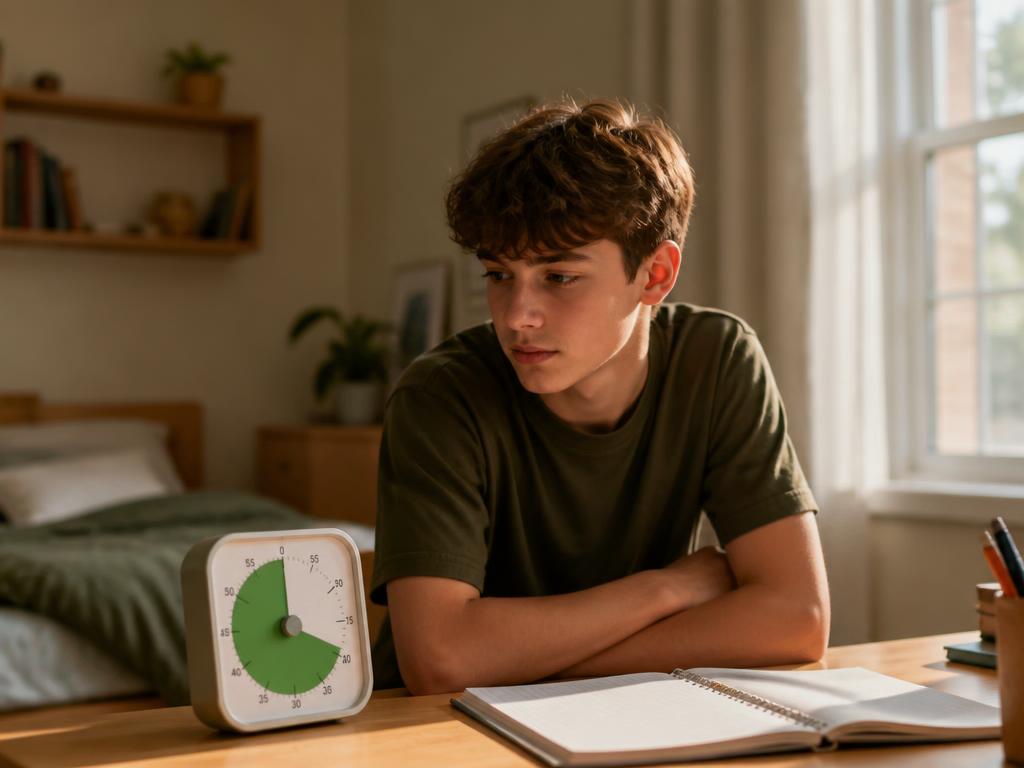
A timer showing a shrinking coloured wedge. Children who cannot feel time can see it.
- 02Named alarms
Not 'alarm 3' — 'shoes and bag'. The label removes the decision from the moment.
- 03Time anchors, not durations
'We leave when the news finishes' beats 'in twenty minutes'.
- 04Two-minute launch rule
Agree the first physical action, not the whole task: open the book, put one shoe on. Initiation is the barrier.
- 05Honest timing audit
Measure the routine for a week. Plan for the real number, not the aspirational one.
When it looks like defiance
The most damaging misreading is that a child who is late is telling you they do not value your time. Some are. Most are simply arriving from a different temporal experience, and being repeatedly told they are inconsiderate builds shame on top of an executive difficulty.
Children do not need a perfect parent. They need a predictable one who returns after hard moments.
Sian Trombley, Canadian Certified Counsellor
What you can try this week
Make time visible
A visual countdown timer or an analogue clock in the room where time goes missing. Digital numbers show a moment; a shrinking wedge shows time passing.
Time one routine honestly
Stopwatch the morning routine for three days. Most families discover the real number is double the assumed one — and that ends a lot of arguments.
Move the reminder off you
Alarms with names ('shoes on'), not a parent's voice. It removes the relationship from the conflict.
- Time blindness is a perceptual difference, not laziness or defiance.
- Internal estimates are unreliable; visible external time works.
- Analogue and countdown displays outperform digital clocks for most children.
- Task initiation, not task duration, is where most of the time disappears.
- Reminders from a parent create conflict; reminders from a device do not.
Am I treating a perception problem as an attitude problem?
Where in our day does time disappear most reliably?
What could hold the reminder instead of me?
Printable resources
Recommended Thrive courses

Share this article
This article is educational and is not a substitute for individual clinical advice. Comments are closed so the Journal stays a calm place to read.
Keep going
You may also like
Courses, worksheets and pathways from the same part of the library.
- ResearchThe Research LibraryPeer-reviewed parenting and child mental health research, translated into plain language.Read
- Thrive GuideThrive GuideAsk a question and get warm, evidence-informed guidance drawn from the Thrive library.Read
- Thrive Care PlanThrive Care PlanA short check-in that turns how your week actually went into one focused plan.Read
- Thrive ToolThrive ToolsPremium printable workbooks and therapeutic tool kits.Read
- CollectionThe Resource LibraryFree printable worksheets, scripts and planners for families.Read
- JournalADHD Burnout in Children Is RealIt is not that they have stopped trying. It is that trying has become more expensive than they can currently afford.Read