When Your Child Calls Themselves Stupid
When a child says “I’m stupid,” the words usually describe a painful moment, not a settled truth. Your response can turn self-criticism into accurate, workable self-understanding.
Written by Sian Trombley · BEd, MACP, CCC
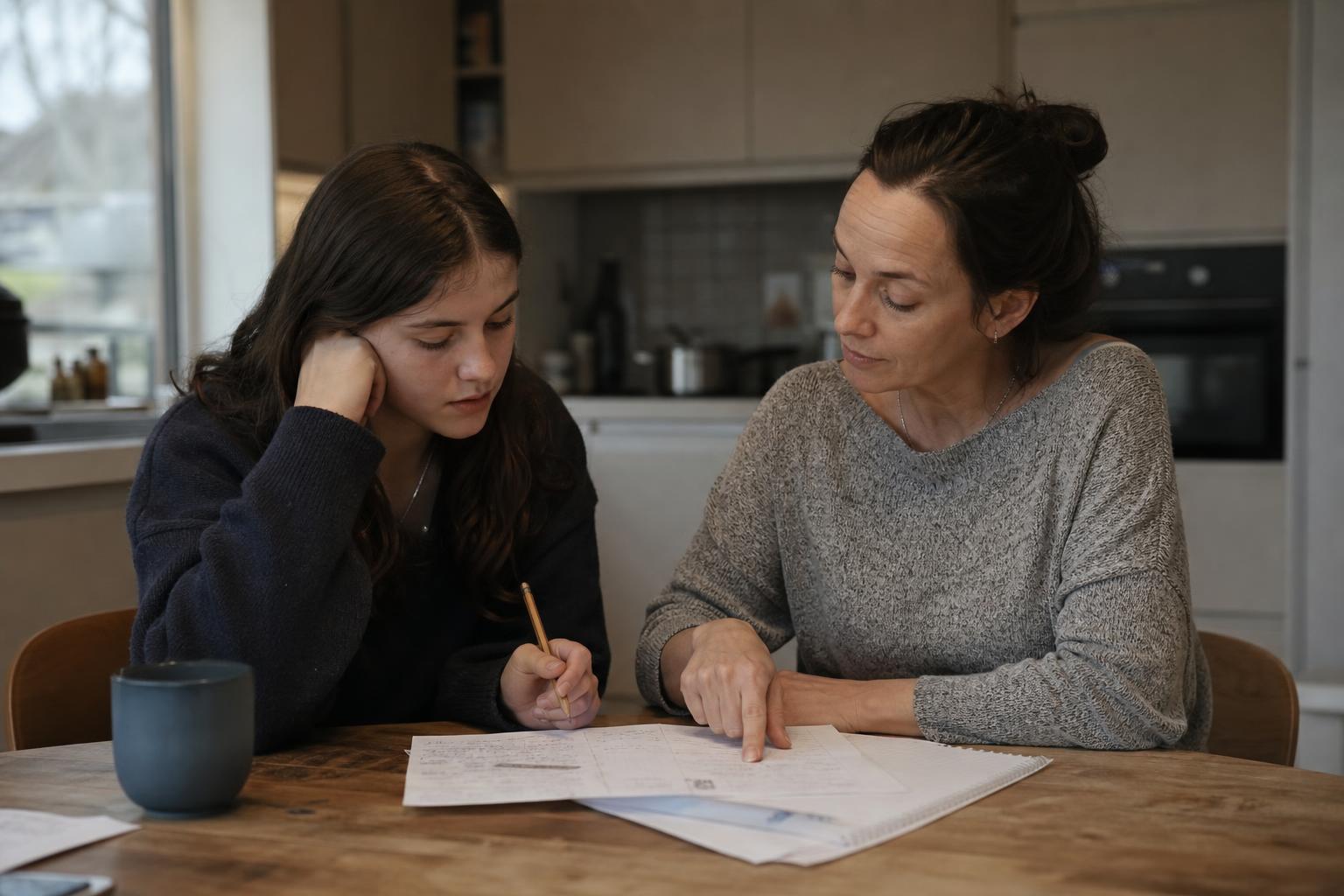
It is 7:42 on a Tuesday evening. Your child has rubbed a hole through the maths worksheet, snapped the pencil lead and pushed the page away. “I’m so stupid,” they say, staring at the table. Your instinct may be immediate: “Don’t say that. You’re so clever.” It comes from love. You want to pull them out of pain and restore what the moment appears to have taken. But your child may hear something different: Mum does not understand how badly this went. Dad needs me to stop feeling this. If I am clever, why can’t I do it? The reassurance can close the door before you learn what “stupid” means tonight. The helpful reframe is this: self-critical talk is not primarily a debate about intelligence. It is communication about distress. Your first task is to understand the experience beneath the verdict; your next is to help your child build a more accurate sentence.
What your child may really be saying
Children use large identity words when they do not yet have precise language for a complicated internal experience. “I’m stupid” may mean, “Everyone else finished,” “I forgot something I knew,” “The teacher corrected me in front of the class,” or “I worked hard and still got a low mark.” For a teenager, it may also mean, “This result threatens the future I imagined.” The statement compresses disappointment, comparison, shame and fear into two blunt words.
Context tells you more than the phrase alone. Notice when it appears, what happened immediately beforehand and how quickly your child recovers. A nine-year-old who says it once while tired may need rest and help with fractions. A 14-year-old who says it daily, withdraws from friends and stops submitting work needs a broader conversation. Ask teachers whether they see the same pattern, while avoiding discussions about your child’s confidence within earshot.
Sometimes self-criticism is protective. If your child declares themselves incapable before trying, failure may feel less surprising. Refusing the task can also prevent classmates from seeing them struggle. This does not make the behaviour manipulative. It means the strategy serves a function, even if it causes problems. You can hold a boundary around homework, attendance or respectful speech while remaining curious about what your child is protecting themselves from.
Why quick reassurance can shut the conversation down
“You’re clever” answers the literal statement while missing the emotional message. If your child feels humiliated, a positive label does not resolve the humiliation. They may argue harder—“No, I’m not”—and you can become trapped in a courtroom exchange where each side produces evidence. The more urgently you insist, the more your child may feel required to defend their negative conclusion. Connection is lost in an argument neither of you can win.
Broad praise can create another problem: it leaves ability feeling like something your child must continually prove. Research by Carol Dweck and colleagues does not suggest that parents should never praise. It suggests that person labels such as “smart” can make setbacks feel like evidence about identity. Feedback is more useful when it notices specific choices, effective strategies, progress, help-seeking and the reality of what remains difficult.
This is not a case for praising effort regardless of outcome. Children can detect empty encouragement, particularly when they have worked hard without improving. “At least you tried” may feel dismissive if the strategy was ineffective or the task was poorly matched to their current skills. A more respectful response is: “You put substantial effort into studying, and the result was still disappointing. Let’s find out whether the study method, the material or the support needs to change.”
How to respond in the moment
Begin by regulating the temperature of the moment. Lower your voice, pause what you are doing and resist delivering a lesson. If your child is highly upset, problem-solving may be inaccessible for a few minutes. You might say, “That was rough. Let’s take a breath before we look at the page.” Some children want closeness; others need space. Ask rather than assume: “Do you want me beside you, or should I give you five minutes?”
Next, validate the feeling without endorsing the judgement. “You feel stupid” is not quite the same as “You are stupid,” but even that phrasing can accidentally strengthen the label. Prefer: “You’re feeling embarrassed because you forgot the answer,” or, “You’re frustrated that this still does not make sense.” Validation means the emotional response is understandable in context. It does not mean every conclusion produced by that emotion is accurate.
Then move from global to specific. Ask one gentle question at a time: “Which part stopped making sense?” “What did you expect would happen?” “What was going through your mind when the teacher returned the test?” Avoid rapid questioning, which can feel like an interrogation. If your child says “I don’t know,” accept it: “All right. We can come back to it. I noticed the instructions had three steps; perhaps we can start there.”
- 01Pause before correcting
Notice your urge to erase the statement. Take one breath and answer the distress first: “Ouch. You sound really disappointed.” A calm opening communicates that difficult feelings are bearable and that your child does not need to hide or intensify them to be understood.
- 02Find the trigger
Ask what happened immediately before the thought. Keep the question concrete: “Was it when you saw the mark, when Sam finished first, or when the instructions changed?” The aim is not to cross-examine your child but to locate the experience that the global label has obscured.
- 03Name the feeling
Offer tentative emotional language: “I wonder if you felt embarrassed and worried you would be the only one who did not understand.” Let your child correct you. Being accurately understood reduces the pressure to communicate distress through increasingly harsh claims about themselves.
- 04Rewrite the sentence
Help turn identity into information: “I’m stupid” becomes “I don’t understand equivalent fractions yet,” “I made two mistakes because I rushed,” or “I froze when I had to speak.” The replacement must be believable. Your child does not need a cheerful thought; they need a fair one.
- 05Choose one next step
Ask what would make the next attempt slightly more manageable: a worked example, a break, quieter space, teacher help or shorter practice. Do not solve every problem at once. A small, relevant action teaches that difficulty can be investigated rather than converted into a verdict on the self.
Building an accurate inner voice
The goal is not inflated self-esteem. Your child will not benefit from being told every performance is excellent, and they do not need to feel confident before doing difficult things. A sturdy inner voice can say, “I am struggling with this,” “I made a poor choice,” or “I need more practice” without adding, “Therefore, I am worthless.” It makes room for accountability, limits and genuine areas of weakness while keeping identity larger than one result.
Model this distinction in ordinary life. If you miss an appointment, avoid saying, “I’m such an idiot.” Try, “I forgot to put it in the calendar. That inconvenienced someone, so I need to apologise and change my system.” Children learn not only from the affirmations directed at them but from the way adults narrate their own errors. Your repair language becomes part of the emotional vocabulary available in your home.
Offer evidence-based feedback rather than a new label. Say, “You checked the instructions after the first attempt,” “You asked for clarification even though you felt awkward,” or, “You practised consistently, but this strategy did not help enough.” Specific observations are easier to trust than “You’re amazing.” They also help your child identify behaviours they can repeat, change or request support for, rather than waiting to feel naturally capable.
When self-criticism needs more support
Take a wider look when harsh self-talk is frequent, intense or spreading across areas of life. Relevant signs include persistent school avoidance, perfectionism that prevents starting, repeated reassurance-seeking, unexplained physical complaints, sleep or appetite changes, withdrawal from friends, loss of pleasure, falling performance or intense distress around mistakes. These signs do not prove a particular condition. They indicate that your child’s coping resources and environment deserve careful assessment.
Begin with collaborative information-gathering. Speak privately with your child and ask what they have noticed. Contact the teacher or school support team to explore workload, peer experiences, instruction and accommodations. If there is a consistent academic difficulty, ask about appropriate screening or assessment rather than concluding that motivation is the issue. A family doctor, paediatrician, registered psychologist or qualified counsellor can help consider emotional, developmental, learning and environmental factors.
Treat comments about death, disappearing, self-harm or having no reason to live seriously. Ask directly and calmly: “Are you thinking about hurting yourself?” and “Are you thinking about suicide?” Asking does not put the idea in a child’s mind. If your child may act soon, has a plan or cannot stay safe, remain with them, reduce access to dangerous items and contact emergency services or your local crisis service immediately.
Your child does not need you to prove that they are brilliant every time they struggle. They need to know that difficulty can be named without humiliation, mistakes can be examined without attacking the person, and support remains available when confidence disappears. Each time you help change “I’m stupid” into a fair description and one workable next step, you are giving them language they can eventually use when you are not in the room.
When a child says 'I'm stupid', they are not asking you to disagree. They are asking whether you can bear to hear it.
Sian Trombley, Canadian Certified Counsellor
What you can try this week
Translate one label
When your child uses “stupid,” “useless” or another global label, pause before correcting it. Say, “That sounds like a really hard moment. What happened just before you thought that?” Then help translate the label into one specific sentence, such as, “I got lost during long division and felt embarrassed to ask.”
Model an accurate recovery
Let your child hear you make a minor mistake without attacking yourself. You might say, “I put the wrong date in the calendar. That is frustrating. I was rushing, so I’ll slow down and check the email.” Keep it natural. You are demonstrating that mistakes can provide information without becoming evidence about a person’s worth.
Make a support plan
Choose one recurring difficulty and identify support before the next attempt. Ask, “Would it help to see an example, work beside me for ten minutes, ask the teacher, or divide it into smaller parts?” Write down the chosen step. A concrete plan makes compassionate language credible because it does not pretend the difficulty has disappeared.
- “I’m stupid” is usually a distress signal or global conclusion, not a reliable assessment of ability.
- Immediate contradiction can unintentionally tell your child that the feeling or experience is not safe to discuss.
- Begin with curiosity and emotional acknowledgement before offering perspective or solutions.
- Help your child replace identity labels with specific descriptions of the task, feeling and support needed.
- Seek additional help when self-criticism is persistent, worsening or accompanied by withdrawal, hopelessness, self-harm talk or major changes in daily functioning.
When my child criticises themselves, do I become reassuring, corrective, worried or impatient?
What specific event, comparison or unmet need might be hidden inside my child’s global label?
How do adults in our home speak about themselves when they make mistakes or need help?
Printable resources
Recommended Thrive courses

Share this article
This article is educational and is not a substitute for individual clinical advice. Comments are closed so the Journal stays a calm place to read.
Keep going
You may also like
Courses, worksheets and pathways from the same part of the library.
- JournalHow to Help a Child With Low Self-Esteem (When Compliments Do Not Land)"You're brilliant" is an opinion. Children with low self-esteem do not need more opinions — they need proof.Read
- JournalThe Cost of Getting It Right: Perfectionism in ChildrenPerfectionism is not high standards. It is the fear of what a mistake will prove about you.Read
- ResearchThe Research LibraryPeer-reviewed parenting and child mental health research, translated into plain language.Read
- Thrive GuideThrive GuideAsk a question and get warm, evidence-informed guidance drawn from the Thrive library.Read
- Thrive Care PlanThrive Care PlanA short check-in that turns how your week actually went into one focused plan.Read
- Thrive ToolThrive ToolsPremium printable workbooks and therapeutic tool kits.Read