Guide
The Question That Gets a Real Answer
Why "how was school?" fails, and the eight questions that work instead.

Share this
- Time in real life
- 2 minutes, once a day
- Ages
- 5–18
- Reading
- 6 min
Reviewed by Sian Trombley, CCCFounder, Thrive Family Company
6 min read
"How was school?" "Fine." It is the most reported conversational dead end in family life, and parents almost universally read it as a closing door — proof that a child is pulling away, or hiding something, or simply not interested in talking to them.
It is almost never any of those things. It is a question that asks a child to summarise six hours, forty social interactions and three difficult moments into one word, at the precise point in the day when they have the least capacity to do it.
The fix is not more warmth. It is a better question, asked at a better moment, from a better angle.
Why the question fails
- It is too large. Summarising a whole day is a sophisticated cognitive task; children default to the smallest answer that closes it.
- It is timed badly. The first fifteen minutes after school is a recovery window, not a debrief window. Most children need food and silence before language.
- It is face-to-face. Direct eye contact raises the stakes of a conversation, particularly for adolescents and for any child who is anxious.
- It is evaluative. "How was it" quietly asks for a verdict, and children who had a mediocre day often do not want to hand you a worry.
Eight questions that actually work
- Who did you sit with at lunch? — concrete, specific, one answer available.
- What was the funniest thing that happened today? — humour is the easiest door into a day.
- Was anyone in trouble? — children love reporting on other people, and it reveals the emotional weather of the room.
- What was the most boring part? — gives a child permission to be negative about something small and safe.
- Who did you help today, or who helped you? — surfaces friendships without asking about friendships.
- If you could change one thing about today, what would it be? — the single most useful question for a struggling child.
- What's something you learned that I probably don't know? — flips the expertise and works remarkably well at eight to twelve.
- Rate the day out of ten. — then, only then: what would have made it one point higher?
The three conditions that matter more than the question
- 01
Side by side, not face to face
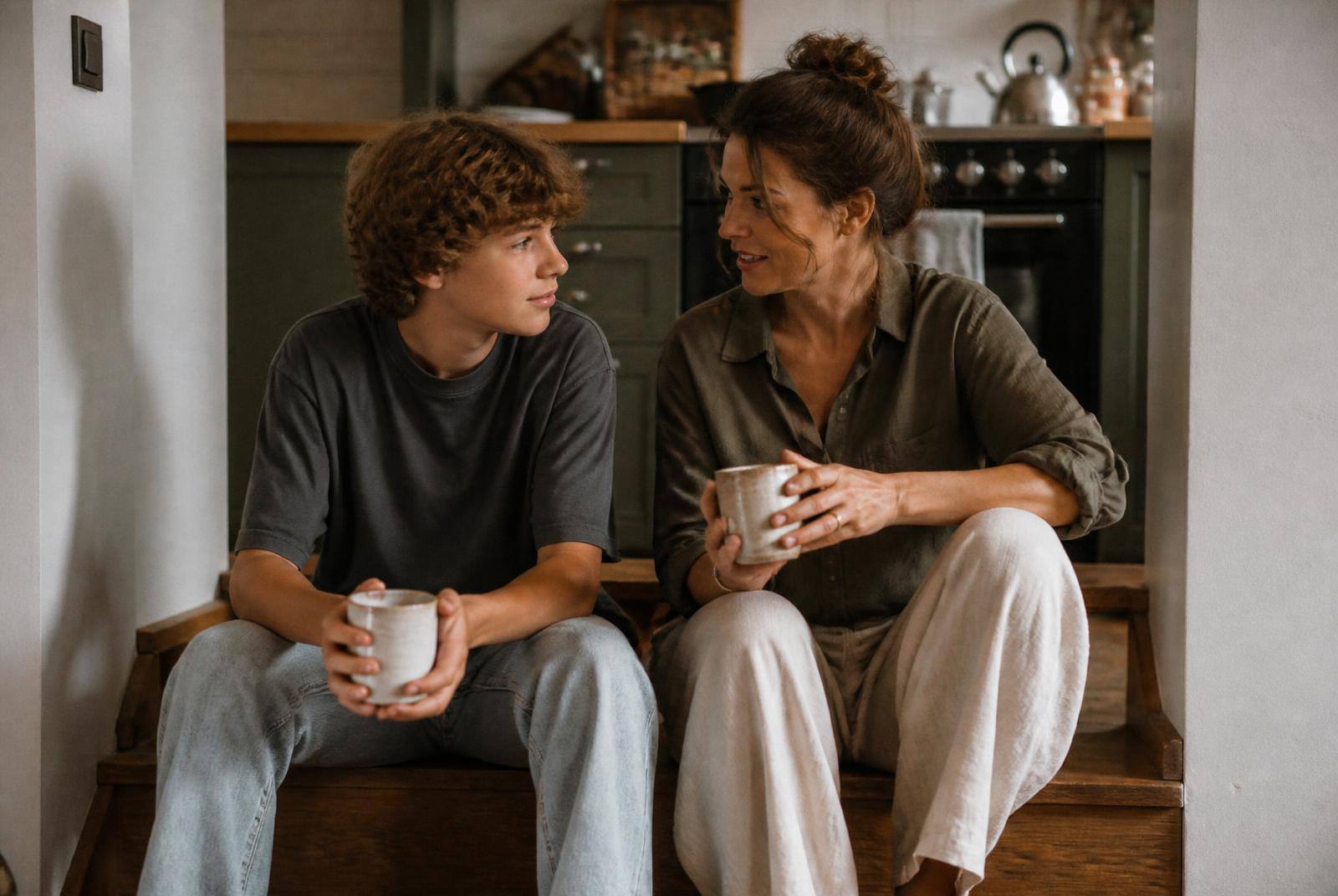
Driving, walking, washing up, sorting laundry, cooking together. Shoulder-to-shoulder conversation is measurably easier for children — there is somewhere else to put your eyes, and either party can stop without it being a rejection.
- 02
Ninety minutes late, not ninety seconds
Most children talk about the day at bedtime or in the car the next morning, not at the school gate. Ask at the gate and you get "fine"; ask at 8pm and you often get the whole thing.
- 03
Answer first
Offer your own small, true, slightly unflattering thing before you ask — the meeting that went badly, the thing you forgot. Modelling disclosure is the fastest way to invite it.
What to do with the answer
This is where most conversations are actually lost, not at the question. A child offers something small and the adult solves it, corrects it, or turns it into a lesson — and the child concludes, accurately, that telling you costs something.
That middle line — help, or just know? — is the most useful sentence in this entire guide, and it works from about age eight all the way through adulthood. It hands the child authority over what happens next, and children who have that authority disclose more.
Children tell you things in the gaps: in the car, at the sink, in the dark. Almost never across a table when asked directly.
Sian Trombley
Try this week
- 01Retire "how was school?" for seven days and notice how often you reach for it.
- 02Ask one specific question, side by side, at least ninety minutes after pick-up.
- 03Offer one true thing about your own day before you ask about theirs.
- 04When something is shared, ask: do you want help, or do you just want me to know?
- 05Leave the silence for five seconds longer than feels natural.
The therapist's perspective
Parents of teenagers often tell me their child never talks any more. When we look closely, the child talks fairly often — in the car, late at night, sideways — and the parent has been waiting for a face-to-face conversation that was never going to arrive.
Take the conversations in the shape they come. The ones that happen at eleven at night, at the end of your energy, are usually the real ones.
Sian
Founder, Thrive Family Company
Share this
Continue in Daily Practices

The Five Senses Pause
A grounding practice short enough to use in a supermarket car park, and concrete enough to work when breathing exercises are refused.

The Morning Send-Off Sentence
The final ten seconds of a morning tend to be spent on reminders. One consistent sentence instead does something a reminder cannot.

The Evening Inventory
A short, structured way to close a parenting day that neither replays every mistake nor pretends it went well.