Routine 01
Start the day · Wake-up to out-the-door
The School Morning
One sequence, run the same way most days, so nobody has to invent the morning at 7am.
- Who it's for
- Ages 5-13, and any household running more than one child out of the same front door.
- When it runs
- Every school morning.
- Approx. time
- 45-60 minutes, flexible. Flexible by design.
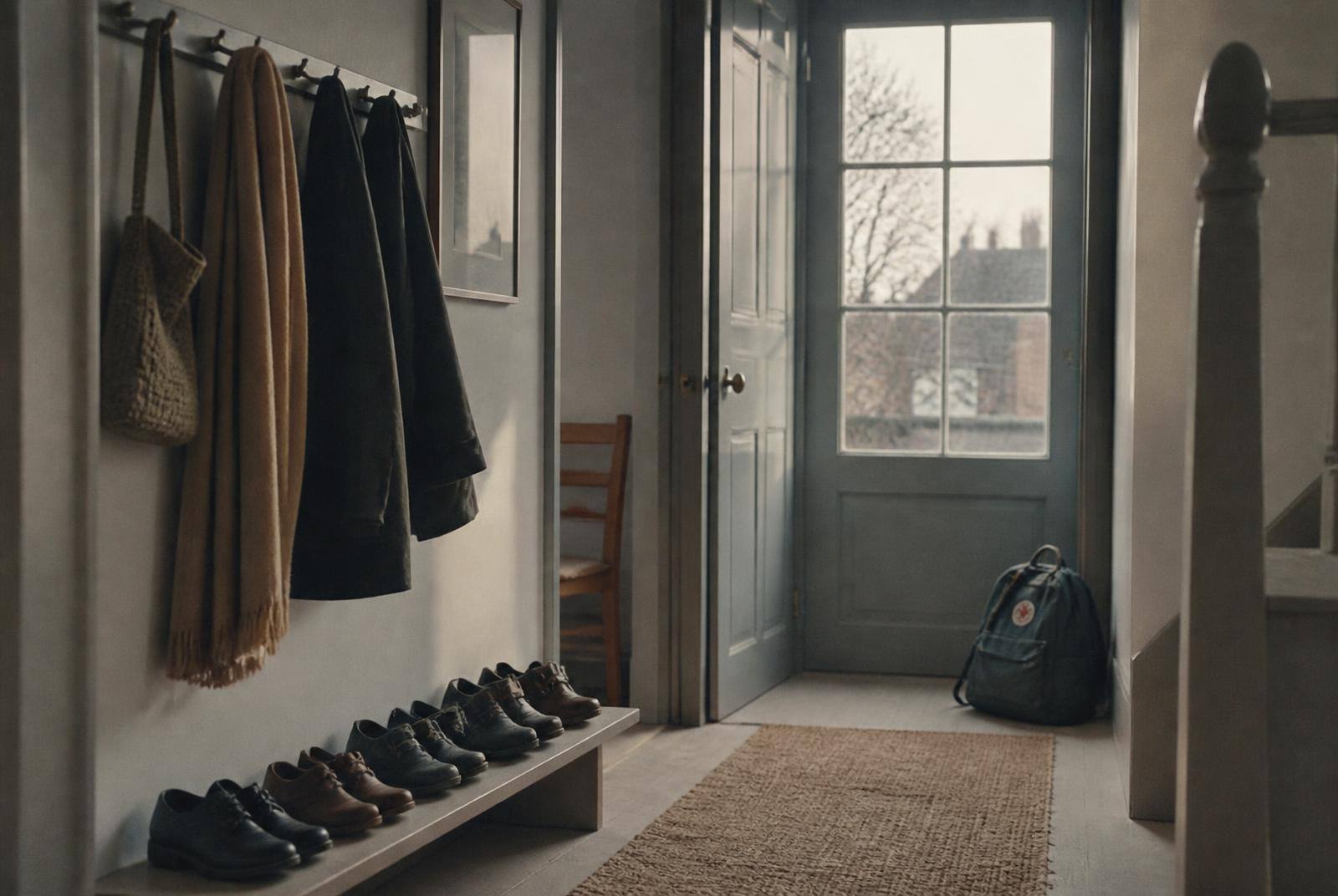
The friction
The first twenty minutes are fine. The last eight are not.
Someone is eating standing up. Someone else cannot find a reading folder.
You have said the same four sentences every day for two years.
Everyone gets in the car slightly angry and slightly late.
Why it breaks down
The morning is rebuilt from scratch each day
In most households the school morning is not a routine at all. It is a set of tasks reorganised on the spot, in a different order, by whichever adult is most awake. Children respond to that by waiting to be told, because being told is the only reliable signal that anything needs doing.
Prompting replaces structure
When the sequence lives in a parent's head, the parent has to speak it aloud every few minutes. That is exhausting for the adult and, for the child, it converts the whole morning into a stream of instructions to resist or tune out.
The exit absorbs everything left undone
Anything not finished by the last ten minutes lands in the hallway at once: shoes, lunch, permission slip, a sudden memory of PE kit. Mornings rarely fail evenly. They fail at the narrowest point.
Set this up first
- Fix one departure time and write it somewhere visible. Not a range. One time, used every day.
- Move as much as possible to the night before: uniform out, bags packed and at the door, water bottles filled, anything that needs signing signed.
- Give every leaving item one home. Shoes in the same place, bags in the same place, keys in the same place.
- Agree breakfast options the night before so nobody makes a food decision under time pressure.
- Put a clock in the room where the delay usually happens, not just in the kitchen.
The sequence
T-55
Wake, light, and no requests yet
Curtains open, a few minutes of nothing being asked. Children who wake into a list tend to start the day already braced.
T-45
Dressed before downstairs
Clothes are already out from last night, so this step is putting on rather than choosing. Keep the order identical each day; sameness is what eventually makes it automatic.
"Uniform first, then breakfast. Same as always."
T-35
Breakfast, sitting down
Ten quiet minutes at the table does more for the pace of the morning than any amount of chivvying. Sit with them for part of it if you can.
T-20
Teeth, face, hair
Group the bathroom jobs into one block rather than scattering them. One trip, three tasks, done.
T-10
The self-check
Children name their own four items rather than being read a list. Retrieving beats being told, and it shows you where the gap actually is.
"Tell me your four before you get your shoes."
T-5
Shoes, coats, launch point
The last five minutes belong to leaving, not to searching. If something is genuinely missing, it goes unfound and is solved after school.
T-0
Out on the same words
Choose one closing line and use it every day, whatever kind of morning it was. A fixed line stops carrying tone.
"Have a good one. See you at pick-up."
When it doesn't work
It works for one child and not the other.
Stagger rather than parallel-run. Wake the slower starter fifteen minutes earlier and let the faster one have the bathroom first. Most sibling morning conflict is a queueing problem wearing a behaviour costume.
Everyone is on time but the mood is terrible.
That is worth taking seriously. Move one task to the night before and start five minutes earlier for a week. Tone is usually a symptom of compression rather than attitude.
The night-before prep stops happening.
Attach it to something that already happens reliably, like straight after dinner or immediately before screens go off. Prep that floats free of an anchor quietly disappears within a fortnight.
Make it yours
Younger children
Draw the sequence in four pictures and put it at their eye level where the stalling happens. Point at it instead of repeating yourself.
Tweens
Hand over one block completely, usually the bathroom block. Ownership of a real piece of the morning reduces the sense of being managed.
ADHD or executive functioning
Shorten the chain and add a checkpoint mid-way. See the ADHD Morning for the full version built around working memory and time blindness.
What to say
Instead of
"Hurry up, we're going to be late again."
Try
"Ten minutes until the door. You're on shoes."
Urgency without information tends to raise the temperature. A time plus a next step gives the child something to act on.
Instead of
"How many times do I have to tell you?"
Try
"Check your four."
Short, repeatable, and it asks them to retrieve the list rather than receive it again.
Instead of
"You've made us late."
Try
"That was a rough one. We'll try starting the bags after dinner tonight."
Keeps the problem attached to the system rather than the child, which is the only version anyone can fix.
The minimum viable routine
Slept badly, someone is unwell, everything is behind. This morning, keep:
- 01Something to eat, even standing up.
- 02Dressed and bags in hands.
- 03One warm sentence before the door.
Late and calm is a better outcome than on time and shouting. Tomorrow can go back to the full sequence.
Try it for a week
Pick the parts that look most useful and run them for seven days. Then look at what actually happened:
- Which step needed the fewest reminders by Friday?
- Where did the morning actually run out of time?
- Did the night-before prep hold, or did it slide?
- What can you drop entirely without anything going wrong?
Then adjust. The aim is not adherence to the sequence; it is a rhythm that makes this part of the day easier to run.
Thrive printable
Morning Routine Chart
A visual version of the sequence to put where the delay usually happens.
Included with Premium
Download the printable →Keep this line
A good morning is not a faster morning. It is a morning where nobody has to be told what happens next.
A note from Sian
Most families arrive at this wanting their children to move quicker. Speed is rarely the lever. What changes school mornings is making the sequence predictable enough that it stops depending on a parent's voice.
Give it two weeks before you judge it, and measure the tone rather than the clock.
Thrive Routines are psychoeducational family wellbeing guidance. They are not therapy, diagnosis or medical advice, and they are not a substitute for support from a professional who knows your child.