Routine 02
Start the day · ADHD mornings
The ADHD Morning
A morning built for a brain that cannot hold a five-step instruction at 7:40am.
- Who it's for
- Ages 6–14. ADHD, executive-function differences, or any child who stalls between tasks.
- When it runs
- Every school morning. Forty minutes, front-loaded the night before.
- Approx. time
- 40 minutes, front-loaded the night before. Flexible by design.

The friction
You have asked about the shoes three times.
They are not refusing. They are standing in the hallway, genuinely blank.
You raise your voice at 7:52 and feel terrible about it by 8:10.
By the time the car door shuts, both of you have already used up the day's patience.
Why it breaks down
Working memory runs out before the list does
"Shoes, teeth, bag, coat" is four items held in a system that, for many children with ADHD, holds one at a time under pressure. What looks like ignoring is often the second instruction quietly falling out on the way to the first.
Time is invisible
A child who cannot feel the difference between four minutes and fourteen is not being casual. Without an external clock they are navigating the morning with no dashboard, relying on your voice to tell them how urgent things are — which is why urgency arrives as alarm rather than information.
The transitions cost more than the tasks
Getting dressed is not hard. Stopping one thing and starting another is hard, and a school morning contains six or seven of those hinges. Most families work on speed when the useful lever is reducing the number of starts.
Set this up first
- Everything that can be decided the night before is decided the night before: clothes out in one pile, bag by the door, shoes in the same square metre every day.
- One visible clock in the room where the stalling happens. Analogue is easier to feel than digital.
- A short written or drawn sequence, at the child's eye level, in their words. Four steps maximum.
- Breakfast that does not require a decision. Choice at 7:30 is a tax nobody can afford.
The sequence
T-40
Wake, then ten minutes of nothing being asked
No instructions in the first ten minutes. Light on, curtains open, a drink. A brain that starts the day being managed spends the rest of it resisting management.
T-30
Body first, tasks second
Dressed and washed before anything else, in the same order every day. The pile of clothes from last night removes the choosing step entirely.
"Clothes are on your chair. I'll be in the kitchen."
T-22
Breakfast, sitting down, with you nearby
Sit at the table for part of it if you can. Proximity does more for the pace of a morning than any reminder does.
T-12
The single checkpoint
One check, not a running commentary. Ask them to name the four things from the list rather than listing them yourself — retrieving beats being told, and it shows you where the gap actually is.
"Run me through your four."
T-5
Shoes and coat by the door, timer visible
The last five minutes belong to the exit, not to finding things. If something is missing at T-5, it goes in the bag unfound and gets solved after school.
T-0
Leave on a neutral line
Whatever the morning was, the last sentence before the door is not a summary of it. Pick a fixed line and use it every day so it stops carrying tone.
"See you at half three. Nothing to prove today."
When it doesn't work
They do the first step then disappear.
Shorten the chain. Two steps, then a check-in, then two more. The routine is not failing — it is longer than their current capacity, and capacity grows with successful repetitions, not with longer lists.
It works for four days then collapses.
Expect this. Novelty carries a new system for about a week; after that the structure has to carry it. Keep the sequence identical and let the boredom of sameness do the work.
Medication has not kicked in yet.
Plan the morning for the unmedicated brain, not the afternoon one. If a dose lands at 8:30, nothing before it should depend on sustained attention.
Make it yours
Younger children
Draw the sequence instead of writing it and put it where the stalling happens, not on the fridge. Four pictures, in order, at their height.
Teens
Hand over the clock. They set the alarms, you agree the single fixed departure time, and you stop being the human reminder. Being late once is a better teacher than being nagged eighty times.
Two or more children
Stagger the wake times by fifteen minutes rather than running parallel mornings. Bathroom collisions cause more escalation than slowness does.
When you have no capacity today
Run only T-5 and T-0. Everything else can be uneven if the exit is calm.
What to say
Instead of
"Shoes, teeth, bag, coat — go!"
Try
"First thing: shoes. Then come and find me."
One instruction at a time is not babying them. It is matching the list to what working memory can hold under pressure.
Instead of
"We're going to be late, hurry up!"
Try
"It's twenty to. Where are you up to?"
Time as information rather than alarm. Alarm slows most children with ADHD down.
Instead of
"Why do we do this every single morning?"
Try
"Run me through your four."
Asking them to retrieve the sequence builds the thing that is missing. Repeating it for them does not.
The minimum viable routine
Bad night, late start, nothing in the tank. This morning, keep:
- 01Something in their stomach.
- 02Shoes and bag in hands.
- 03A neutral line at the door.
Skip the checkpoint, skip the timer, skip the conversation about yesterday. Getting out without a row is the whole job today.
Try it for a week
Pick the parts that look most useful and run them for seven days. Then look at what actually happened:
- How many times did you have to prompt at each step?
- Which step consistently fell apart, and is it the step or the order?
- Did the night-before prep actually happen?
- What could be moved to the evening permanently?
Then adjust. The aim is not adherence to the sequence; it is a rhythm that makes this part of the day easier to run.
Thrive printable
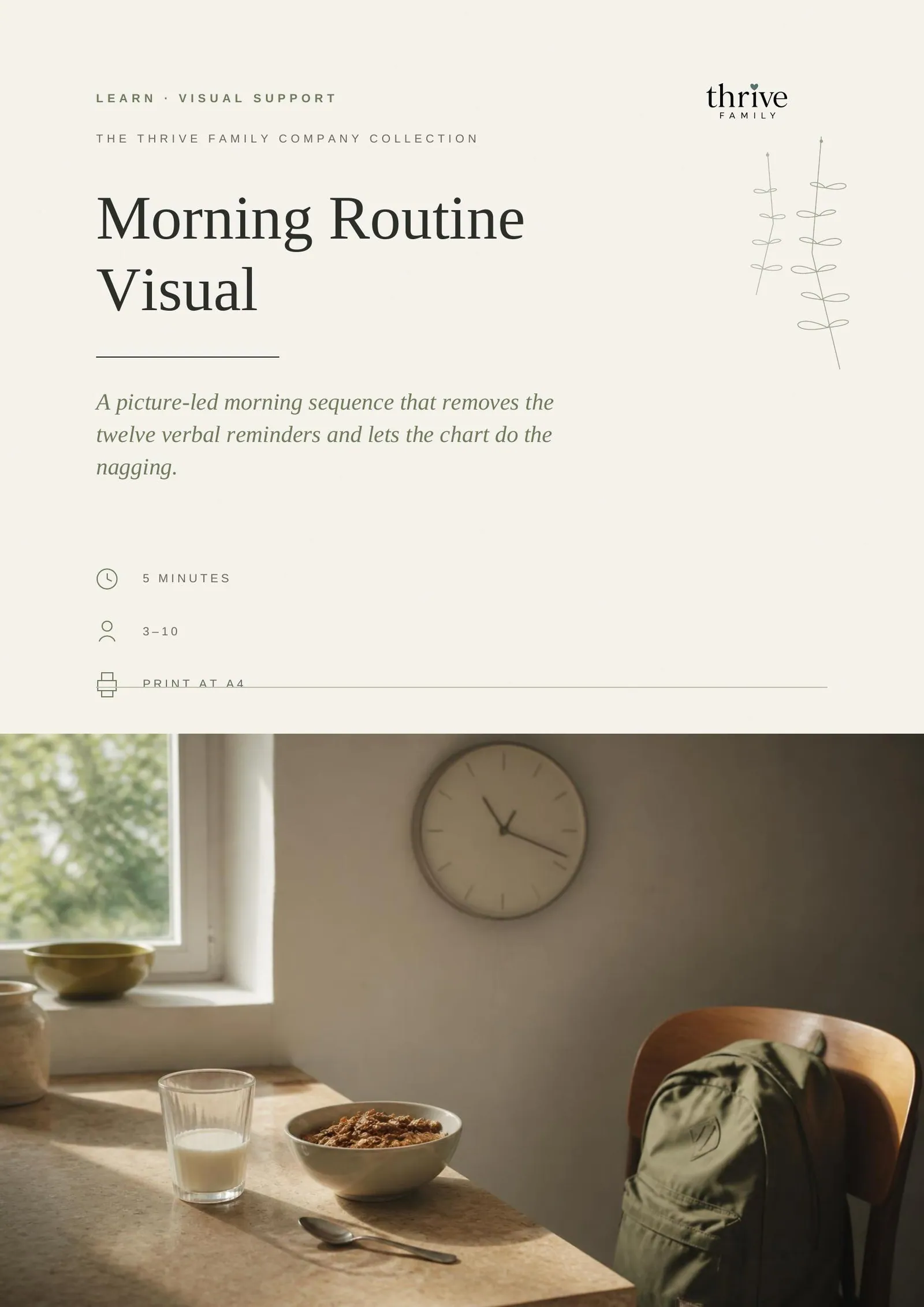
ADHD Morning Visual Routine
The sequence in pictures, at their eye level, where the stalling happens.
Download the printable →Keep this line
A morning that works is not a faster morning. It is a morning with fewer decisions in it.
A note from Sian
Families often arrive at this convinced their child needs more motivation. Almost none of them do. What changes ADHD mornings is lowering the cognitive price of each step until the sequence can run without a parent narrating it.
Give it three weeks before you judge it, and measure the right thing: not whether you left on time, but whether anyone shouted.
Thrive Routines are psychoeducational family wellbeing guidance. They are not therapy, diagnosis or medical advice, and they are not a substitute for support from a professional who knows your child.