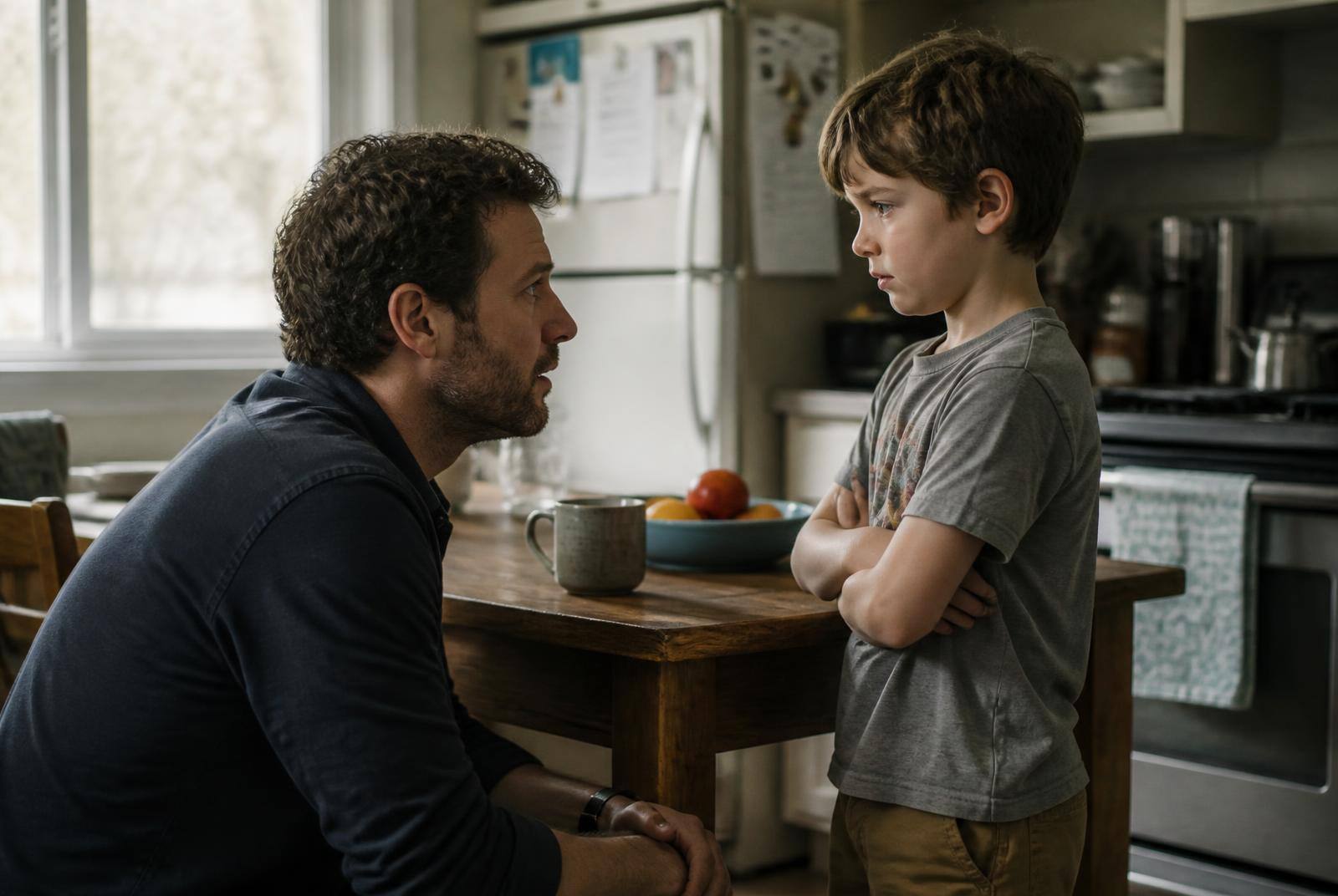
How to Help Children Solve Their Own Arguments
Children learn to handle conflict not when adults disappear, but when we replace judging and rescuing with calm, structured coaching.
Reviewed by Sian Trombley, CCCFounder, Thrive Family Company
10 min read
Best for parents of children who are…
- clashing with a brother or sister
- needing extra emotional support at the moment
- going through a change at home or at school

Share this
The argument began with a charger. Twelve-year-old Lina said she had been using it. Her 15-year-old brother, Marcus, said it belonged in the kitchen and pulled it from the wall. By the time their father arrived, Lina was shouting, Marcus was holding the charger above his head, and both were presenting evidence at courtroom speed. “Tell him to give it back.” “Tell her she can't claim everything.” Their father felt the familiar pressure to reconstruct the scene, identify the offender, and issue a ruling. But even when he produced a technically fair decision, the next argument arrived with the same demand: You decide who is wrong. That evening, he tried something different. He stopped the taunting and separated the children long enough for their bodies to settle. When they returned, he did not ask, “Who started it?” He said, “I will help you make this safe and fair, but you two are going to help build the solution.” This is the central shift when we want to help children solve arguments: the parent stops being the permanent courtroom judge and becomes a temporary conflict coach.
Why “work it out yourselves” usually fails
Children do not automatically know how to negotiate because an adult tells them to. In a heated moment, “Work it out” may sound like abandonment to the child who feels hurt, or permission to dominate to the child with more confidence, age, size, or verbal skill. Independence needs a bridge.
Conflict activates the brain's threat-detection systems. Heart rate rises, muscles prepare for action, and attention narrows around danger and injustice. A child may become intensely focused on proving a sibling wrong while losing access to flexible thinking. This is why an otherwise thoughtful 11-year-old can repeat, “But it was mine,” without being able to imagine a next step.
The first task is therefore not agreement. It is enough regulation for thinking to return. Use fewer words and a lower voice: “Pause. Put the controller down. You take the sofa; you take the chair. We will talk when voices are steady.” This is not the silent treatment or a punishment disguised as a break. It is a brief interruption of escalation.
Move from referee to mediator
A referee gathers evidence and declares a winner. A mediator protects the process so the people in conflict can understand the problem and shape a workable agreement. Parents need both roles, but many everyday arguments benefit from mediation.
Begin with a boundary that makes participation possible: “I won't let either of you grab, threaten, block the doorway, or call names.” Then describe your role: “I am not choosing a winner. I will make sure each person is heard, and I will help you find a fair next step.” A fair solution does not have to make both children delighted. It needs to protect essential needs and be something each child can genuinely accept.
Try not to conduct an exhaustive investigation when the central facts are already clear. Arguments about who touched what first can consume all the energy needed to solve the actual problem. You might say, “You remember the beginning differently. I may not be able to settle that part. I do know you both want to use the same space without your things being moved. Let's solve that.”
Neutrality does not mean pretending harmful behavior is acceptable. You can acknowledge both perspectives and still set a firm limit: “I understand that you felt excluded. Posting an embarrassing photo was not a safe way to handle that. The photo needs to come down, and then we will address the exclusion.” Understanding explains behavior; it does not erase responsibility.
A five-step method children can learn
- 01Create enough calm
Stop unsafe actions, lower stimulation, and allow a short reset. Do not demand eye contact or immediate conversation. Say, “We are pausing for five minutes. No following, messaging, or recruiting someone else into the argument.” Return at a specific time so the pause does not feel like avoidance.
- 02Ask for each account
Give each child an uninterrupted turn: “Tell us what happened from your point of view, beginning with what you saw or heard.” Ask the listener to summarize one key point before responding. If accusations take over, translate them: “Instead of ‘She ruins everything,’ tell us the action that affected you.”
- 03Locate the shared problem
Turn competing positions into one solvable sentence. “I get the bathroom first” and “You always take forever” might become: “You both need enough bathroom time before leaving at 7:40.” A shared problem puts siblings on the same side of the puzzle, even when their preferences differ.
- 04Make several options
Require at least three ideas before evaluating them. Children may swap the order, use a timer, divide a shared item by time, replace something damaged, choose separate spaces, or agree on a rule for next time. Parents can contribute an option, but should avoid making theirs the automatic answer.
- 05Choose, repair, and review
Select one specific plan and decide when to review it: “Marcus uses the charger for 20 minutes, then leaves it in the kitchen for Lina. We will check at 7:30.” If harm occurred, add a repair connected to the impact. Repair might mean returning an item, deleting a post, rebuilding a knocked-down project, or giving space—not simply producing the word “sorry.”
For elementary-aged children, keep the process concrete and brief. You might write or draw three options and let each child mark the ones they can accept. Tweens can begin naming the difference between a position—“I want the room”—and an underlying need—“I need somewhere quiet.” Teens can often manage more of the conversation, but may need clear boundaries around privacy, shared property, social media, and retaliatory behavior.
Know when children should not be left to negotiate
Conflict coaching is not appropriate while a child is being hit, threatened, cornered, relentlessly mocked, blackmailed, or pressured to surrender privacy or belongings. It also fails when one sibling repeatedly dominates and the other agrees only to make the situation stop. Children cannot negotiate freely when they are afraid.
Step in directly when there is physical aggression, property destruction, credible threats, coercion, repeated targeting, a serious power imbalance, or a child who cannot yet stay within the basic rules of the conversation. Your response can be calm and decisive: “This is no longer a problem you two need to solve together. I am taking responsibility for safety now.” Separate first, support the child who was harmed, and address accountability with the other child privately.
For ordinary disagreements, reduce your involvement gradually. At first, you may lead every step. Later, prompt with one question: “What is the shared problem?” Eventually, invite them to try the process and return with their plan. If they cannot reach one, you can make a temporary decision without shaming them: “You are too stuck to negotiate tonight, so I will hold the tablet until tomorrow. We can practise again when everyone is rested.”
Expect uneven progress. A child may negotiate beautifully over a board game and fall apart when the conflict touches belonging, fairness, or embarrassment. That does not mean the method has failed. Skills become reliable through many supported repetitions, especially after difficult moments.
Every argument you settle for your children is an argument they do not learn to settle.
Sian Trombley, Canadian Certified Counsellor
What you can try this week
Post three neutral opening questions
Coach one low-stakes disagreement
Notice independent repair
- Calm bodies before asking children to solve the problem; reasoning is limited while either child is overwhelmed.
- Act as a mediator rather than a judge: protect safety and fairness without rushing to announce a winner.
- Help each child explain the event, its impact, and what they need now—not the other child's entire character.
- Ask children to generate several workable options before choosing one to test.
- Step in directly when there is aggression, intimidation, repeated targeting, or a power difference that prevents free negotiation.
When my children argue, do I tend to judge, rescue, lecture, withdraw, or become overwhelmed myself?
Which conflicts are safe opportunities for coaching, and which patterns require firmer adult protection?
What would progress look like this month: fewer insults, faster recovery, more proposed solutions, or less need for my verdict?
Printable resources
Recommended Thrive courses
This article is educational and is not a substitute for individual clinical advice. Comments are closed so the Journal stays a calm place to read.
Share this
Keep going
You may also like
Courses, worksheets and pathways from the same part of the library.
- CollectionFamily RelationshipsEverything Thrive publishes on family relationships — articles, courses, worksheets and research.Read
- Learning PathwayFamily RelationshipsA guided Learning Pathway from Thrive Family Company.Read
- Learning PathwayFamily WellnessA guided Learning Pathway from Thrive Family Company.Read
- CollectionFamily WellnessEverything Thrive publishes on family wellness — articles, courses, worksheets and research.Read
- ResearchThe Research LibraryPeer-reviewed parenting and child mental health research, translated into plain language.Read
- Thrive GuideThrive GuideAsk a question and get warm, evidence-informed guidance drawn from the Thrive library.Read