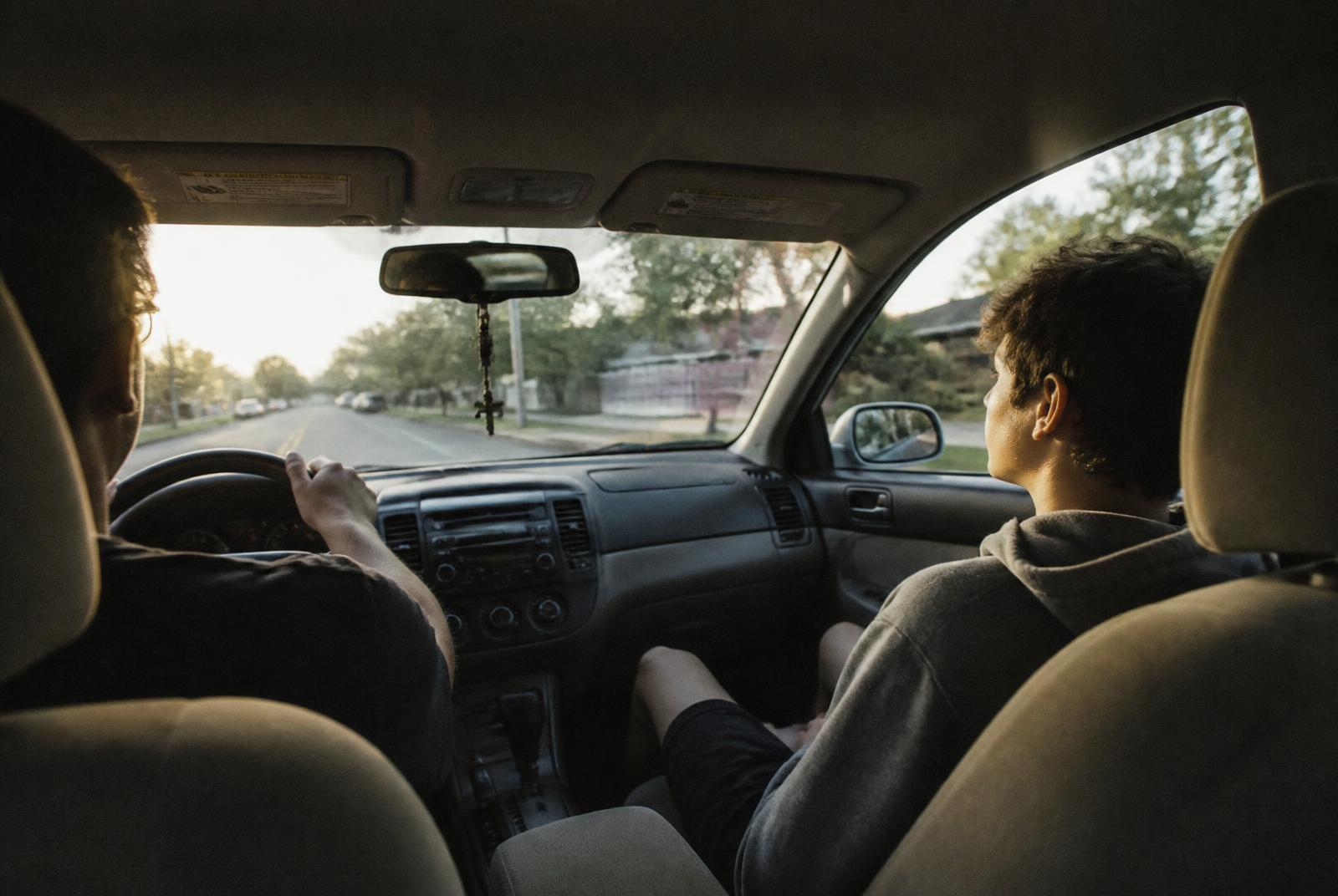
The Argument in the Car
The worst place to have a row is also, curiously, one of the best places to talk.
Written by Sian Trombley · BEd, MACP, CCC
You are eleven minutes from home, in traffic, and something about the weekend has escalated into something about respect, and neither of you can leave the room because the room is doing forty miles an hour.
Why the car escalates things
Conflict de-escalates when people can take space. In a car, nobody can. Both parties are captive, one of them is managing traffic, and the emotional temperature has only one direction available.
Add the classic timings — straight after school, straight after work, both of you depleted — and the car becomes the single most reliable argument venue in family life.
Why the car is also the best place to talk
The same features that make rows worse make disclosure easier. Side by side, no eye contact, a shared forward focus, and a natural end point. Teenagers who will not sit down opposite you will often talk freely at fifty miles an hour.
The trick is protecting that. If the car becomes the place where difficult subjects are ambushed, they will stop talking in it, and you will lose the best channel you have.
- 01Protect the first four minutes
Music, silence, nothing asked. Nervous systems need the transition.
- 02Ask open, low-stakes questions
'What was the funniest thing today?' opens more than 'how was school'.
- 03Have one exit phrase
'I'm parking this until we're home.' Agreed in advance, honoured every time.
- 04Never discipline while driving
Consequences delivered at speed are heard as ambush and can genuinely be unsafe.
- 05Repair before the handbrake
One sentence. It stops the row from following you into the house.
Rules that keep the channel open
Delay hard topics past the first few minutes. Let them choose the music. Ask nothing for the first stretch of the journey, and see what arrives unprompted.
And when something does go wrong, repair before the doors open. An argument that ends with a slammed car door lives in the house all evening.
Children do not need a perfect parent. They need a predictable one who returns after hard moments.
Sian Trombley, Canadian Certified Counsellor
What you can try this week
The four-minute rule
No difficult subjects in the first four minutes of a journey. Let everyone's body settle first.
Park the topic, not the child
'We'll finish this at home' ends a spiral without ending the conversation permanently.
Use the last minute for repair
Before the handbrake: 'That got heated. We're fine.' Never let them leave the car in a rupture.
- No eye contact makes hard topics easier to raise.
- No exit makes escalating arguments harder to stop.
- Wait four minutes before starting anything difficult.
- In a row, drop the topic — you can return to it standing up.
- Repair before anyone gets out of the car.
Do I raise hard topics when my child cannot leave?
What does our family do with an argument that has nowhere to go?
When did we last have a good conversation in the car?
Printable resources
Recommended Thrive courses

Share this article
This article is educational and is not a substitute for individual clinical advice. Comments are closed so the Journal stays a calm place to read.
Keep going
You may also like
Courses, worksheets and pathways from the same part of the library.
- JournalThe First Ninety SecondsYou do not have to have the right words. You have to have a warm face and an open door — the rest can be built over months.Read
- JournalHow to Talk to Your Teenager So They Talk Back"How was your day?" is not a question. It is a survey, and they have already filled it in.Read
- Learning PathwayRaising TeensA guided Learning Pathway from Thrive Family Company.Read
- Learning PathwayMental Health First Aid for TeensA guided Learning Pathway from Thrive Family Company.Read
- CollectionRaising TeensEverything Thrive publishes on raising teens — articles, courses, worksheets and research.Read
- ResearchThe Research LibraryPeer-reviewed parenting and child mental health research, translated into plain language.Read