The First Night Away
Homesickness is not weakness. It is attachment doing its job in the wrong postcode — and it is highly trainable.
Reviewed by Sian Trombley, CCCFounder, Thrive Family Company
7 min read
Best for parents of children who are…
- needing help bouncing back after setbacks
- worrying often, or asking the same question again and again
- needing closeness and reassurance to feel safe
- finding school days hard to get through

Share this
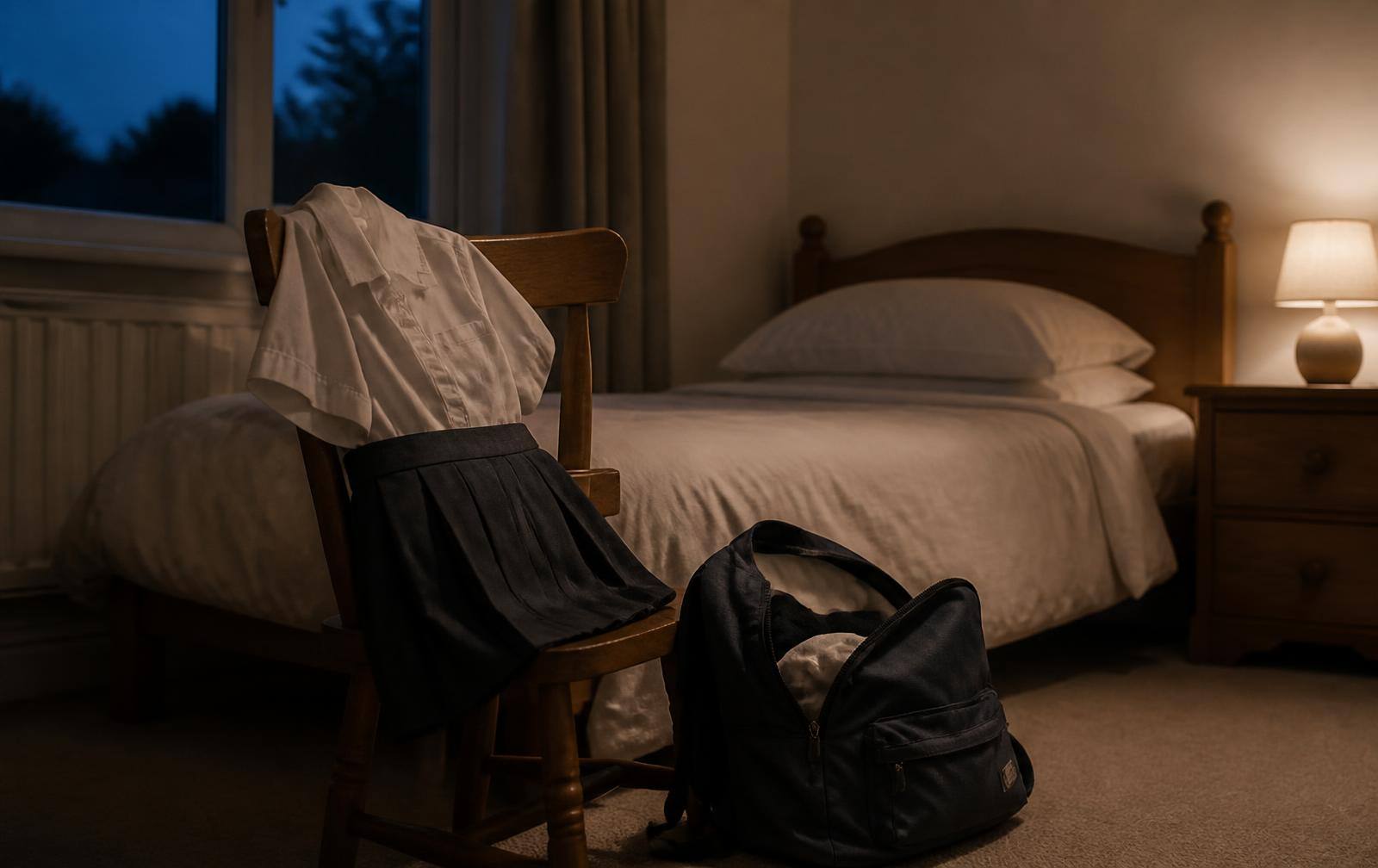
The bag is packed and standing by the door. Your child has spent two days constructing reasons why this is a bad week to go. Somewhere around nine in the evening, in a strange room that smells wrong, the wheels come off.
Homesickness gets treated as a small comedy of childhood — the tearful phone call, the early pickup, the story told for years afterwards. It is actually a straightforward attachment response: the systems that keep a child close to their caregivers are firing correctly, in a location where nothing familiar answers them.
Why the evening is the hard part
During the day there is structure, noise and other children. Homesickness needs quiet to grow. It arrives in the two windows the timetable does not fill: unstructured free time in the afternoon, and the thirty minutes after lights out. This is why 'they were fine all day and fell apart at bedtime' is not a contradiction. It is the pattern.
Preparation that actually transfers
- 01Build a separation history
Afternoons, evenings, then a whole night, then two. Children draw on memory under stress. Give them something to draw on.
- 02Involve them in the packing
Control lowers threat. Let them choose the torch, the socks, which pyjamas. A bag someone else packed feels like a bag someone else decided about.
- 03Rehearse the specific worries
'What if I need the toilet in the night?' 'What if nobody sits with me at breakfast?' Answer each one concretely. Vague reassurance leaves the questions alive.
- 04Agree the message discipline
One scheduled call or none at all, decided in advance with the staff or host. Unscheduled contact at the worst moment reopens the wound each time.
What makes it worse
- Telling them how much you will miss them and how empty the house will be.
- Long, drawn-out goodbyes at the coach door — brief and confident beats lingering and tender.
- A secret phone kept in a bag 'just in case'; it guarantees a 1am spiral.
- Framing the trip as a test of bravery. It is a trip, not an examination of character.
- Collecting them at the first difficult call, which converts one hard night into a permanent belief.
When it is more than homesickness
Occasionally the refusal is not about the night away at all. Panic symptoms, refusal to leave you in ordinary daytime situations, a specific fear of something happening to you while they are gone, or distress that is escalating rather than settling across the year deserve a proper look at separation anxiety rather than another attempt at a sleepover.
For most children, though, the arc is short and unglamorous. A hard first night. A better second. A child who comes home talking about something entirely unrelated to home — and who, quietly, now knows something about themselves that no amount of encouragement could have told them.
The first night away is not a test of the child. It is a rehearsal for every leaving that comes after.
Sian Trombley, Canadian Certified Counsellor
What you can try this week
Bank a practice night
One night at a grandparent's or a trusted friend's, weeks before the real thing. Success at small scale is the evidence they will draw on later.
Write the letter in advance
A short note tucked in the bag, read on the first night. Warm, funny, forward-looking. Never 'we miss you so much, the house is so quiet'.
Name the dip before it happens
'Around bedtime you'll feel a big wave of wanting to be home. It's normal, it lasts about twenty minutes, and everyone in that room will be having one.'
- Nearly all children feel some homesickness; only a minority find it overwhelming.
- Practice separations are the single best predictor of a good first trip.
- 'Call me and I'll fetch you' undermines the child's ability to settle.
- Homesickness peaks in unstructured moments — bedtime and free time.
- A child rescued at midnight learns the place was genuinely unsafe.
Whose anxiety is louder about this trip — my child's or mine?
What separations has my child actually succeeded at, and have I reminded them?
Have I promised a rescue I would not really want to carry out?
Printable resources
Recommended Thrive courses
This article is educational and is not a substitute for individual clinical advice. Comments are closed so the Journal stays a calm place to read.
Share this
Keep going
You may also like
Courses, worksheets and pathways from the same part of the library.
- JournalThe First Shift: A Teenager's First JobNothing convinces a sixteen-year-old that they are capable quite like a stranger paying them to be.Read
- ResearchThe Research LibraryPeer-reviewed parenting and child mental health research, translated into plain language.Read
- Thrive GuideThrive GuideAsk a question and get warm, evidence-informed guidance drawn from the Thrive library.Read
- Thrive Care PlanThrive Care PlanA short check-in that turns how your week actually went into one focused plan.Read
- Thrive ToolThrive ToolsPremium printable workbooks and therapeutic tool kits.Read
- CollectionThe Resource LibraryFree printable worksheets, scripts and planners for families.Read