The Sunday Night Feeling: Anxiety Before the School Week
The stomach ache arrives before the school week does. Anticipatory anxiety is not a child avoiding school — it is a nervous system rehearsing it.
Reviewed by Sian Trombley, CCCFounder, Thrive Family Company
8 min read
Best for parents of children who are…
- worrying often, or asking the same question again and again
- finding school days hard to get through
- going from calm to overwhelmed very quickly

Share this
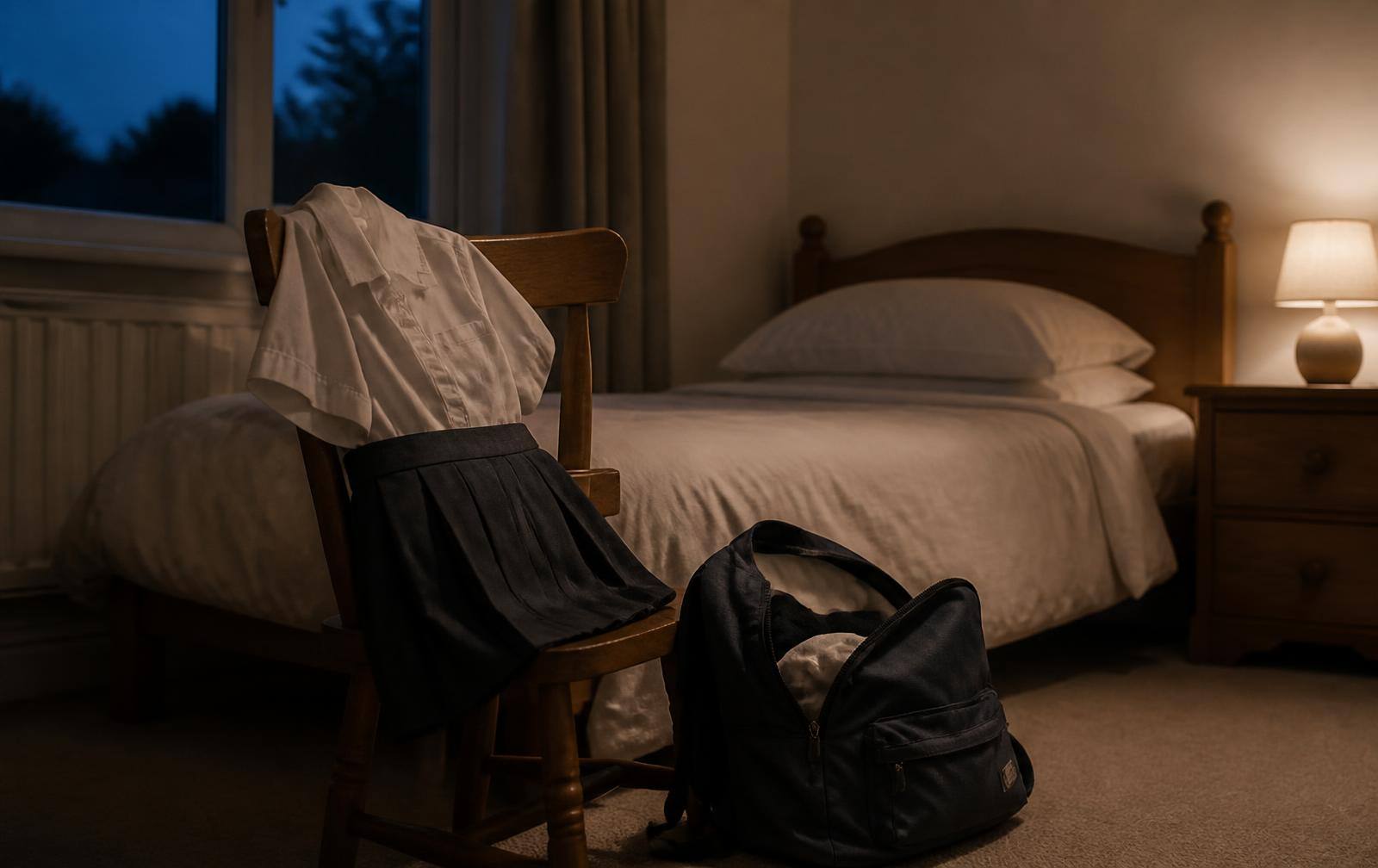
Nothing has happened. The weekend was good. And yet by six o'clock on Sunday your child is quieter, or louder, or suddenly furious about a sock. The uniform is out. The bag is half-packed. The week has arrived in the room before anyone has left the house.
This is anticipatory anxiety, and it is one of the most misread patterns in family life. Parents see a child who was perfectly fine an hour ago and reasonably conclude the distress is about something small, or made up, or strategic. It is none of those. The child's nervous system has begun rehearsing Monday, and the body does not distinguish clearly between a rehearsal and the real thing.
Why the evening before is often worse than the day itself
On Monday morning there are tasks: get dressed, find shoes, walk. Action occupies the brain. On Sunday evening there is nothing to do but imagine — and imagination runs unedited. The child pictures the corridor, the maths test, the lunch table, the friend who was cold on Friday. Each image triggers a small stress response. Twenty images later, they have a stomach ache.
The reassurance trap
When a child asks 'What if nobody plays with me?' the loving answer is 'Of course they will.' It works for about ninety seconds. Then the question returns, slightly reworded. Reassurance soothes the moment and strengthens the loop, because it teaches the brain that the worry can only be tolerated with an adult's help.
Build a Sunday evening that asks very little
Most families unintentionally load Sunday evening: the forgotten project, the haircut, the reading log, the difficult conversation about grades. A worried child arrives at bedtime already spent. The goal is not a special evening. It is a predictable, unremarkable one.
- 01Finish admin before dinner
Bag packed, uniform out, homework closed, forms signed. After dinner, nothing more can be asked of anyone.
- 02One shared, low-stakes thing
A programme you both like, a card game, cooking together. Side-by-side activity lowers arousal far more effectively than a face-to-face talk.
- 03Same wind-down, every week
Bath, book, lights, same order. Repetition tells the nervous system that nothing unexpected is coming tonight.
- 04A written worry, not a spoken loop
Two minutes to write the worry on paper and put it in a drawer until Saturday. Externalising stops the mental rerun.
Give the worry somewhere to go
Children with Sunday dread usually have one or two specific, solvable problems buried under a general fog of anxiety. Finding them takes daylight, not bedtime. On Saturday morning ask, sideways and briefly: 'Which bit of the week is heaviest?' You are looking for concrete details — a teacher, a lesson, a changing room, a lunch queue — because concrete problems can be worked on and fog cannot.
When it is more than Sunday
If dread has spread to Saturday, if your child is regularly missing school, or if the physical symptoms persist into the school day, this has moved beyond ordinary anticipation. That is a signal to involve the school and, if it continues, a clinician — not a signal that you have handled it badly.
For most families, though, the change is smaller than expected. Move the talking earlier. Make the evening duller. Stop answering the same question. Within a few weeks, Sunday stops being the day the week begins.
The dread does not arrive on Monday. It arrives on Sunday evening, and that is where it should be met.
Sian Trombley, Canadian Certified Counsellor
What you can try this week
Move the worry conversation to Saturday
Ten minutes, daytime, side by side. Ask what part of the week feels heaviest, write it down, and agree one small change. Then close the topic.
Make Sunday evening identical every week
Same order, same food, same wind-down. Novelty on a Sunday costs a worried child more energy than it costs you.
Pack the bag before dinner
Unfinished tasks hover. A packed bag by the door removes one loop the brain keeps replaying at bedtime.
- Sunday evening dread is anticipatory anxiety, not a behaviour problem.
- The body reacts to an imagined Monday almost as strongly as a real one.
- Reassurance repeated many times feeds the worry rather than settling it.
- Predictable, low-demand Sunday evenings reduce the load more than any pep talk.
- Problem-solving belongs earlier in the weekend, not at bedtime.
What time on a Sunday does the mood in our house change?
Am I answering the same reassurance question repeatedly?
What could we remove from Sunday evening rather than add?
Printable resources
Recommended Thrive courses
This article is educational and is not a substitute for individual clinical advice. Comments are closed so the Journal stays a calm place to read.
Share this
Keep going
You may also like
Courses, worksheets and pathways from the same part of the library.
- JournalThe Child Who Needs to Know the PlanThey do not want the answer. They want the feeling that the answer briefly gives them — and it wears off in about four minutes.Read
- JournalBuilding Your Child's Feeling VocabularyWhen a child can name what they feel, they are less likely to act it out. Emotional vocabulary is the foundation of self-regulation.Read
- CollectionEmotional RegulationEverything Thrive publishes on emotional regulation — articles, courses, worksheets and research.Read
- ResearchThe Research LibraryPeer-reviewed parenting and child mental health research, translated into plain language.Read
- Thrive GuideThrive GuideAsk a question and get warm, evidence-informed guidance drawn from the Thrive library.Read
- Thrive Care PlanThrive Care PlanA short check-in that turns how your week actually went into one focused plan.Read