The Sibling Who Waits
Growing up beside a brother or sister with a disability, chronic illness or high support needs shapes a child’s whole life. Here is how to see the quiet one in the waiting room — not just praise them for being easy.
Reviewed by Sian Trombley, CCCFounder, Thrive Family Company
13 min read
Best for parents of children who are…
- clashing with a brother or sister
- needing extra emotional support at the moment
- going through a change at home or at school

Share this
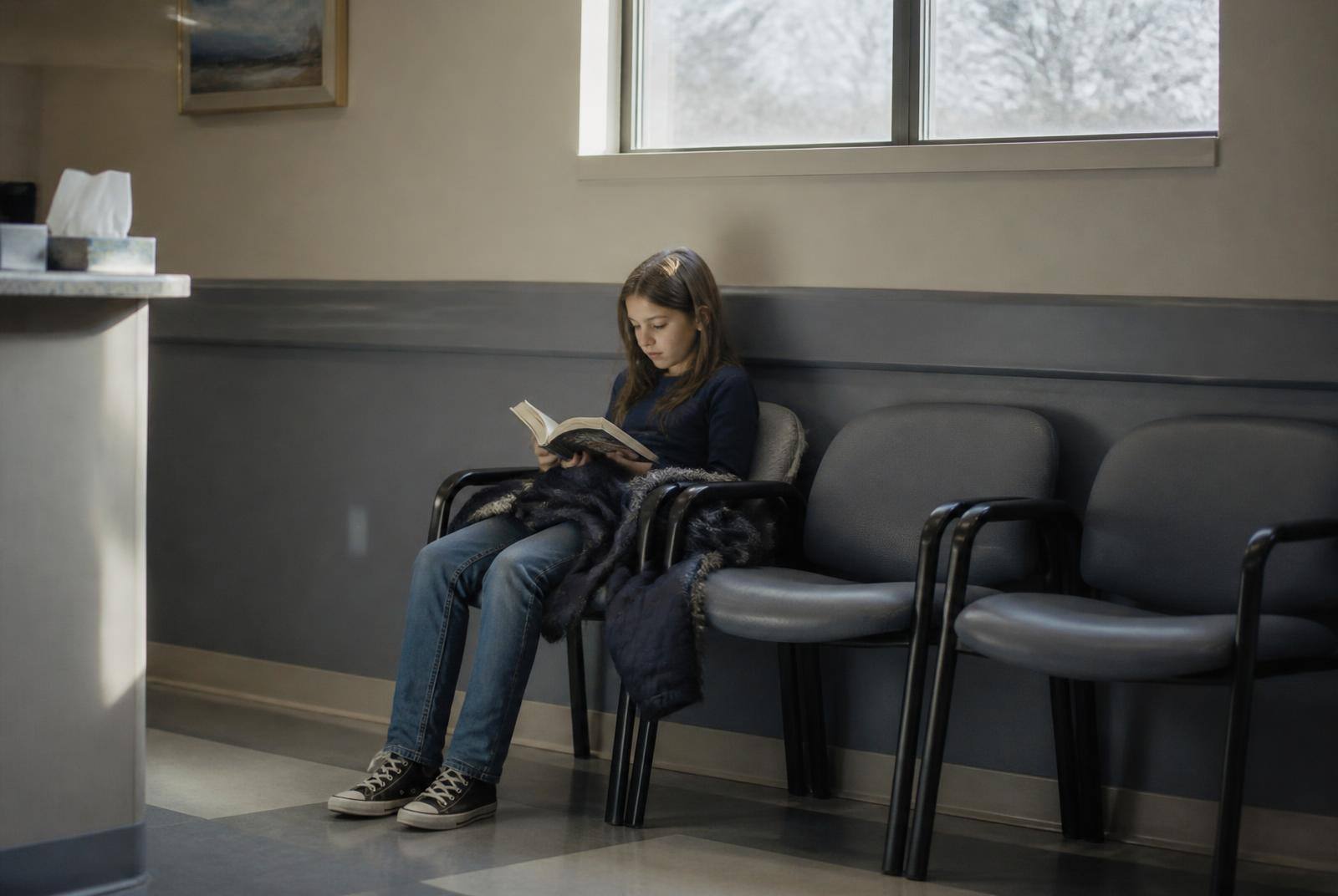
In every clinic waiting room, there is often a child nobody is examining. She has brought a book. She knows where the toys are kept and no longer bothers with them. She has learned to read her parents’ faces for how the appointment is going, and to ask for nothing until it is over. This is the sibling who waits — not just in clinics, but in kitchens, in cars, in the quiet moment after bedtime when a parent finally has ten unclaimed minutes and it goes, understandably, to the child with higher needs. Most of these siblings do not resent their brother or sister for existing. What is harder to carry is something more specific: the sense that their own needs, achievements and hard days must be small enough not to add to an already full plate. This piece is not about guilt. Complete equality of attention is not possible in a family where one child has significantly higher support needs, and pretending otherwise helps no one. It is about making the imbalance visible, naming it honestly to the child living inside it, and protecting a few things that are theirs alone.
What siblings actually report — strain and strength together
It is tempting to reach for one of two stories. The first is tragic: the sibling as a casualty, quietly damaged by a childhood spent in the shadow of someone else’s needs. The second is saccharine: the sibling as a little hero, wise beyond their years, grateful for the lesson in compassion. Neither is accurate, and both can make a real child feel unseen.
Vermaes and colleagues’ meta-analysis of sibling adjustment across families of children with chronic illness found a modest but real increase in internalising difficulties such as anxiety and low mood compared with siblings in typically developing families. At the same time, the variation between families was large — many siblings showed no measurable difficulty at all, and on several measures of empathy and prosocial behaviour, siblings performed as well as or better than peers. Growth and strain were not opposites competing for the same child; they frequently lived in the same person.
What predicted difficulty was rarely the sibling’s condition itself. It was family climate: how much parental stress the household was carrying, how cohesive the family felt, and — critically — how openly the illness or disability was discussed. This is a genuinely useful finding for parents, because it means the sibling’s wellbeing is not simply the price of loving a child with high needs. It is shaped by decisions parents can actually make.
The cost of being ‘the easy one’
Many siblings figure out early, often without anyone teaching them, that the household runs more smoothly when they ask for less. They stop mentioning the school project due Friday because the week has been hard. They say “I’m fine” reflexively, sometimes before the question is even finished. Parents, exhausted and stretched, often respond to this with genuine gratitude — “You’re just so good, I don’t know what I’d do without you” — not realising that the compliment quietly confirms the rule: being good means being undemanding.
Over time this can produce a child who is competent, self-sufficient and very hard to worry about — which is exactly the problem. Difficulties that would trigger concern in another child, a drop in grades, a withdrawn mood, a lost friendship, can go unnoticed in the ‘easy’ sibling because everyone, including the child, has stopped expecting to be checked on. Some researchers and support organisations describe this pattern informally as the “glass child” experience: seen through, rather than seen.
The remedy is not to manufacture problems or lower your expectations of this child’s independence. It is to actively look past the competence. Ask specific questions rather than the general “How are you?”, which trained politeness answers automatically. “What was the worst five minutes of your day?” or “Who did you sit with at lunch?” require a real answer and signal that you are still paying attention, even when nothing is visibly wrong.
Guilt, embarrassment and protectiveness can all be true at once
It is common — and not a sign of poor character — for a sibling to feel fiercely protective of their brother or sister one moment and deeply embarrassed by them in front of friends the next, sometimes followed swiftly by guilt for the embarrassment. A tween might defend her sister loyally at home and then ask a parent not to bring her to a birthday party. A teen might feel a flash of resentment watching a parent cancel his plans for a hospital visit, and then feel ashamed of the resentment within seconds.
These are not contradictions to be resolved. They are the ordinary emotional texture of growing up alongside a sibling with high needs, and naming them out loud, without judgement, does more good than trying to talk a child into feeling only the acceptable half. Say plainly: “It’s completely normal to love your brother and also wish, sometimes, that things were different. Both feelings can live in you. Neither one makes you a bad person.”
Anger deserves the same honesty. A sibling who snaps, “I wish we’d never had him,” in a moment of frustration is not confessing a hidden truth about the family — they are venting an overwhelmed feeling in the only vocabulary available to them in that moment. Respond to the feeling underneath rather than the literal words: “You’re really at the end of your patience today. That’s allowed. What happened?”
Fairness versus need — language that actually helps
Children are fairness detectors from a very young age, and a household where one child requires more time, money, therapy appointments or parental energy will register on that radar constantly. Trying to convince a sibling that things are actually equal usually fails, because they can count. A more durable approach is to teach the distinction between fair and equal directly, using language they can reuse themselves.
- 01Name the imbalance without apologising for existing
Say, “Your brother needs more of my time right now because of what his body and brain need. That’s not because he’s more loved. It’s because needs aren’t the same as love.” Avoid over-apologising, which can make the sibling feel responsible for managing your guilt.
- 02Distinguish need-based from want-based decisions
When a sibling asks why their brother gets something they don’t, sort it honestly: “That’s about what his body needs, not about what’s fun. If you needed that, you’d get it too.” Reserve real want-based unfairness for genuine correction — sometimes the sibling is right that something was overlooked.
- 03Build in a few genuinely equal things
Not everything can be equalised, but choose a handful of things that will be, deliberately: the same bedtime negotiation rules, the same amount warning before a family plan changes, the same right to say no to a hug. Protect these fiercely so the sibling has proof that fairness still exists somewhere.
- 04Let them push back on the framework
Occasionally ask, “Does this still feel fair to you, even understanding why it’s different?” A sibling who can express disagreement without being shut down is less likely to bottle resentment until it leaks out sideways.
Protected time that survives a crisis week
Every family managing a child’s disability or chronic illness will have crisis weeks: a hospital admission, a regression, a school placement falling through. In these weeks, the sibling’s one-to-one time is usually the first thing to be quietly dropped, with every intention of making it up later. The making up rarely happens, because the next crisis is often close behind.
The single most protective structural change most families can make is choosing a small unit of time — fifteen minutes, not two hours — that is treated as non-negotiable rather than aspirational. Small and reliable beats generous and occasional, because what the sibling is actually learning is not “how much time do I get” but “do I still count when things are hard.”
If a crisis genuinely makes even fifteen minutes impossible, say so directly rather than letting the time simply vanish: “I can’t do our walk today, and I’m sorry. Tomorrow, even if it’s short, we’re doing it.” The apology and the concrete replacement plan matter more than the original time slot.
Explaining a diagnosis honestly by age
Vague or absent explanations do not protect siblings from worry; they simply leave them to construct their own theory, which is often worse than the truth and sometimes involves blaming themselves. A young sibling who is never told why their brother has seizures may quietly conclude that something they did caused it, or that it might happen to them next.
For an elementary-aged child, keep explanations concrete and connected to what they observe: “Your brother’s brain works differently, which is why loud places are hard for him. It’s not something you caught, and it’s not going away, but we know how to help him.” Expect the same questions to come back weeks later — this is processing, not forgetting.
A tween can usually manage more medical or diagnostic detail and often wants the correct vocabulary, partly so they can answer classmates’ questions without embarrassment. Give them the actual name of the condition, in plain language, and check what they have already heard from friends or the internet, which is sometimes inaccurate or frightening.
A teenager will often want to know the honest trajectory — whether the condition is stable, progressive, or uncertain — and may be thinking ahead to questions about their own future role. Do not manufacture certainty you do not have. “We don’t know exactly how this will progress, and I’ll tell you what we learn as we learn it,” is more trustworthy than false reassurance that may later collapse.
School, friendships and awkward questions
Bringing friends home can feel risky for a sibling who is unsure how a peer will react to a brother’s wheelchair, a sister’s meltdown, or unfamiliar equipment in the living room. Some siblings solve this by simply stopping invitations, which quietly narrows their social world. It helps to talk about this directly rather than waiting for it to become obvious: “If you want to prep a friend before they come over, we can do that together. You get to decide how much to explain and when.”
Classmates will sometimes ask blunt or clumsy questions — “What’s wrong with your sister?” — and a sibling benefits enormously from having a ready, low-effort answer rather than having to invent one on the spot, flustered. A short factual sentence usually works well: “She has cerebral palsy, it affects her muscles, she’s smart, she just moves differently.” Let the sibling choose their own wording rather than scripting it entirely for them.
Bullying or teasing aimed at the sibling because of their brother or sister’s disability is a serious matter, not an inevitable cost of having a different family. Take reports seriously, involve the school promptly, and make clear to your child that defending their sibling does not have to mean absorbing cruelty silently. If teasing persists, loop in the school counsellor and document incidents in case a more formal response is needed.
Young carer responsibilities — what is reasonable
Many siblings take on genuine caregiving tasks: fetching medication, supervising a sibling briefly, learning to recognise the signs of a seizure or a meltdown, translating for a nonverbal sibling in public. Some of this is a normal, even bonding, part of family life. The line into inappropriate burden is crossed when a child’s responsibilities begin to displace their own schooling, sleep, friendships or right to simply be a kid rather than a junior staff member.
A useful check: could an outside adult look at this child’s daily responsibilities and describe them as ‘helping out’, or would they describe them as ‘running the household’? If a ten-year-old is regularly responsible for medication timing, safety supervision, or managing a sibling’s distress without an adult present, that is a signal to bring in more formal support — respite care, extended family, or community services — rather than relying on the sibling as backup staffing.
It is worth naming caregiving contributions with genuine, specific thanks rather than treating them as invisible defaults: “Thank you for watching him while I made that call — I know that wasn’t your job to do, and I appreciate it.” Specific acknowledgement, offered occasionally, feels very different from constant unspoken reliance.
Future worries and long-term care
Older siblings, particularly teens, sometimes begin quietly wondering whether they will be expected to take over their brother or sister’s care as adults, especially once parents are no longer able to. Left unspoken, this worry can shape major life decisions — where to live, what to study, whether to have children of their own — without ever being examined out loud.
It helps to raise the subject before it becomes urgent, framed as a family planning conversation rather than a burden being handed over: “We are thinking about long-term plans for your sister’s care, and we want you to know this is not automatically your responsibility. We’ll make a plan that doesn’t depend only on you.” Involving a social worker or disability services planner in these conversations, when the time comes, takes pressure off the sibling relationship and keeps the decision grounded in real options rather than assumed obligation.
Sibling support groups, respite and when a sibling needs their own therapist
Siblings often benefit enormously from meeting other children who understand the specific texture of their experience without needing it explained. Sibling support groups — run through hospitals, disability organisations, or programmes such as the Sibling Support Project’s Sibshops model — give children a space where their sibling’s condition is the unremarkable backdrop rather than the whole conversation. In Canada, Sibling Collaborative Canada and many children’s hospitals maintain lists of local groups; ask your child’s care team or school counsellor for a current referral.
Respite care — professional or family-arranged breaks from caregiving demands — benefits the whole family, but it particularly benefits siblings by restoring stretches of ordinary parental attention that do not have to be shared. If your family has not explored respite funding or services, a social worker attached to your child’s care team is usually the right starting point.
Consider a sibling’s own regulated therapist when you notice persistent low mood, anxiety, sleep disruption, marked withdrawal from friends, a sharp drop in school performance, or a pattern of self-erasure — a child who cannot name a single thing they want, or who apologises reflexively for having needs. A school counsellor is a reasonable first step and can refer onward to a psychologist or counsellor experienced with sibling or family adjustment.
When the sibling says “I wish I was the sick one”
Few sentences land harder on a parent than this one. It is rarely a literal wish for illness. More often it is an attempt to say something like: “I wish I got the attention. I wish people worried about me the way they worry about him. I wish I didn’t have to be the strong one.” Responding to the surface content — “Don’t say that, you don’t mean it” — shuts the conversation down exactly when it has finally opened.
After a conversation like this, follow through with something concrete within days, not eventually. A single visible change — a protected outing, a specific compliment about something unrelated to their sibling, a question about their own life asked with real curiosity — does more to answer the underlying wish than any explanation ever could.
Children do not need a perfect parent. They need a predictable one who returns after hard moments.
Sian Trombley, Canadian Certified Counsellor
What you can try this week
Book the unbreakable half hour
Choose a recurring slot this week — even fifteen minutes — that belongs only to the sibling. Tell them explicitly: “This time is yours. If something comes up with your brother, we will move it, not cancel it.” Then prove it by actually moving it once, out loud, so they see the promise held under pressure.
Ask the fairness question directly
Say, “I know it can feel like your sister gets more of my time and attention. That’s true some weeks, and it isn’t fair, even though it’s necessary. What’s one thing you’d like more of from me?” Let them answer without you defending the imbalance.
Prepare one honest sentence for outside the family
Help your child draft a short, comfortable answer for classmates or friends who ask awkward questions about their sibling, such as, “He has autism, it means his brain works differently, he’s not contagious.” Rehearsing removes the pressure to improvise under embarrassment.
- Siblings of children with disabilities or chronic illness show both real strain and real strengths — avoid flattening their experience into either pity or a tidy inspirational story.
- Fairness is not the same as sameness; explain the difference between equal and needs-based attention honestly, in words the sibling can use back to you.
- Protect small, reliable one-to-one time that survives even hospital admissions and hard weeks — consistency matters more than length.
- Give truthful, age-appropriate information about the diagnosis; secrecy and vague reassurance both increase a sibling’s private fear.
- Watch for the ‘easy child’ pattern of over-functioning and suppressed need, and consider sibling support groups or their own therapist before a crisis forces the issue.
When did you last spend time with this child that had nothing to do with their sibling’s condition, appointments or needs?
Have you ever praised this child mainly for being ‘no trouble’? What might that be teaching them about when they are allowed to need something?
What does this child actually know about their sibling’s diagnosis, in their own words — and where did they learn it?
Printable resources
Recommended Thrive courses
This article is educational and is not a substitute for individual clinical advice. Comments are closed so the Journal stays a calm place to read.
Share this
Keep going
You may also like
Courses, worksheets and pathways from the same part of the library.
- ResearchThe Research LibraryPeer-reviewed parenting and child mental health research, translated into plain language.Read
- Thrive GuideThrive GuideAsk a question and get warm, evidence-informed guidance drawn from the Thrive library.Read
- Thrive Care PlanThrive Care PlanA short check-in that turns how your week actually went into one focused plan.Read
- Thrive ToolThrive ToolsPremium printable workbooks and therapeutic tool kits.Read
- CollectionThe Resource LibraryFree printable worksheets, scripts and planners for families.Read
- JournalThe One Watching You for Weather: The Child Who Worries About Their ParentThey ask if you are okay before you have said anything. They check your face when the phone rings. They are eleven, and they are managing you.Read