Routine 08
Transitions · The moment the screen goes off
The Device Handoff
Most screen conflict is not about screens. It is about how they end.
- Who it's for
- Ages 6–17. Any household where the device is fine until it has to stop.
- When it runs
- Every time a device session ends. Five minutes.
- Approx. time
- 10-15 minutes. Flexible by design.

The friction
You give a warning. They say yes.
Ten minutes later nothing has happened and the warning has to become a threat.
The device comes off and the next twenty minutes are ruined for everyone.
You end up either confiscating something or letting it slide, and neither feels right.
Why it breaks down
Games and feeds are designed not to end
Autoplay, match timers, streaks and infinite scroll all remove natural stopping points. Asking a child to stop is asking them to do something the product is engineered to prevent — which is worth naming out loud to them.
Stopping mid-task feels like loss
Leaving a round unfinished can cost a child progress, a team's goodwill or social standing. "Two more minutes" is often a genuine attempt to reach a stopping point, not a stalling tactic.
The ending has no shape
When time is the only rule, the parent becomes the timer. Households that agree an ending — the end of a match, the end of an episode — hand the job to the structure instead of the adult.
Set this up first
- Agree what an ending looks like for each thing they use: end of a match, end of an episode, end of a chapter. Time alone rarely works for games.
- A timer they can see and, ideally, set themselves.
- Somewhere the device goes afterwards, in a shared room. Handing it to a parent is a defeat; putting it in the same place every time is a habit.
- One thing to walk into. An empty handoff into nothing is the hardest kind.
The sequence
T-10
Warning tied to the game, not the clock
Ask what a natural ending is from where they are, then agree to it. This one question changes more screen conflicts than any rule does.
"How long till you can save it?"
T-5
Get in the room
Warnings shouted from another room are easy to absorb and ignore. Come in, be near, say nothing much.
T-2
Name what comes next
Give the brain somewhere to go. A landing place makes the ending an arrival rather than a removal.
"Two minutes. Then help me with the salad."
T-0
The handoff itself, said once
One sentence, level voice, then wait ten seconds without repeating it. The silence after the request is doing more work than another instruction would.
"That's it. Screen in the box."
After
Two minutes of neutral company
Do not review their behaviour, comment on how long it took or mention tomorrow's limit. Coming off a device leaves most children flat and irritable for a few minutes; ride it out beside them.
When it doesn't work
They get angry every single time.
Change the ending, not the consequence. Try ending after a win rather than at a fixed time, or moving the session earlier in the evening. Fatigue plus a device ending is a predictable escalation.
They hide the device or use it at night.
Move all charging out of bedrooms for everyone including adults, and treat it as a household rule rather than a punishment for one child. Then talk about what they are going online for at 1am — usually connection, sometimes worry.
You confiscated it and now everything is worse.
Confiscation ends a moment and costs the relationship. Where a consequence is genuinely needed, make it short, named in advance and unemotional, then let it end cleanly.
Make it yours
Younger children
Use a visible sand timer and end on a physical action — putting the tablet in its box themselves. Doing the ending with their hands helps more than hearing about it.
Teens
Negotiate the ending, not the amount. Teens hold a rule they helped set far longer than one they were handed, and phones carry their social life inside them.
When everyone is already upset
Take the device, say nothing, and come back in ten minutes. Do not attempt the conversation while the loss is fresh.
What to say
Instead of
"Off. Now. I've told you three times."
Try
"End of this round, then it goes on the side."
Tied to their content rather than your clock, which is the difference between an interruption and an ending.
Instead of
"You're always on that thing."
Try
"You've got ten minutes. When it ends, let's work out what's next."
Warning plus a named next thing gives the brain somewhere to go after the screen.
Instead of
"If you don't get off, that's it for the week."
Try
"It's going on the side now. We can talk about tomorrow's plan later."
Keeps the boundary without a punishment invented in the heat of it, which rarely survives the next day anyway.
The minimum viable routine
No capacity for the full handover tonight. Keep:
- 01One warning, given in the room rather than shouted.
- 02The device physically taken and put somewhere else.
- 03Two minutes of neutral company afterwards.
Skip the conversation about limits. Getting through the handover without a row is the win.
Try it for a week
Pick the parts that look most useful and run them for seven days. Then look at what actually happened:
- Did tying the warning to their content reduce the resistance?
- What happened in the ten minutes after the device went down?
- Which time of day was the handover hardest?
- Does the agreement need revisiting as a family rather than nightly?
Then adjust. The aim is not adherence to the sequence; it is a rhythm that makes this part of the day easier to run.
Thrive printable
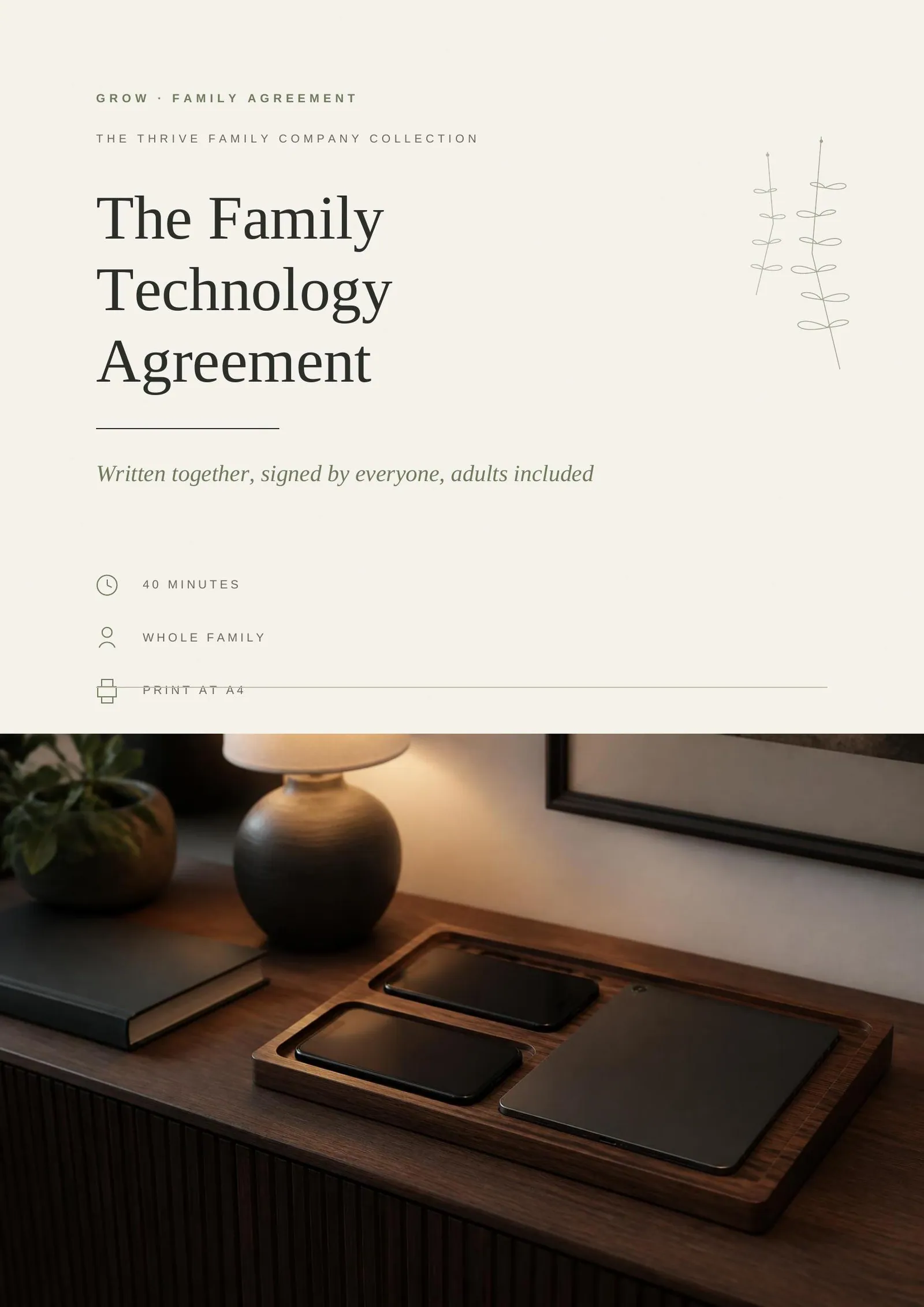
Family Technology Agreement
The written version, so the rules stop being renegotiated in the moment.
Included with Member
Download the printable →Keep this line
Change the ending and you will not need to change the rule.
A note from Sian
Screens are the most common conflict families bring, and the one where adults feel least confident. It helps to remember that you are not competing with your child's willpower — you are competing with design.
Say that to them. Children respond well to being told the game is built to be hard to leave; it moves the two of you onto the same side of the problem.
Thrive Routines are psychoeducational family wellbeing guidance. They are not therapy, diagnosis or medical advice, and they are not a substitute for support from a professional who knows your child.