Routine 10
Transitions · Getting everyone to the same table
The Dinner Transition
The fifteen minutes before dinner, which is where most mealtime conflict actually happens.
- Who it's for
- Any household eating together at least some evenings, including split and staggered schedules.
- When it runs
- Weekday evenings, before the meal.
- Approx. time
- 15 minutes before you eat. Flexible by design.
The friction
Dinner is ready and nobody comes.
One is mid-game, one is upstairs, one is watching something with eleven minutes left.
You call three times, then you call differently, and everyone arrives irritated.
The food is cold and the meal starts on a bad note before anyone sits down.
Why it breaks down
Dinner is a transition, not an event
The meal itself is rarely the problem. The problem is asking several people to stop different absorbing things at the same unpredictable moment. Households that fix the handover usually find the meal was fine all along.
The call comes with no warning
"Dinner's ready" is the first anyone has heard about it. From inside a game or an episode, that lands as an interruption rather than an instruction, and the resistance is about the abruptness rather than the food.
Expectations are pitched too high
When dinner is carrying the weight of being the family's daily connection point, every distracted or monosyllabic meal registers as a failure. That pressure is often what makes the table tense.
Set this up first
- Pick a rough time and keep it stable across the week. Give or take fifteen minutes is enough.
- Decide which evenings are realistically shared meals. Three good ones beat seven resented ones.
- Phones live somewhere else during the meal, adults included. That rule only survives if it applies to everybody.
- Give each person one small job: laying, pouring, carrying, clearing. Arriving with a task is easier than arriving to be sociable.
The sequence
T-15
The heads-up, delivered in person
Go to each person rather than shouting up the stairs. A quarter of an hour is enough time to find a stopping point in most things.
"Dinner in fifteen. Find a save point."
T-5
Screens off, bodies moving
This is the actual boundary. Say it once and stay until the device goes down; standing there quietly is more effective than a second call from the kitchen.
T-3
Jobs
Hands doing something make the arrival at the table gradual. Nobody has to switch straight from a screen into conversation.
Sit
Everyone sits, food goes round
Start together where you can. It is a small marker and it does a surprising amount of work.
First 5 min
Let it be ordinary
Silence is allowed. So is talking about nothing. Resist opening with an inventory of the day; if conversation comes, it usually comes later in the meal.
End
A defined ending
Say what happens when the meal finishes, so leaving the table is not a separate negotiation.
"Plates in the dishwasher, then the evening's yours."
When it doesn't work
Someone will not stop the game.
Move the warning earlier and tie it to their content rather than your clock: the end of the round, the end of the episode. If it still fails repeatedly, the problem is the device transition itself, not dinner.
Teenagers will not talk.
Lower the expectation and keep the seat. Presence at the table with very little conversation is still worth having, and interrogation guarantees less.
Activities mean you never eat at the same time.
Choose two fixed evenings and protect them properly rather than aiming at all seven. On the other nights, sit with them while they eat even if you are not eating.
Make it yours
Younger children
Ten minutes at the table is a reasonable target. Let them leave when they are done rather than turning the last five minutes into a battle.
Teens
Let them help choose one meal a week and cook it if they want to. Ownership brings people to the table more reliably than rules about it.
Sensory needs
Lower the lights, reduce the noise, and let a child sit slightly apart if a full table is too much. The point is being together, not the seating plan.
What to say
Instead of
"Dinner! Now! I've called you three times."
Try
"Dinner in fifteen. Find a save point."
A warning tied to their world is the difference between an interruption and a wind-down.
Instead of
"So, how was everyone's day?"
Try
"Anything good, or shall we just eat?"
Gives permission for a quiet meal, which often produces more conversation than the direct question does.
Instead of
"Sit down properly and stop messing about."
Try
"Ten minutes at the table, then you're free."
A defined ending makes the middle much easier for a child who finds sitting still hard.
The minimum viable routine
Late finish, three directions, nothing cooked. Tonight, keep:
- 01Everyone eats something, even if it is not together.
- 02Sit with whoever is eating for five minutes.
- 03Phones down for those five minutes only.
Eating in shifts is not a failed dinner. Shared meals are a weekly average, not a nightly test.
Try it for a week
Pick the parts that look most useful and run them for seven days. Then look at what actually happened:
- Did the fifteen-minute warning reduce the number of calls you had to make?
- Which evening went best, and what was different about it?
- How long did people actually stay at the table?
- Is the number of shared meals you are aiming for realistic for this term?
Then adjust. The aim is not adherence to the sequence; it is a rhythm that makes this part of the day easier to run.
Thrive printable
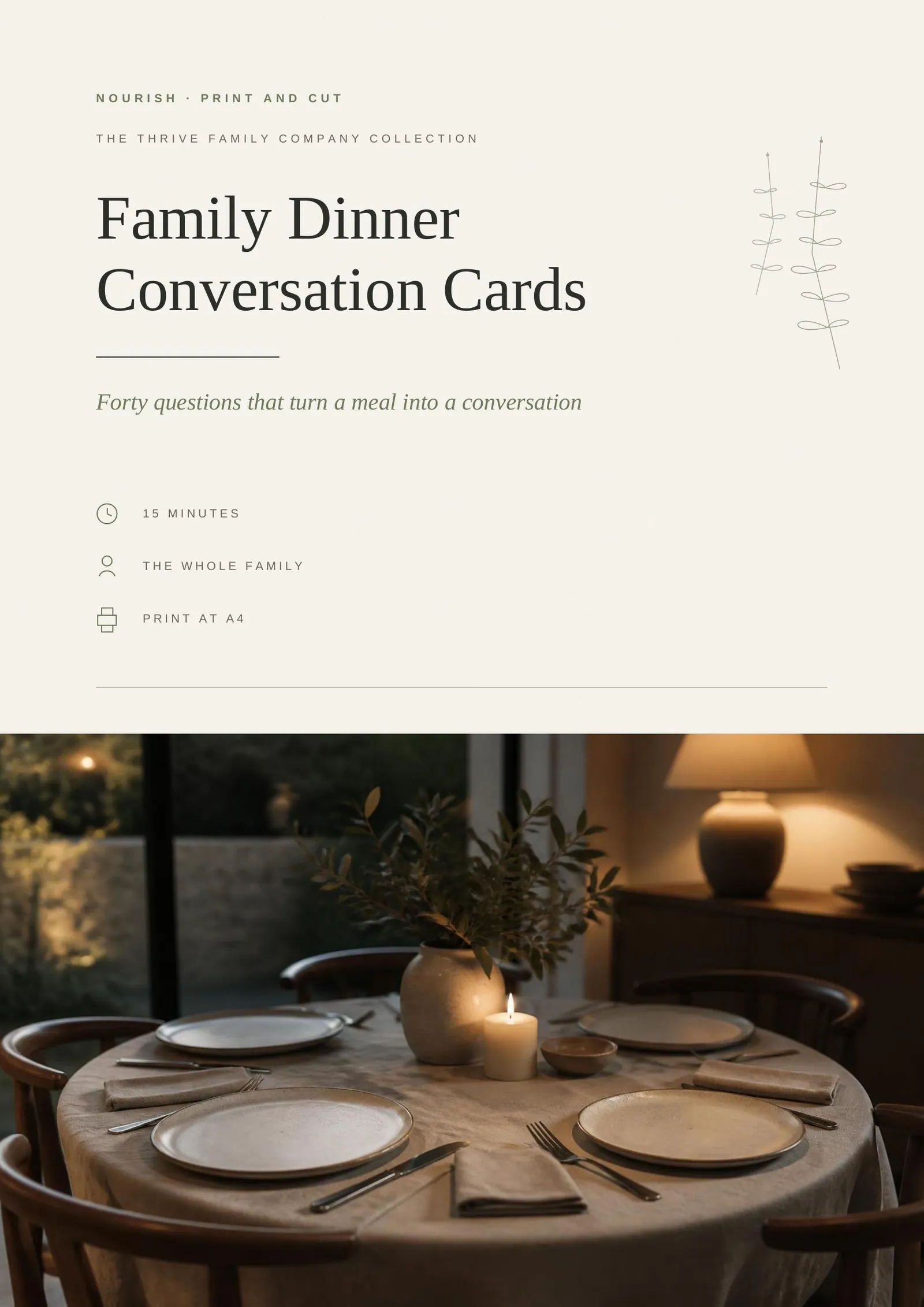
Family Dinner Conversation Cards
For evenings when the table is quiet and you would rather it was not.
Included with Member
Download the printable →Keep this line
Most dinner arguments are not about dinner. They are about being asked to stop something with no warning.
A note from Sian
The families who enjoy dinner most are usually the ones expecting the least from it. When the meal stops being the place where connection has to happen, it often becomes the place where it does.
If mealtimes are consistently tense in your house, spend a fortnight working only on the fifteen minutes beforehand and change nothing about the meal itself. That alone is frequently enough.
Thrive Routines are psychoeducational family wellbeing guidance. They are not therapy, diagnosis or medical advice, and they are not a substitute for support from a professional who knows your child.