The Body Sounds the Alarm: Panic Attacks in Teenagers
A panic attack is not a teenager being dramatic. It is a false alarm from a very old warning system — and the way the adults in the room respond changes how long it lasts and how often it returns.
Reviewed by Sian Trombley, CCCFounder, Thrive Family Company
10 min read
Best for parents of children who are…
- withdrawing during the teenage years
- worrying often, or asking the same question again and again
- having sudden waves of panic they cannot explain
- going from calm to overwhelmed very quickly

Share this
It starts in the middle of something ordinary. A maths lesson. A queue in a shop. Their chest tightens, their hands go strange and tingling, the room feels further away than it was a moment ago, and a single thought arrives with total conviction: something is very wrong with me and it is happening now.
Twenty minutes later it has passed. They are shaky, wrung out, and mortified. You are standing in a corridor or a car park with your heart going, wondering whether to drive to A&E and whether you have just watched the beginning of something much bigger.
Panic attacks are common in adolescence, frightening out of all proportion to their danger, and highly responsive to the right response. The difficulty is that almost everything the body tells a parent to do in the moment is the opposite of what helps.
What is actually happening in the body
A panic attack is a full threat response firing in the absence of a threat. Adrenaline floods the system in seconds. The heart speeds up to move blood to large muscles. Breathing quickens to load oxygen. Blood is shunted away from the hands, feet and digestive system, which is why fingers tingle and stomachs turn. Vision narrows. The world takes on a flat, unreal quality because attention has collapsed onto the perceived danger.
Every one of those sensations is a system working correctly. The problem is only that it fired at the wrong moment. Nothing in that cascade can harm a healthy young person. It is deeply unpleasant and completely safe — two things that are hard to hold together at fifteen.
Why one attack becomes a pattern
Most teenagers who have one panic attack never develop panic disorder. The ones who do usually travel a predictable route, and it is the interpretation, not the intensity, that decides the direction.
- 01The sensation is read as catastrophe
A fast heart becomes 'I am having a heart attack'. Unreality becomes 'I am losing my mind'. The interpretation itself releases more adrenaline, which produces more sensation.
- 02The body is then monitored
They start checking their pulse, noticing their breathing, scanning for the early signs. Vigilance guarantees they will find something, because bodies are always doing something.
- 03The place gets avoided
The bus, the assembly hall, the shop. Avoidance brings instant relief, which is exactly what makes it stick, and the brain files the location as genuinely dangerous.
- 04Life narrows
One avoided place becomes several. Within a term a teenager can be organising their entire week around not being somewhere an attack might happen.
What to do while it is happening
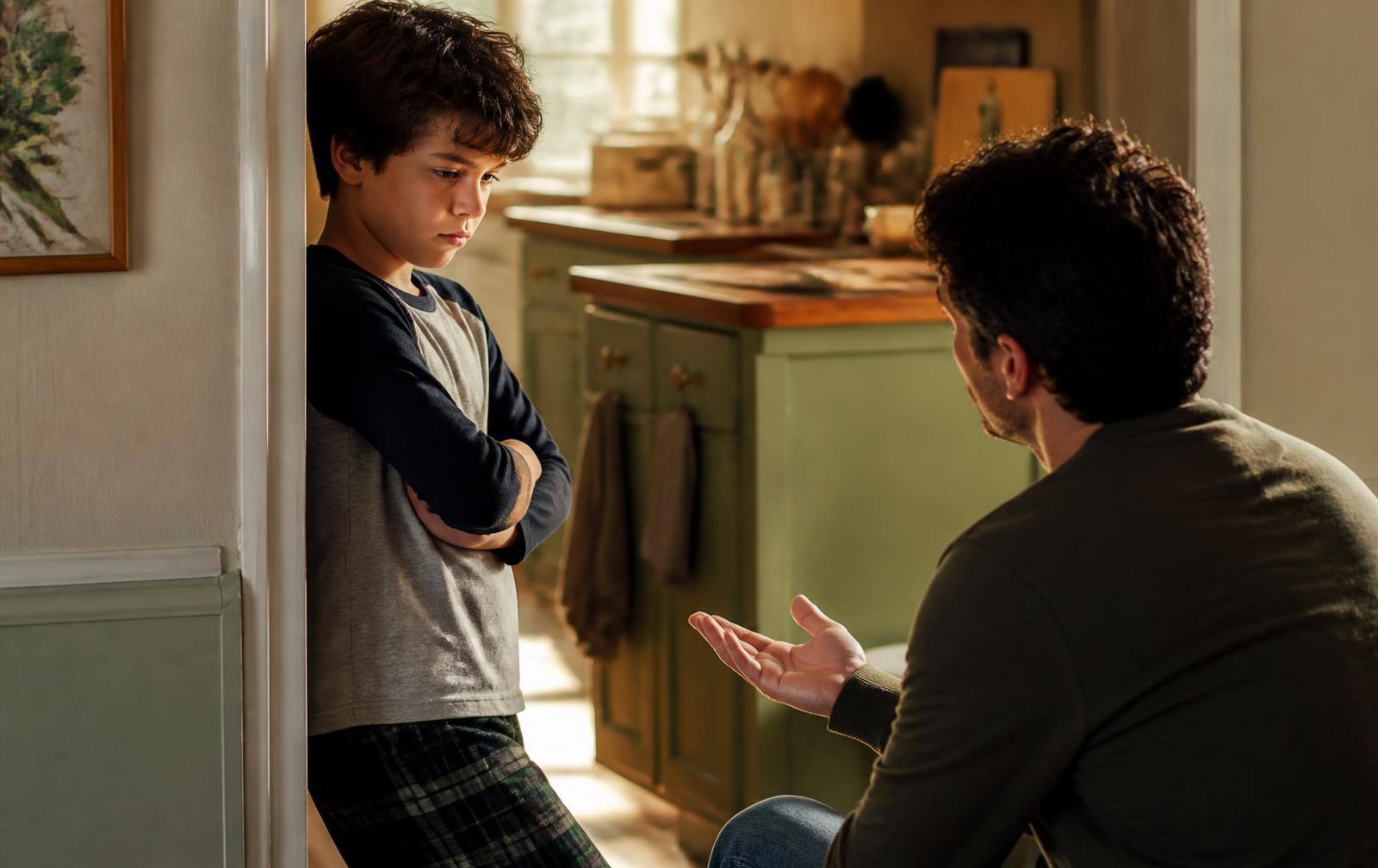
Your nervous system is the loudest thing in the room. Teenagers read faces faster than words, and a frightened parent confirms that the danger is real. The most useful thing you can offer is a body that is not alarmed.
- Lower your voice and slow your speech. Aim for flat and unhurried, not soothing and urgent.
- Say less. One short orienting sentence, then presence. Long explanations cannot be processed mid-attack.
- Do not ask them a stream of questions. 'What's wrong? Can you breathe? Should I call someone?' raises arousal.
- Offer the long exhale by doing it audibly yourself rather than instructing them to breathe.
- Stay put if you safely can. Leaving the situation the instant it starts is how avoidance is built.
- Afterwards, do not treat them as fragile. Fetch water, sit down, talk about something else for ten minutes.
The reassurance trap
After the attack comes the question, and then the same question again. Am I definitely fine? Is my heart okay? Would you tell me if it wasn't? Answering feels like kindness. It is, briefly. But each answer teaches the anxiety that certainty is available on request, and the interval before the next question shortens.
The alternative is not coldness. It is answering once, properly, and then changing the currency of the response: 'I've told you what I know, and I'm not going to keep checking with you — not because I don't care, but because checking is feeding it. Come and sit with me instead.'
Building tolerance between attacks
The work that reduces panic mostly happens on ordinary days. A teenager who has learned, in calm conditions, that a racing heart is survivable will interpret it differently at 11am on a Tuesday.
- 01Deliberate exercise
Running, cycling, anything that makes the heart pound on purpose. It rehearses the exact sensations in a context where the explanation is obvious and harmless.
- 02Ordinary sleep and food
Broken sleep, skipped breakfast, high caffeine and energy drinks all raise baseline arousal. Panic sits on top of an already activated system.
- 03Named pressure
Attacks rarely arrive out of nowhere. Look at the term ahead: exams, a friendship rupture, a change of set, a family stress nobody has said out loud.
When to seek clinical help
Speak to your GP or a mental health professional if attacks are recurring rather than isolated, if your teenager is avoiding school, transport or social situations to prevent them, if they are frightened of being alone, if there is persistent low mood alongside, or if they mention not wanting to be here. Also check in medically after a first attack if there is any chest pain, fainting or an existing heart condition — ruling out the physical is part of making the psychological explanation believable.
Panic responds well to treatment. Most young people who get the right help do not go on to have panic disorder in adulthood. What predicts a good outcome is not how severe the first attack was, but how quickly the world stopped being rearranged around it.
A panic attack is a false alarm from a very loyal system. It is terrifying, and it is not dangerous.
Sian Trombley, Canadian Certified Counsellor
What you can try this week
Name it out loud, once
'This is panic. It peaks and passes. I'm staying here.' One sentence, said calmly, then quiet. Explanation during an attack does not land — the thinking brain is offline.
Lengthen the out-breath
In for four, out for six or seven. The long exhale is the part that engages the calming branch of the nervous system. Do it beside them rather than instructing them.
Return to the place within 48 hours
The classroom, the bus, the supermarket. Briefly, together, with no requirement to stay long. Avoidance is what teaches the brain the place was genuinely dangerous.
- A panic attack peaks in around ten minutes and cannot physically harm a healthy teenager.
- The fear of the sensations, not the sensations themselves, is what turns one attack into a pattern.
- Calm, low, slow adult presence works better than reassurance-seeking questions.
- Letting them avoid the place it happened is the single fastest way to make it recur.
- Frequent attacks, or reorganising life around avoiding them, warrants clinical assessment.
When the attack happens, does my own face say 'this is survivable' or 'this is an emergency'?
Which places or situations have quietly dropped off my teenager's life since the first one?
Am I answering the same reassurance question repeatedly — and is it helping for longer each time?
Printable resources
Recommended Thrive courses
This article is educational and is not a substitute for individual clinical advice. Comments are closed so the Journal stays a calm place to read.
Share this
Keep going
You may also like
Courses, worksheets and pathways from the same part of the library.
- ResearchThe Research LibraryPeer-reviewed parenting and child mental health research, translated into plain language.Read
- Thrive GuideThrive GuideAsk a question and get warm, evidence-informed guidance drawn from the Thrive library.Read
- Thrive Care PlanThrive Care PlanA short check-in that turns how your week actually went into one focused plan.Read
- Thrive ToolThrive ToolsPremium printable workbooks and therapeutic tool kits.Read
- CollectionThe Resource LibraryFree printable worksheets, scripts and planners for families.Read
- JournalThe First Ten Minutes: When You Discover Your Child Is Self-HarmingYou saw something you were not meant to see. Every instinct is shouting at once — fix it, remove it, demand a promise. Almost all of those instincts will close the door.Read