The Child Who Cannot Fall Asleep Without You
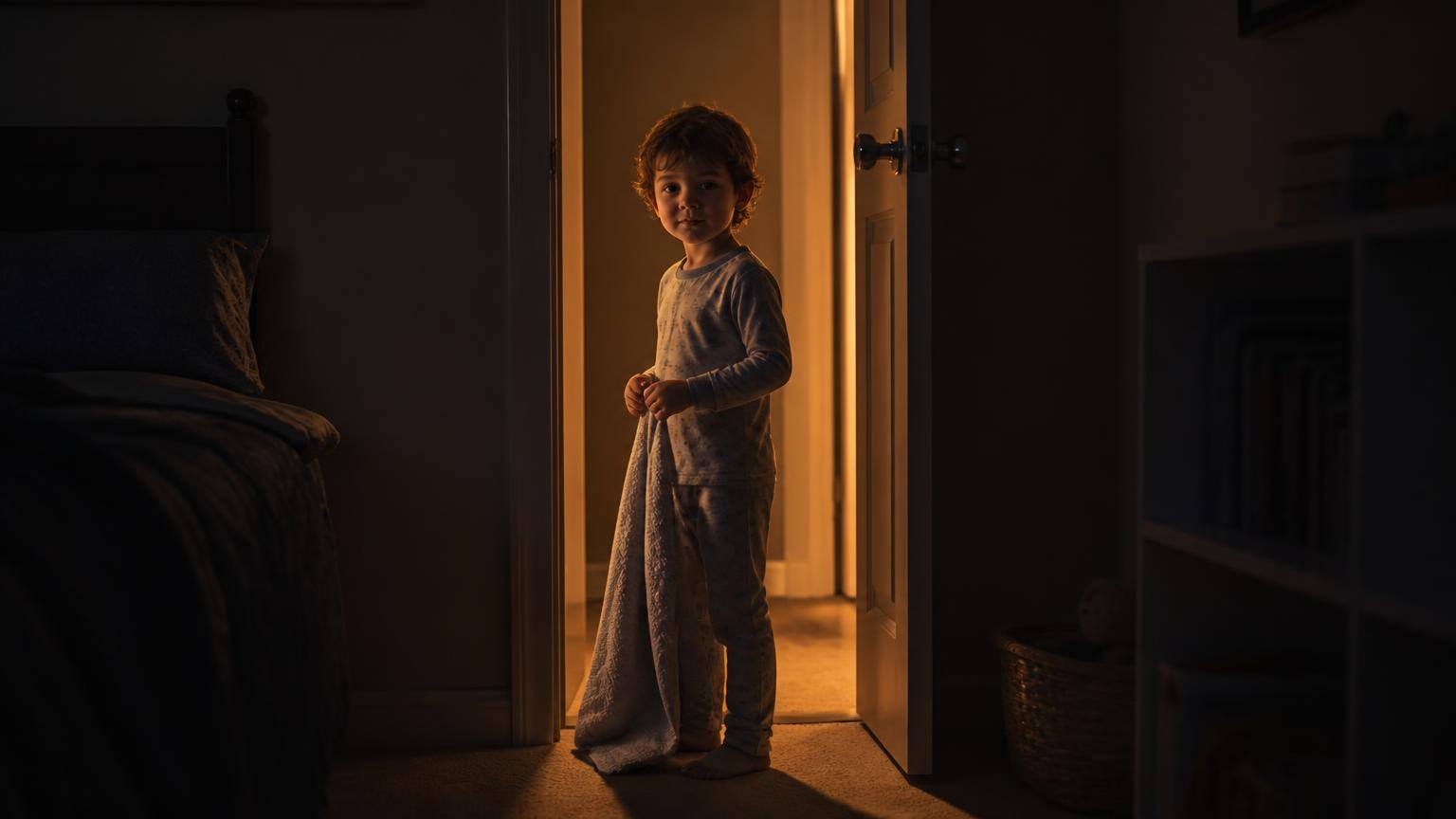
Every evening ends the same way: on the floor beside their bed, waiting for their breathing to change.
Reviewed by Sian Trombley, CCCFounder, Thrive Family Company
8 min read
Best for parents of children who are…
- finding it hard to settle or stay asleep
- worrying often, or asking the same question again and again
- needing closeness and reassurance to feel safe

Share this
It was meant to be temporary. It has been fourteen months, your back hurts, and last night you got as far as the door before a voice said 'are you going?'
How the arrangement forms
Sleep onset is a learned association. Whatever conditions are present when a child crosses from awake to asleep become the conditions their brain expects to find again — and every human surfaces briefly several times a night. If you were there at the crossing and are not there at 1am, the child wakes properly and comes looking.
This is not weakness or manipulation. It is the same mechanism that makes adults reach for a specific pillow.
Why abrupt removal usually backfires
Shutting the door on a child who has never fallen asleep alone can work, but for anxious children it commonly produces weeks of escalation, night waking, and a lasting association between bedtime and abandonment. The gains are rarely worth the cost.
Graduated withdrawal takes longer on paper and is usually faster in practice, because each step is small enough that the child's system never floods.
- 01Name the plan together
Children cope far better with change they can see coming. Draw the steps if that helps.
- 02Step one: on the bed to beside the bed
Contact reduced, presence unchanged. Hold three to four nights until it is unremarkable.
- 03Step two: chair by the door
Then chair on the landing, then landing without the chair. Slow is the point.
- 04Use timed returns
'Back in five.' Keep it exactly, every time. Reliability is what replaces your physical presence.
- 05Expect a bad week
Illness, holidays and change reset progress. Go back one step, not to the beginning.
When it is anxiety, not habit
If your child is genuinely frightened at bedtime, work on the fear during the day rather than negotiating at 9pm. Daytime exposure — being upstairs alone briefly, sitting in the dim room with the door open, a torch game — builds tolerance in a state where they can actually learn.
Reassurance seeking at night is worth capping gently. Answer a worry once, kindly, then move to 'we've answered that one; I'll be back in five minutes'. Repeated reassurance feeds the loop it is trying to close.
Protecting the parent
Two hours a night on a landing is a real cost, and resentment travels straight into bedtime. Where possible, alternate nights between adults, keep the plan visible on the fridge, and count progress in weeks rather than nights.
If sleep problems persist beyond a couple of months of consistent effort, or your child snores heavily, wakes gasping, or is exhausted all day, speak to your GP — a physical cause is worth ruling out before more behavioural work.
Children do not need a perfect parent. They need a predictable one who returns after hard moments.
Sian Trombley, Canadian Certified Counsellor
What you can try this week
Move six inches, not six feet
From the bed to a chair beside it. Same room, slightly less contact, held for three or four nights before the next move.
Do the worrying earlier
Ten minutes of worry time before bath, written down. Bedtime is the worst possible moment to start processing the day.
Add a returning check
'I'll come back in five minutes.' Then do — reliably. Predictable return beats an argument about staying.
- Falling asleep with you present becomes the condition the brain expects at every waking.
- Cold turkey works for some families and damages trust in many.
- Move in small, announced steps and hold each one for several nights.
- Progress is not linear — illness and change reset it, briefly.
- If the resistance is fear rather than habit, treat the fear first.
When did this arrangement start, and what was happening then?
Is my child anxious at bedtime, or simply used to company?
What would a realistic first step look like — one I could hold for a week?
Printable resources
This article is educational and is not a substitute for individual clinical advice. Comments are closed so the Journal stays a calm place to read.
Share this
Keep going
You may also like
Courses, worksheets and pathways from the same part of the library.
- JournalThe Child Who Walks at NightYour child is standing in the hallway with their eyes open, and they are not there. It is frightening to watch, and almost always harmless.Read
- ResearchThe Research LibraryPeer-reviewed parenting and child mental health research, translated into plain language.Read
- Thrive GuideThrive GuideAsk a question and get warm, evidence-informed guidance drawn from the Thrive library.Read
- Thrive Care PlanThrive Care PlanA short check-in that turns how your week actually went into one focused plan.Read
- Thrive ToolThrive ToolsPremium printable workbooks and therapeutic tool kits.Read
- CollectionThe Resource LibraryFree printable worksheets, scripts and planners for families.Read