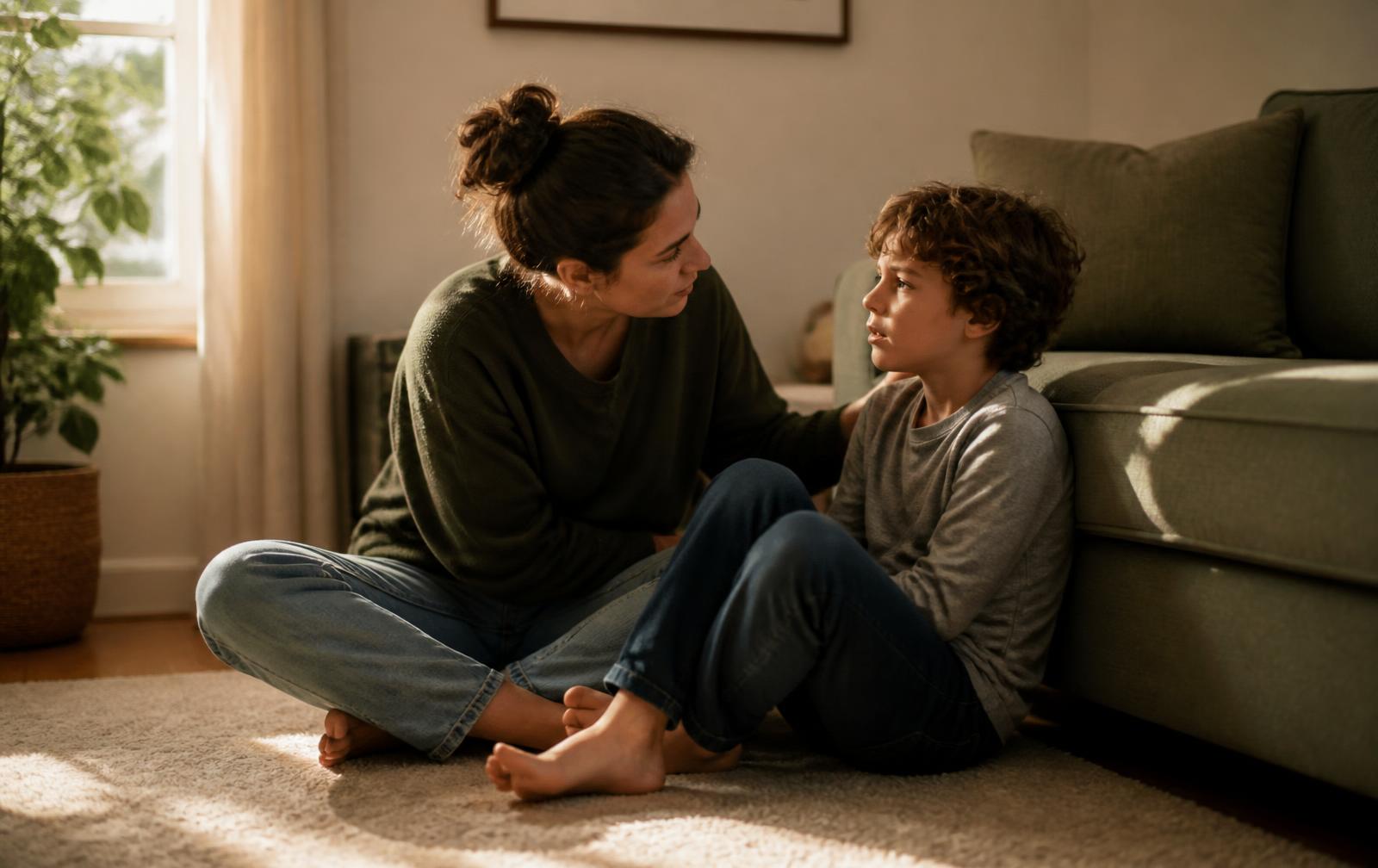
When Your Child Says 'I'm Fine' (And Definitely Isn't)
The five words every parent dreads—and a gentle way to get past the wall without forcing a confession.
Written by Sian Trombley · BEd, MACP, CCC
You notice the signs. They are quieter than usual. Their shoulders are tight. They are eating less, sleeping differently, or snapping at small things. You ask the question every parent asks: 'Are you okay?' And they look at you with a half-smile and say the three words that shut the door: 'I'm fine.'
Every parent has heard this. And almost every parent has responded with some version of the same instinct: 'Are you sure? You don't seem fine.' We mean well. We want to help. But to a child who is already holding something heavy, that response can feel like an interrogation. They may double down on the lie, retreat further, or explode in frustration.
Why Children Hide Their Struggles
There are many reasons a child says 'I'm fine' when they are not. Sometimes they do not yet have the language for what they feel. Sometimes they are ashamed. Sometimes they are protecting us from worry. And sometimes they have learned from experience that telling the truth leads to advice, punishment, or a flood of anxious questions they are not ready to answer.
Children are excellent observers of their parents. If a parent tends to panic, fix, or lecture when emotions appear, the child learns that honesty has a cost. 'I'm fine' becomes the safest option. The wall is not defiance. It is self-protection.
What to Do Instead of Pushing
The best response to 'I'm fine' is not to demand proof that it is true. It is to lower the pressure to talk while increasing the safety to do so. This sounds like a paradox, but it works. When a child feels that they can choose silence without disappointing you, silence becomes less necessary.
- 'I believe you. I also want you to know I am here if that changes.'
- 'I noticed you seem a little off today. You don't have to explain. I just wanted you to know I see you.'
- 'Sometimes I say I'm fine when I'm not ready to talk. I respect it if that's where you are.'
- 'I am not going anywhere. When you are ready, I am ready.'
Side-by-Side Conversations
Some of the most important conversations in childhood do not happen across a kitchen table. They happen in the car, on a walk, while fishing, or while folding laundry. Side-by-side positioning reduces the intensity of eye contact and makes emotional disclosure feel less exposing. Movement also helps regulate the nervous system, which makes it easier for children to access their thoughts.
If you want to know what is happening in your child's life, create more low-stakes time together. The conversation often starts with the least important topic and lands on the most important one without either of you planning it.
“Your child does not owe you every feeling. They owe you honesty when they are ready. Your job is to be the kind of parent honesty feels safe with.”
Sian Trombley, Founder & Clinical Director
When Silence Is a Signal
There are times when 'I'm fine' is masking something serious: depression, bullying, self-harm, or abuse. If your child's behavior has changed significantly, if they are withdrawing from friends and activities, or if you have a gut feeling that something is wrong, do not rely on words alone. Make an appointment with a mental health professional. A skilled therapist can create a space where your child feels safe enough to say what they cannot yet say at home.
Most of the time, though, 'I'm fine' is simply a child who needs a little room, a lot of patience, and a parent who keeps the door open without banging on it. Trust the slow build. The truth usually arrives when it feels welcome.
Children do not need a perfect parent. They need a predictable one who returns after hard moments.
Sian Trombley, Canadian Certified Counsellor
What you can try this week
Use the side-by-side technique
Bring up a hard topic while walking the dog, driving, or doing dishes together. Lower eye contact can make emotional conversations feel less exposing.
Name what you observe
Instead of 'What's wrong?' try: 'I notice you have been quieter than usual. I am here if you want to talk, and I am fine just sitting with you if you don't.'
Share your own feelings first
Model vulnerability by saying something like, 'I felt overwhelmed today and didn't know how to say it. How do you usually handle that feeling?'
- 'I'm fine' is often a protective response, not a literal report on wellbeing.
- Children open up when they feel safe, not when they feel pressured or interrogated.
- Side-by-side conversations—in the car, while walking, or during shared activities—often feel safer than face-to-face talks.
- Naming what you notice without demanding an explanation can lower the wall.
- Your child does not need to tell you everything today. Consistency builds disclosure over time.
When my child says 'I'm fine,' do I accept it, push harder, or offer quiet presence?
How comfortable am I with my child's silence or sadness?
What could I say that would make honesty feel safer than hiding?
Printable resources
Recommended Thrive courses

Share this article
This article is educational and is not a substitute for individual clinical advice. Comments are closed so the Journal stays a calm place to read.
Keep going
You may also like
Courses, worksheets and pathways from the same part of the library.
- CollectionEmotional RegulationEverything Thrive publishes on emotional regulation — articles, courses, worksheets and research.Read
- JournalBuilding Your Child's Feeling VocabularyWhen a child can name what they feel, they are less likely to act it out. Emotional vocabulary is the foundation of self-regulation.Read
- JournalWhen Your Child Says "I Hate You"Children say the worst thing they know to the safest person they have. That is the whole mechanism.Read
- ResearchThe Research LibraryPeer-reviewed parenting and child mental health research, translated into plain language.Read
- Thrive GuideThrive GuideAsk a question and get warm, evidence-informed guidance drawn from the Thrive library.Read
- Thrive Care PlanThrive Care PlanA short check-in that turns how your week actually went into one focused plan.Read